Can GLP-1 Hair Shedding Reveal Female Pattern Hair Loss?
Your shedding slowed down.
There is less hair in the shower.
Your brush looks a little more normal.
But when you look at your part, crown, or overall density, something still feels different.
Maybe your ponytail never returned to what it was before.
Maybe the top still looks more see-through.
Maybe the shedding improved, but the density did not seem to follow.
And now you're wondering:
Was this really just GLP-1-related shedding, or did the shedding reveal something else that was already happening?
Sometimes, that question is worth investigating.
GLP-1-associated shedding and female pattern hair loss are not the same thing, but they can occur at the same time. A significant shedding event may also make an underlying density pattern much easier to notice.
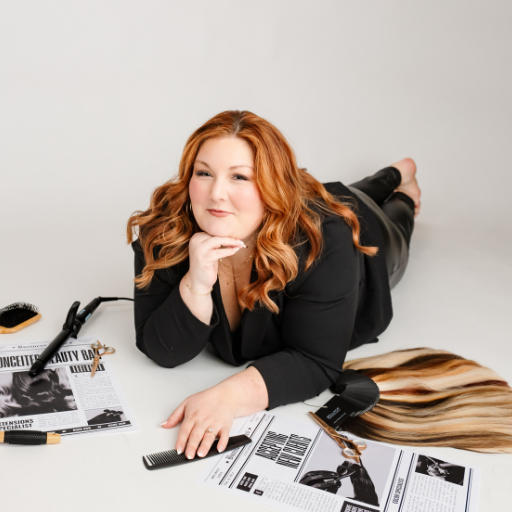
I'm Brooke Chhina, a licensed cosmetologist, cosmetology educator, hair restoration specialist, and trichology student with the International Association of Trichologists (IAT) in Lancaster, PA.
GLP-1 & Medication and Genetics & Pattern Hair Loss are two separate contributing causes within The 6-Cause Restoration Method™.
This article is about what can happen when those two hair stories overlap.
First, the scope
I'm a licensed cosmetologist, cosmetology educator, hair restoration specialist, and trichology student, not a physician or dermatologist.
My trichology education allows me to recognize hair and scalp patterns, understand the science behind many forms of hair change, identify factors that may be contributing to what you're experiencing, and know when something belongs with a medical provider.
It does not allow me to diagnose female pattern hair loss or determine medically why you are shedding.
A physician or board-certified dermatologist is the appropriate person to diagnose hair-loss conditions and discuss medical treatment.
My cosmetic hair restoration work can take place alongside medical care, never in place of it.
GLP-1 shedding and female pattern hair loss are different processes
This distinction matters.
When increased shedding happens during GLP-1 use, the pattern may resemble telogen effluvium, a disruption of the normal hair cycle that causes more hairs than usual to move toward the resting and shedding phases around the same period.
Rapid weight change, reduced nutritional intake, physiologic stress, medication-related factors, and other changes may all be part of that picture.
The exact relationship between GLP-1 medications and hair shedding is still being studied.
Female pattern hair loss, also called androgenetic alopecia, is different.
It involves progressive changes within susceptible hair follicles.
Over time, affected follicles may produce hairs that become progressively finer, shorter, or less visually dense.
So one condition primarily involves increased shedding from a disrupted hair cycle, while the other involves progressive follicular miniaturization.
They can look similar from across the bathroom mirror.
They are not the same process.
If you want the broader explanation of GLP-1-related shedding, start with my GLP-1 Hair Loss guide.
Can GLP-1 shedding cause female pattern hair loss?
I would not describe it that way.
GLP-1 shedding does not automatically mean someone has developed female pattern hair loss.
And taking a GLP-1 medication does not mean female pattern hair loss is inevitable.
What can happen is more subtle.
Someone may already have early follicular miniaturization that was not cosmetically obvious.
Then a substantial shedding event occurs.
There is suddenly less hair contributing to overall coverage.
Now the widening through the part, reduced crown density, or finer hairs that were previously disguised by greater overall fullness become much easier to see.
In that situation, the shedding may not have created the pattern hair loss.
It may have made an existing pattern more visible.
Think of it as losing some of the camouflage
Imagine that your hair density has been slowly changing for years, but very gradually.
You still have enough surrounding hair that you do not pay much attention to it.
Then you experience a large shedding event.
Even if that shedding is temporary, the overall volume drops quickly.
Suddenly the crown looks more open.
Your part looks wider.
The top feels flatter.
The scalp is easier to see under bright lighting.
The temporary shedding removed some of the density that had been visually masking a slower underlying process.
That is one reason some women first become aware of female pattern hair loss after a major shedding event.
Why the two can happen together
Hair loss is not always one-cause-at-a-time.
Someone can be experiencing more than one contributing factor simultaneously.
For example, a woman may be:
using a GLP-1 medication
losing weight rapidly
eating less because of appetite suppression
entering perimenopause
genetically predisposed to female pattern hair loss
Those factors do not all create the same type of hair change.
But they can exist in the same person at the same time.
That is exactly why I built The 6-Cause Restoration Method™ around contributing causes rather than trying to force every client into one label.
Sometimes the hair story is layered.
What GLP-1-related shedding may look like
A telogen-effluvium-like shedding pattern is often described as more diffuse.
You may notice:
more full-length hairs coming out
increased hair in the shower
more hair in the brush
a smaller-feeling ponytail
less overall volume
scalp becoming more visible simply because overall density has dropped
But appearance alone cannot confirm the cause.
Diffuse shedding can happen for many reasons.
And someone with female pattern hair loss can also experience periods of increased shedding.
What female pattern hair loss may look like
Female pattern hair loss often creates a more persistent density pattern through the top of the scalp.
That may include:
a part that gradually appears wider
more visible scalp through the crown
decreased density through the top
hairs that appear increasingly fine in affected areas
a gradual reduction in volume over time
Not everyone presents exactly the same way.
And those signs are not exclusive to female pattern hair loss.
That is why I do not look at a widening part and declare a diagnosis.
A dermatologist can evaluate the pattern, examine the scalp and follicles more closely, and determine what is actually happening.
You can read my full Female Pattern Hair Loss guide for a deeper explanation.
DHT is part of the conversation, but not the whole story
Female pattern hair loss is often discussed in relation to androgens, particularly dihydrotestosterone, or DHT.
DHT is produced when the enzyme 5-alpha-reductase converts testosterone into dihydrotestosterone.
In genetically susceptible follicles, androgen signaling can contribute to progressive miniaturization.
But DHT is not the whole story.
Female pattern hair loss is complex, and hormone levels alone do not explain every presentation.
Age, genetics, follicular sensitivity, hormonal transitions, and other biological factors may all matter.
That is another reason laboratory results alone do not diagnose what you see happening in the hair.
What if the shedding stopped but your density still looks different?
This is where the distinction becomes especially important.
The amount of hair falling out can return closer to your normal baseline before your visible density fully recovers.
Hair growth takes time.
So continued thinness immediately after shedding improves does not automatically mean female pattern hair loss.
But if your density pattern continues changing, the crown or part remains progressively more visible, or the hair does not seem to be following the recovery pattern you expected, it is reasonable to have it evaluated.
The answer may still be post-shedding recovery.
It may be female pattern hair loss.
It may be another contributor entirely.
Or it may be more than one thing.
Does regrowth prove it was only temporary shedding?
No.
Seeing short new hairs is encouraging, but it does not automatically rule out another hair-loss process.
You can have regrowth after a shedding episode and still have underlying follicular miniaturization in other hairs.
Likewise, short hairs are not always regrowth.
Some may be breakage.
Some may simply be hairs at different stages of their normal cycle.
Context matters.
That is why I look at the larger pattern rather than treating a few short hairs as proof of what is happening.
If your main question is whether the hair typically returns after a GLP-1-related shedding episode, my Does Hair Grow Back After Ozempic? What to Expect article goes deeper into the recovery side.
Why family history matters
Genetics can be relevant to female pattern hair loss.
If women in your family have experienced progressive crown thinning, widening parts, or pattern hair loss, that information is worth mentioning to your dermatologist.
But family history is not destiny.
And the absence of an obvious family history does not automatically rule female pattern hair loss out.
It is simply another piece of context.
Perimenopause can complicate the picture too
This overlap becomes particularly interesting in women who are using GLP-1 medications during perimenopause.
Now you may have:
weight change
appetite and nutritional changes
medication-related factors
hormonal transition
genetically influenced pattern loss
all happening within a similar window.
That can make it very difficult to decide from the timing alone what caused what.
Hormonal Transitions is another one of the six contributing causes within The 6-Cause Restoration Method™.
So when someone tells me:
"My hair started thinning after I started the medication."
I still want to know what else was happening at the same time.
The medication start date matters.
It just does not tell me the entire story.
When to see a dermatologist
I would involve a physician or board-certified dermatologist if:
your part continues widening
crown density continues decreasing
thinning is becoming progressively more noticeable
shedding has improved but the density pattern continues changing
you have defined areas of hair loss
you have scalp redness, scaling, tenderness, burning, or inflammation
you notice smooth or shiny areas
your hairline is changing significantly
you are unsure whether you're seeing temporary shedding, pattern hair loss, or both
You do not need to wait for your hair loss to become severe before asking for an evaluation.
What about bloodwork?
Hair changes can sometimes overlap with medical or nutritional factors.
If your doctor thinks bloodwork is appropriate, ask whether thyroid testing and ferritin should be included rather than assuming a standard panel covers everything relevant to hair shedding.
Your physician can determine which tests make sense based on your history and symptoms.
Bloodwork can provide useful context.
It does not, by itself, diagnose female pattern hair loss.
Where cosmetic hair restoration fits
Cosmetic hair restoration does not treat female pattern hair loss or make follicles regrow.
Its job is different.
It provides a cosmetic solution for the hair and density you have today.
For some women, that is not needed.
If the visible density begins recovering and you are comfortable with how your hair looks, there may be nothing to restore cosmetically.
For someone whose density remains difficult to style around, cosmetic coverage may become part of the plan.
Extensions versus coverage
This distinction matters.
Hair extensions primarily add:
length and fullness through existing hair
They are not the primary solution for a widening part or significant crown coverage.
If your natural hair remains appropriate for extension support and your goal is fullness through the lengths, extensions may still be part of your plan.
But if the main concern is visible scalp through the crown, part, or top, I start thinking about targeted coverage instead.
Custom hair toppers
A custom hair topper provides targeted coverage through an area where visual density has changed.
The topper is the actual hairpiece.
It may then be supported using either Meshless Integration or Mesh Integration, depending on the natural hair available.
Meshless Integration
Meshless Integration uses a customized beaded-only foundation underneath the topper.
There is no mesh layer.
The foundation is designed using natural hair with sufficient structural strength to appropriately support the system.
The custom hair topper is sewn onto the completed foundation.
Mesh Integration
Mesh Integration uses a mesh-and-beaded foundation beneath the custom hair topper.
The natural hair is carefully incorporated into the foundation, and the topper is sewn onto the completed structure.
Neither method is automatically better for female pattern hair loss.
I choose the foundation based on:
natural hair available for support
structural strength
coverage area
comfort
lifestyle
maintenance preferences
cosmetic goals
Sometimes the answer is both topper and extensions
Female pattern hair loss often affects the top differently from the sides and back.
That means someone may need:
a custom topper for targeted crown or part coverage + extensions through appropriate support hair for additional length or fullness
For someone else, a topper alone may be enough.
For another client, no cosmetic restoration may be needed yet.
The plan should follow the actual hair pattern.
How this fits into The 6-Cause Restoration Method™
This is exactly the kind of situation where looking at only one possible cause can be misleading.
GLP-1 & Medication is one contributing cause.
Genetics & Pattern Hair Loss is another.
Someone may have one.
She may have both.
Or another cause may be contributing entirely.
During The Discovery, I look at the context instead of assuming the most obvious recent event explains everything.
I want to know:
when the shedding started
whether the shedding has changed
whether your density is recovering
where the density changes are occurring
whether the pattern looks diffuse or more concentrated
your family history
hormonal transitions
medication history
styling and chemical history
scalp symptoms
what you actually want your hair to look like
Then I determine what belongs within my cosmetic scope and what should be evaluated medically.
If this sounds like your hair
If your GLP-1 shedding has slowed but your density still does not look like it did before, Begin Your Discovery.
The Discovery is an in-studio consultation in my private Lancaster, PA studio.
I assess the visible hair and scalp pattern, learn what has changed and when, review the natural hair available for cosmetic support, and consider which contributing causes within The 6-Cause Restoration Method™ may be relevant to your hair story.
I do not diagnose female pattern hair loss.
If your pattern belongs with a dermatologist, I will tell you.
From there, I create your personalized Restoration Roadmap and send it to your phone.
Your Roadmap may include:
a custom hair topper with Meshless Integration
a custom hair topper with Mesh Integration
hair extensions if length or fullness is also a goal and appropriate support hair is available
a combination of topper-based restoration and extensions
a cosmetic hair-care plan while your natural hair changes
a recommendation to see your physician or dermatologist first and return to me afterward
Your Restoration Roadmap is yours to keep whether or not you continue with me.
I work by application only.
GLP-1 shedding and female pattern hair loss are not interchangeable diagnoses.
But when substantial shedding changes the amount of hair covering the scalp, an underlying density pattern can become much easier to see.
The important question is not simply:
"Did the GLP-1 cause this?"
It is:
"What is actually contributing to the hair I see now?"
That is the question worth answering.
I'm Brooke Chhina, a licensed cosmetologist, cosmetology educator, hair restoration specialist, and trichology student with the International Association of Trichologists (IAT) in Lancaster, PA, and the creator of The 6-Cause Restoration Method™. I'm not a medical doctor. Medical diagnosis, laboratory testing, prescription medication, and treatment of conditions affecting the hair, scalp, or general health belong with a licensed physician or board-certified dermatologist. My cosmetic restoration work can take place alongside your medical care.
Conceited Beauty Bar · Sola Salons Studio 9A · 1500 Gilbert Way, Lancaster, PA 17601
Crowned in Confidence · Your Beauty, Elevated.