When Does GLP-1 Hair Shedding Stop? The Typical Timeline
You started Ozempic, Wegovy, Mounjaro, Zepbound, or another GLP-1 medication.
Maybe the weight is coming off.
Maybe you're feeling better about a lot of things.
And then you notice something you were not expecting.
More hair in the shower.
More strands in your brush.
A wider-looking part.
A ponytail that suddenly feels smaller than it used to.
If that's where you are right now, hair loss has been reported in people taking GLP-1 medications, and newer research supports an association between GLP-1 receptor agonist use and increased hair-loss risk.
What research does not yet tell us is that every case has the same cause.
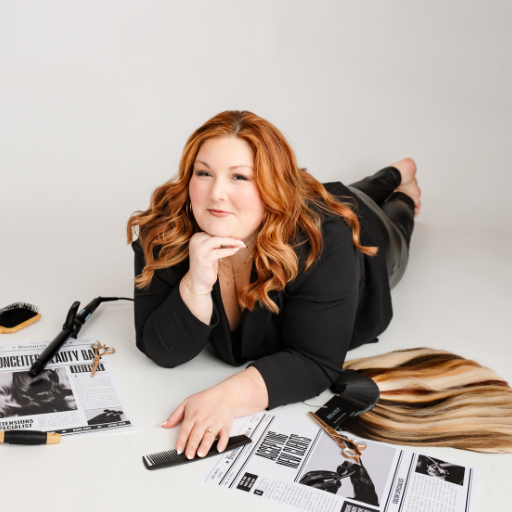
I'm Brooke Chhina, a licensed cosmetologist, cosmetology educator, hair restoration specialist, and trichology student (IAT) in Lancaster, PA.
GLP-1 & Medication is one of the six contributing causes I built The 6-Cause Restoration Method™ around.
Before we talk about cosmetic restoration, though, we need to separate two questions:
Why is your hair changing?
and
What can we do cosmetically about how it looks?
Your physician or dermatologist handles the first question.
I work with the second.
Can GLP-1 medications cause hair loss?
Research increasingly shows an association between GLP-1 receptor agonists and hair loss.
A 2026 systematic review and meta-analysis found a higher risk of hair loss among GLP-1 receptor agonist users compared with placebo.
Other recent research has also identified hair-loss signals with medications including semaglutide and tirzepatide.
But association does not automatically tell us the mechanism.
Researchers are still trying to determine how much of the hair loss is related to:
rapid or substantial weight loss
reduced calorie intake
reduced protein or nutrient intake
physiologic stress from major body changes
hormonal or metabolic shifts
a possible direct medication effect
underlying hair-loss conditions becoming more noticeable
several of these factors happening at the same time
That distinction matters.
I do not want you assuming that every strand you're losing means the medication is directly damaging your follicles.
Telogen effluvium is one possible pattern
One of the hair-loss patterns reported in connection with GLP-1 medications is telogen effluvium.
Hair naturally moves through four stages:
Anagen is the active growth phase.
Catagen is the short transition phase.
Telogen is the resting phase.
Exogen is when the resting hair releases and sheds.
With telogen effluvium, a physiologic stressor causes more hairs than usual to leave the growth phase and enter the resting cycle.
The shedding is delayed.
That means something happening in your body now may not show up as noticeable hair shedding until weeks or months later.
Significant weight loss is one known trigger for excessive shedding.
That is one reason GLP-1-related hair changes can be confusing.
Could rapid weight loss be part of it?
Yes.
The American Academy of Dermatology notes that dermatologists believe sudden weight loss may contribute to thinning hair seen in some people taking GLP-1 medications.
Weight loss is a substantial physiologic change.
Your body may also be adapting to:
a lower overall calorie intake
changes in protein intake
changes in nutrient intake
changes in body composition
changes in energy availability
Any of those may matter to the hair cycle.
But rapid weight loss is not the only possible explanation.
Nutrition can matter too
GLP-1 medications often reduce appetite significantly.
That can be helpful for the medical goal of treatment, but it can also mean you're simply eating much less than you used to.
If overall intake drops substantially, protein, iron, vitamins, and other nutrients may also decrease.
That does not mean everyone experiencing hair loss on a GLP-1 is deficient.
And it does not mean you should start taking every hair supplement you see online.
It means nutrition belongs in the medical conversation when significant shedding is happening.
If your physician thinks testing is appropriate, ask whether thyroid testing and ferritin should be included rather than assuming a standard panel covers everything relevant to diffuse hair shedding.
Your physician can determine which tests make sense based on your history and symptoms.
Could the medication itself be affecting the hair?
Possibly.
This is one of the unanswered questions researchers are still investigating.
AAD notes that a direct effect of GLP-1 medications on hair growth is also possible.
Recent studies show an association between these medications and hair loss, but research has not yet established one single mechanism that explains every case.
So when someone tells me:
"I started Ozempic and then my hair started falling out."
I take that timeline seriously.
But I still do not treat the medication name as the diagnosis.
What does GLP-1 hair shedding usually look like?
If the pattern is telogen effluvium, the shedding is usually diffuse.
That means you may notice less overall density rather than one perfectly defined bald area.
Common things women notice include:
more hair in the shower
more hair in the brush
a thinner ponytail
less density through the lengths
more visible scalp through the part
changes that seem to happen relatively quickly
But a widening part or visible crown can also be a sign that something else is happening alongside the shedding.
That is why pattern matters.
Do not assume every hair change is "just the GLP-1"
This is one of the most important things I can tell you.
You can be taking a GLP-1 and have another hair-loss factor happening at the same time.
That may include:
perimenopause or menopause
postpartum changes
thyroid issues
iron deficiency
female pattern hair loss
an autoimmune or inflammatory hair condition
another medication change
significant illness or surgery
major stress
A GLP-1 may be one contributing factor without being the entire explanation.
When I want you to involve a dermatologist
If your hair is changing significantly, involve a physician or board-certified dermatologist when:
the shedding remains substantial or keeps getting worse
your part continues to widen
the crown becomes progressively more visible
you develop defined bald patches
your hairline is noticeably changing
you lose eyebrow or body hair
your scalp burns, hurts, itches, scales, or looks inflamed
you have significant fatigue or other systemic symptoms
the pattern does not look like generalized shedding
you cannot identify a likely trigger
the hair is not following the recovery pattern you expected
Those things do not tell me what diagnosis you have.
They tell me the pattern deserves medical evaluation.
When does GLP-1-related shedding stop?
There is no single GLP-1-specific timeline I can responsibly promise.
If what you're experiencing is acute telogen effluvium related to a temporary trigger, the excessive shedding often improves over time once the underlying stressor settles or the body adjusts.
But visible recovery takes longer.
The shed can improve before your density looks recovered because the new hair still has to physically grow.
That is why I separate:
shedding recovery
from
visual density recovery
They are not the same milestone.
If you want a deeper breakdown of the timeline, read my guide to when GLP-1 hair shedding may slow.
Does hair recover if you stay on the medication?
It can.
Continuing a GLP-1 does not automatically mean you will continue shedding indefinitely.
If rapid weight loss, nutritional changes, or another temporary physiologic stressor contributed to the shedding, the hair cycle may improve as those factors become more stable.
But if shedding stays heavy, returns repeatedly, or the visible pattern keeps changing, I would not assume you simply need more patience.
That is when medical evaluation matters.
Should you stop the medication because of your hair?
That is not a decision I can make for you.
And it is not one I would recommend making from a blog post.
Any decision about stopping, changing, tapering, or adjusting a GLP-1 medication belongs with the medical provider who prescribed it.
Your hair matters.
So does the reason you're taking the medication.
Those need to be weighed together medically.
What actually helps?
There is no miracle product that instantly switches off telogen effluvium.
The useful things tend to be much less exciting.
Make sure your medical team knows
Tell your prescriber or dermatologist about substantial hair changes.
Do not assume they already know simply because you're taking the medication.
Pay attention to nutrition
If you're struggling to eat enough or appetite suppression is severe, talk with your medical provider.
Adequate protein and overall nutrition matter for hair growth.
Treat deficiencies based on evidence
Do not assume you need iron, biotin, or another supplement without knowing whether there is actually a reason to take it.
Be gentle with the hair you have
Avoid repeatedly tight hairstyles.
Minimize unnecessary mechanical stress.
Detangle gently.
Use heat thoughtfully.
Keep your scalp clean and your hair manageable.
Give the hair cycle time
This part is frustrating.
Hair grows slowly.
Even once the excessive shedding improves, visible fullness does not return overnight.
What about biotin?
Biotin is not a universal fix for hair shedding.
Most people are not biotin deficient.
Taking high doses when you do not need them is unlikely to solve telogen effluvium, and biotin can interfere with certain laboratory tests.
If you are concerned about a nutritional deficiency, let your physician evaluate the actual need.
Where cosmetic hair restoration fits
This is where my role begins.
I cannot medically stop GLP-1-related shedding.
I cannot tell you why a follicle entered telogen.
What I can do is evaluate the hair you currently have and determine whether there is a cosmetic restoration option that makes sense.
That decision starts with:
how much shedding is still happening
where density has changed
how much natural hair remains
structural strength
scalp condition
support areas
cosmetic goals
lifestyle
maintenance preferences
There is no single best GLP-1 extension method.
The method comes after the assessment.
Sometimes the correct answer is no installation yet
During substantial active shedding, I generally do not install an integrated extension or topper system.
I want stable natural hair available to support whatever I add.
That does not mean you're banned from cosmetic options for a certain number of months.
It means I want the support pattern to make sense.
I do not use a rule like:
"You're six months into your medication, so you're ready."
Your actual hair determines candidacy.
When hair extensions may make sense
Hair extensions add length and fullness through existing hair.
They may be appropriate when:
shedding has meaningfully stabilized
there is enough natural hair for support
the support hair has adequate structural strength
your primary cosmetic concern is loss of length or fullness rather than missing coverage through the top
The specific extension method is selected after I see the hair.
That may include different attachment options depending on the support pattern and cosmetic goal.
I do not label one extension method universally "safe for GLP-1 hair."
When a custom hair topper may make more sense
If the main concern is a widening part, visible crown, or missing density through the top, extensions may not solve the problem.
A custom hair topper provides targeted coverage.
The topper is the actual hairpiece.
It may be constructed using lace, HD lace, or another appropriate base depending on the coverage area and cosmetic plan.
When an installed topper is appropriate, it may be supported through either Mesh Integration or Meshless Integration.
Mesh Integration
With Mesh Integration, breathable mesh is laid over the appropriate area.
Natural hair is carefully fed through the mesh and secured with beads through or on the mesh foundation.
The custom topper is then sewn onto the completed foundation.
Mesh may be considered when additional foundation structure is appropriate for the natural hair available.
Meshless Integration
Meshless Integration uses no mesh layer.
Instead, I create a customized beaded-only foundation using natural hair with sufficient structural strength to support the system.
The custom topper is then sewn onto that completed foundation.
Neither foundation is automatically better.
The decision depends on:
support hair
structural strength
coverage area
comfort
lifestyle
maintenance
cosmetic goals
Extensions and toppers solve different problems
This distinction is important.
Extensions add length and fullness through existing hair.
Toppers create targeted coverage where visible density is missing.
Some women need one.
Some need the other.
Some may eventually benefit from both.
And some do not need an installed restoration system at all.
What about clip-in toppers?
I do not use clip-in toppers or snap-on hairpieces in my cosmetic restoration work.
Clips repeatedly load small areas of natural hair.
Repeated tension can begin as a potentially reversible, non-scarring process but may become permanently scarring when tension continues over time.
That does not mean every person who wears a clip-in will develop traction alopecia.
It means I prefer support that I can intentionally design and reassess, especially when the natural hair has recently experienced significant shedding.
Two women on the same GLP-1 can need completely different plans
Imagine two women taking the same medication.
One experienced diffuse shedding but still has strong coverage through the top. What bothers her most is how thin her lengths now feel.
Hair extensions may eventually make sense.
Another woman has visible density loss through the part and crown.
Adding length underneath does not solve what she sees in the mirror.
A custom topper may make more sense.
A third woman is still experiencing substantial active shedding.
I may recommend no installation yet.
Same medication category.
Three different cosmetic plans.
That is why The 6-Cause Restoration Method™ begins with understanding what is actually happening before choosing a method.
If this sounds like your hair
If you're experiencing shedding while taking a GLP-1 medication, noticing changes through your part or crown, or wondering whether extensions or a topper are appropriate, The Discovery is where I begin.
The Discovery is an in-studio consultation and the first step in The 6-Cause Restoration Method™.
I review:
your hair and shedding history
GLP-1 timeline
visible density pattern
scalp
natural hair available for support
structural strength
areas where you want length, fullness, or coverage
lifestyle
maintenance preferences
cosmetic goals
other factors that may be contributing to the changes you're seeing
I identify what may be contributing within my scope and tell you when something belongs with a physician or dermatologist first.
From there, I create your personalized Restoration Roadmap.
Your Roadmap may include:
a custom hair topper with Meshless Integration
a custom hair topper with Mesh Integration
hair extensions if length or fullness is the primary goal
a combination of topper-based restoration and extensions
a cosmetic hair-care plan while your natural hair recovers
a recommendation to see a dermatologist first and return to me afterward
Your Restoration Roadmap is sent to your phone and is yours to keep whether or not you continue with me.
Sometimes the right answer is extensions.
Sometimes it's a topper.
Sometimes it's medical evaluation first.
And sometimes your hair simply needs more time.
If you're in Lancaster, PA, or traveling in for cosmetic hair restoration, Begin Your Discovery.
I work by application only.
I'm Brooke Chhina, a licensed cosmetologist, cosmetology educator, hair restoration specialist, and trichology student (IAT) in Lancaster, PA, and the creator of The 6-Cause Restoration Method™. I'm not a medical doctor or prescriber. For diagnosis or treatment of medical conditions affecting your hair, scalp, or general health, or for decisions regarding GLP-1 medication, please consult the appropriate licensed medical provider. Cosmetic hair restoration runs alongside medical care, never in place of it.
Conceited Beauty Bar · Sola Salons Studio 9A · 1500 Gilbert Way, Lancaster, PA 17601
Crowned in Confidence · Your Beauty, Elevated.