Trichotillomania Bald Spot Coverage: What Actually Works
You have a specific spot.
Or maybe a few.
The thinner area behind your part.
A patch through your crown.
A section where you're finally seeing short hairs coming back and you do not want to interfere with what is happening underneath.
You want coverage.
You also want to be thoughtful about the natural hair you still have.
That is a completely reasonable concern.
This article is about cosmetic coverage during trichotillomania recovery: what may help, what I avoid, when a custom hair topper may be appropriate, and when the better answer is to wait.
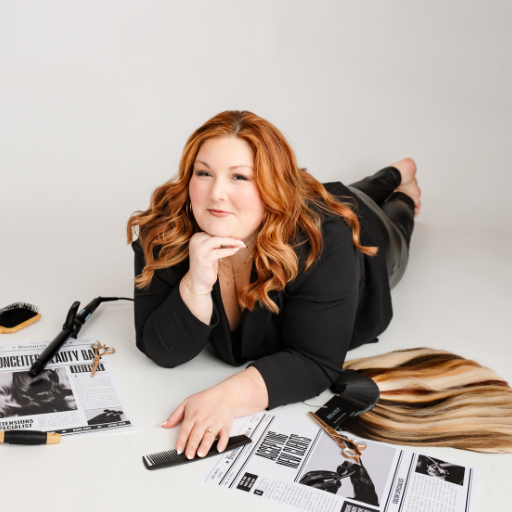
I'm Brooke Chhina, a licensed cosmetologist, cosmetology educator, hair restoration specialist, and trichology student (IAT) in Lancaster, PA.
Trichotillomania Recovery is one of the six hair-change contexts within The 6-Cause Restoration Method™.
If you want the broader conversation about regrowth, permanent hair loss, and where restoration fits, start with my Does Hair Grow Back After Trichotillomania? guide.
This article focuses specifically on cosmetic coverage.
The short answer
There is no single coverage method that is automatically right for every trichotillomania pattern.
What matters is:
whether pulling is still active in the area
where visible density has changed
what natural hair is available for support
the structural strength of that hair
the size and location of the area you want covered
your comfort
your lifestyle
your maintenance preferences
your cosmetic goals
When an integrated cosmetic system is appropriate, the primary coverage option I use is a custom hair topper supported by either Meshless Integration or Mesh Integration.
The custom topper is the hairpiece.
Mesh and Meshless describe the foundation beneath it.
If pulling is still active in the same area where a system would need to be placed or supported, my recommendation may be:
Not yet.
First, the scope
I'm a licensed cosmetologist, cosmetology educator, hair restoration specialist, and trichology student, not a physician, dermatologist, or mental health professional.
My trichology education allows me to recognize hair and scalp patterns, understand the science behind many forms of hair change, identify factors that may be contributing to what you're experiencing, and know when something belongs with a medical or mental health provider.
It does not allow me to diagnose or treat trichotillomania.
The behavioral side of trichotillomania belongs with a mental health professional, ideally one with experience in body-focused repetitive behaviors.
Habit Reversal Training, or HRT, is one of the established behavioral approaches used for trichotillomania.
Cosmetic hair restoration can happen alongside that care.
It does not replace it.
Why the support plan matters
When you're recovering from repeated pulling, it makes sense to be cautious about placing additional mechanical stress on the same areas of hair.
That does not mean every form of cosmetic coverage will damage regrowth.
It means I want to understand where the support for the system would come from before I recommend installing anything.
Repeated tension on natural hair can begin as a potentially reversible, non-scarring process but may become permanently scarring when tension continues over time.
That matters for every client.
It matters even more when I'm working with someone whose hair has already experienced repeated mechanical trauma from pulling.
So my goal is not to promise a "tension-free" system.
No installed system that uses natural hair for support is literally free of mechanical load.
The goal is to select and maintain a foundation around the natural hair that can appropriately participate in the system while avoiding unnecessary stress.
What I do not use for integrated trichotillomania coverage
Clip-in toppers and snap-on hairpieces
I don't use clip-in toppers or snap-on hairpieces in my cosmetic restoration work.
Clips repeatedly load relatively small attachment areas of natural hair.
That does not mean every person who wears a clip-in topper will develop traction alopecia.
It means I prefer foundations where I can intentionally design and reassess the support pattern rather than repeatedly gripping the same attachment points.
Extensions attached directly to a recovering area
Traditional extensions such as K-tips, tape-ins, and wefts are primarily used to create length and fullness through existing hair.
They are not designed to create targeted scalp coverage over a visible patch.
If a particular area has recently been affected by pulling, I would not use that recovering zone simply because I need somewhere to attach additional hair.
The attachment plan has to make sense for the hair that is actually present.
A generic piece chosen only because it covers the spot
Coverage area matters, but so does everything surrounding it.
A topper needs to work with:
your natural density
the shape of the area
the support hair available
your color
texture
comfort
styling goals
That is why my restoration work uses a custom topper rather than choosing a piece based only on the dimensions of the visible spot.
What I do use: a custom hair topper
A custom hair topper is the actual hairpiece used to provide targeted coverage through an area such as the crown, part, top, hairline, or another appropriate zone.
The topper may be constructed using:
lace
HD lace
another appropriate base material
That construction decision is separate from the foundation underneath it.
Once the topper itself has been designed, I determine whether Meshless Integration or Mesh Integration is the more appropriate foundation.
Meshless Integration
Meshless Integration uses a customized beaded-only foundation beneath the custom hair topper.
There is no mesh layer.
I create the foundation using natural hair with enough structural strength to appropriately support the system.
The custom hair topper is then sewn onto that completed foundation.
Meshless Integration may be considered when the natural hair available is appropriate for a beaded-only foundation.
It is not automatically selected because an affected area is small or because someone appears to have "mild" hair loss.
Mesh Integration
Mesh Integration also uses a custom hair topper.
The difference is the foundation beneath it.
With Mesh Integration:
A breathable mesh is laid over the appropriate area.
Natural hair is carefully fed through the mesh.
That natural hair is secured with beads through or on the mesh foundation.
The custom hair topper is sewn onto the completed mesh-and-beaded foundation.
The mesh is not the topper.
The custom hair topper is the hairpiece.
The mesh-and-beaded structure is the foundation beneath it.
Mesh Integration may be considered when additional foundation structure is appropriate for the natural hair available.
How I choose between Meshless and Mesh
I do not choose between the two based on trichotillomania alone.
And I do not use a rule like:
small spot = Meshless
or
larger spot = Mesh
I look at the entire support picture.
That includes:
The natural hair available
I need to see what hair is available to participate in the foundation and where that hair is located.
Structural strength
Meshless Integration requires enough appropriate natural hair for a customized beaded-only foundation.
Mesh Integration may be considered when additional foundation structure is appropriate.
The coverage area
The size, shape, and location of the affected area influence the design.
They do not determine the method by themselves.
Comfort
Some clients have different preferences around how a foundation feels.
That matters.
Lifestyle and maintenance
How you style your hair, how you live in it, and what maintenance feels realistic for you all influence the decision.
Your cosmetic goals
The goal may be targeted coverage.
Or coverage plus additional density.
Or coverage now while natural regrowth continues.
The foundation should be designed around the actual goal.
What happens if your hair changes?
That is expected.
Your natural hair is not static.
Your restoration plan should not be either.
At maintenance appointments, I reassess:
the foundation
the natural hair being used for support
visible density
comfort
the topper
blend
whether the current foundation still makes sense
If your natural coverage changes, the restoration can be reevaluated with it.
I do not build a system around a prediction of exactly how much hair will or will not regrow.
I work with what is present now and reassess over time.
When cosmetic coverage may not be appropriate yet
There are situations where my recommendation may be to wait.
Pulling is still active in the same area
If the topper or foundation is likely to become part of an active pulling pattern, installation may not be the right next step.
That is not judgment.
It is a practical limitation of trying to install a cosmetic system into an area where the underlying behavior is still active.
You can still come in for The Discovery.
But the Roadmap may say:
Focus on the therapeutic piece first, then let me reassess the hair.
Your scalp needs medical evaluation
If I see or you describe signs such as:
redness
scaling
tenderness
burning
unexplained shedding
smooth or shiny areas where follicular openings appear reduced or absent
another change that does not fit the pulling history
I may recommend seeing a board-certified dermatologist before moving forward.
The available natural hair is not appropriate for an integrated system
Sometimes there simply is not enough appropriate support hair available at that moment.
In that case, waiting or using a different cosmetic strategy may be more appropriate than forcing an installation.
Temporary cosmetic coverage while you wait
An integrated topper is not the only way to make an affected area less noticeable.
Sometimes a lower-commitment option is exactly what makes sense.
Strategic styling
Changing your part, adjusting the haircut, redirecting volume, or altering how the surrounding hair falls can sometimes reduce scalp visibility.
It does not replace missing density.
But it may help while you are waiting for more information or regrowth.
Hair fibers and scalp-concealing products
Temporary cosmetic fibers, powders, and scalp concealers can create the appearance of greater density when there is enough existing hair for the product to blend with.
They do not replace the hair itself, but they may be useful for day-to-day coverage or special events.
Scarves, hats, and head coverings
A comfortable head covering can also be a completely legitimate cosmetic choice.
If something causes discomfort, rubbing, or pulling, change how it is worn or choose another option.
The goal is not to make recovery more complicated in the name of hiding the area.
Where extensions fit
Hair extensions and custom hair toppers solve different problems.
Extensions primarily add:
length
fullness through existing hair
A custom topper provides:
targeted coverage through an area where visible density is reduced
If your trichotillomania history involves a specific zone that needs coverage but your surrounding hair also feels thinner or shorter than you want, a combination may sometimes make sense.
For example:
custom topper for targeted coverage + extensions for additional length or fullness
But extensions do not replace a topper when the main concern is visible scalp through the affected area.
If this is you
If you're navigating trichotillomania recovery and want to know whether cosmetic hair restoration is appropriate for your hair right now, Begin Your Discovery.
The Discovery is an in-studio consultation in my private Lancaster, PA studio.
I review:
your hair history
what you've noticed changing
where pulling has historically occurred
whether the area is currently stable
your visible density pattern
your scalp
the natural hair available for support
structural strength
the area where you want coverage
your comfort
lifestyle
maintenance preferences
cosmetic goals
My role is to identify what may be relevant within my scope, determine what cosmetic options the natural hair may appropriately support, and tell you when something belongs with a medical or mental health provider first.
From there, I create your personalized Restoration Roadmap and send it to your phone.
Your Roadmap may include:
a custom hair topper with Meshless Integration
a custom hair topper with Mesh Integration
hair extensions if length or fullness through unaffected hair is also a goal
a combination of topper-based restoration and extensions
a cosmetic hair-care plan while your recovery continues
a recommendation to connect with a dermatologist or mental health professional first and return to me afterward
Your Restoration Roadmap is yours to keep whether or not you decide to continue with me.
I work by application only.
You do not need to know whether you need Mesh, Meshless, extensions, a topper, or no installation at all before you come in.
That is what The Discovery is for.
The goal is not to promise a tension-free solution.
It is to build a cosmetic plan around the hair you have today while respecting the recovery happening underneath.
I'm Brooke Chhina, a licensed cosmetologist, cosmetology educator, hair restoration specialist, and trichology student (IAT) in Lancaster, PA, and the creator of The 6-Cause Restoration Method™. I'm not a medical doctor or mental health professional. For diagnosis, treatment, or care of any medical or mental health condition, please consult an appropriately licensed professional. Cosmetic hair restoration runs alongside medical and mental health care, never in place of it.
Conceited Beauty Bar · Sola Salons Studio 9A · 1500 Gilbert Way, Lancaster, PA 17601
Crowned in Confidence · Your Beauty, Elevated.