Does Hair Grow Back After Trichotillomania? Regrowth & Coverage Options
You already know why you're here.
You may not have told many people, or anyone, about the hair pulling.
You may have been doing it since you were a child, or it may have started in your twenties, or last year during a particularly hard season.
You may still be pulling.
You may have stopped and started many times.
You may be in a long stretch of not pulling and looking at the aftermath in the mirror.
Whichever version of this is yours, I want to say something first:
You are not the only one.
Trichotillomania affects many people, and shame and secrecy can make it especially difficult to talk about.
This post is written for you.
I'm going to walk you through what regrowth can look like after pulling stops, where cosmetic hair restoration can genuinely help, and where it may not be the right move yet.
I'll be honest about what I can offer and honest about what I can't.
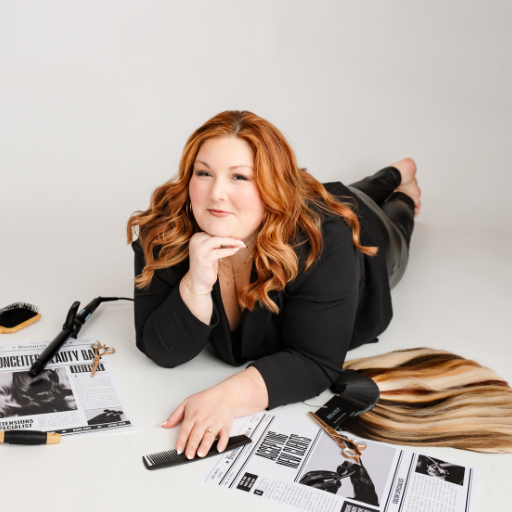
I'm Brooke Chhina, a licensed cosmetologist, cosmetology educator, hair restoration specialist, and trichology student (IAT) in Lancaster, PA.
Trichotillomania Recovery is one of the six hair-change contexts within The 6-Cause Restoration Method™, and I approach it with real care because the emotional weight of this condition is different from many of the other hair-change contexts I see.
The short answer
Hair often can regrow after trichotillomania if the follicles in the affected area remain intact.
Repeated pulling over many years can sometimes damage or scar follicles, which is why some areas may recover more fully than others.
If pulling is still active in a specific area, the priority is addressing the behavior first.
Once an area is stable, cosmetic coverage such as a custom hair topper may be appropriate depending on the natural hair available for support.
The rest of this post walks through what regrowth may look like, how long it may take, when to see a dermatologist, and where cosmetic hair restoration fits.
First, and most importantly
I'm not a therapist, and I'm not a doctor.
The primary care for trichotillomania belongs with a mental health professional, ideally someone trained in body-focused repetitive behaviors.
Habit Reversal Training, or HRT, often delivered as part of a cognitive behavioral approach, is one of the most established behavioral treatments for trichotillomania.
For some people, medication prescribed by a physician may also be part of the treatment plan.
Your therapist and physician are the professionals equipped to address the pulling itself.
What I can offer is the cosmetic side.
My trichology training allows me to recognize hair and scalp patterns, understand the science behind many forms of hair change, identify factors that may be contributing to what you're experiencing, and know when something belongs with a medical or mental health provider.
It does not allow me to diagnose or treat trichotillomania.
Cosmetic hair restoration runs alongside your mental health care, never in place of it.
If you haven't yet connected with a therapist who specializes in trichotillomania or BFRBs, that is an important place to start.
The TLC Foundation for Body-Focused Repetitive Behaviors maintains resources and a provider directory for people looking for professionals with experience in this area.
A word on shame, before we go further
Trichotillomania carries an enormous amount of shame for many people.
Some have never spoken about it aloud.
Some have hidden it for years.
Hair pulling is a recognized mental health condition.
It is not a moral failing.
It is not a character weakness.
And it is not something that can always be stopped by simply "trying harder."
Framing it that way is inaccurate and can make the secrecy around the condition even heavier.
You are allowed to talk about it.
You are allowed to ask questions.
And you do not need to explain or defend yourself in order to have a conversation about your hair.
What trichotillomania is
Trichotillomania, also called hair-pulling disorder, is classified in the DSM-5 within Obsessive-Compulsive and Related Disorders.
It is also commonly discussed as a body-focused repetitive behavior, or BFRB.
BFRB is a descriptive category rather than a DSM diagnosis itself.
Trichotillomania often begins in childhood or adolescence, but it can begin at other ages as well.
Pulling may happen with full awareness during moments of stress, boredom, focus, or emotional intensity.
It may also happen more automatically, where someone does not fully realize they are pulling until afterward.
The scalp is a common pulling site, but the eyebrows, eyelashes, and body hair may also be involved.
For many people, trichotillomania can wax and wane over time.
Periods of stability and periods of recurrence can both happen.
That does not mean treatment has failed.
Does hair grow back after trichotillomania?
Often, yes.
When hair is pulled from the scalp, the follicle itself may remain intact.
The hair shaft is removed, but the follicle can continue participating in the normal hair cycle:
anagen, the growth phase
catagen, the transitional phase
telogen, the resting phase
exogen, the shedding phase
If the follicle remains intact and pulling stops, new hair may begin to grow again.
Some people notice short new growth within the first few months.
That new hair can look:
short
fine
lighter in color
uneven in length
different in texture from the surrounding hair at first
As those hairs continue through the growth cycle, they may gradually gain length, thickness, and pigment.
Regrowth takes time.
Even when a follicle begins producing hair again, visible density does not return overnight.
How long does hair take to grow back after trichotillomania?
There is no single reliable timeline.
Some people begin noticing new growth within the first few months after pulling stops.
For others, visible regrowth takes longer.
How much hair returns and how quickly it returns can depend on:
whether the follicles remain intact
how long the same area has been repeatedly pulled
how often pulling occurred
whether pulling in that specific area has actually stopped
the individual's hair cycle
whether another hair-loss condition is also present
If an area remains bare or does not appear to be regrowing after pulling has stopped, a dermatologist should evaluate the scalp rather than assuming the follicles are permanently damaged.
Can trichotillomania cause permanent hair loss?
It can in some cases.
Repeated trauma to the same follicles over a long period of time may contribute to inflammation and, in some cases, scarring.
When scarring permanently damages a follicle, regrowth may become limited or may not occur.
That does not happen to everyone with long-term trichotillomania.
Some people with years of pulling still experience meaningful regrowth after the pulling stops.
A dermatologist can help determine whether an area appears to have intact follicles or whether scarring may be present.
If you have long-standing affected areas that do not appear to be regrowing after pulling has stopped, that is a good reason to involve a board-certified dermatologist.
If your thinning looks more patterned through the part or crown rather than limited to areas of pulling, you may also want to read my guide to female pattern hair loss.
Can hair restoration help after trichotillomania?
Yes, in the right situation.
But cosmetic hair restoration is not a replacement for mental health care.
It does not treat trichotillomania.
And it should not be used as a way to avoid addressing active pulling.
What cosmetic restoration can do is provide coverage for areas where visible density has not yet returned or where regrowth may remain limited.
For some people, that can make a meaningful difference in how they feel when they look in the mirror.
Can you wear a hair topper while still pulling?
This depends on where the pulling is active.
If pulling is still happening in a specific area of the scalp, I generally would not recommend installing cosmetic restoration directly into that active zone.
An integrated system could become part of the pulling pattern or place additional mechanical stress on the natural hair being used for support.
In that situation, the therapeutic work comes first.
That does not mean you cannot come in for a Discovery.
You are still welcome to have the conversation.
But the most appropriate cosmetic recommendation may be:
Not yet.
When restoration can genuinely help
There are several situations where cosmetic hair restoration may become a meaningful option.
When a previously affected area is stable
If pulling has stopped in a specific area but visible density has not fully returned, a custom hair topper may provide coverage while regrowth continues.
When regrowth is limited
If a dermatologist has determined that some follicles may have permanent damage or scarring, a custom topper may provide targeted coverage over that area.
When regrowth is happening slowly
Even healthy regrowth takes time to create visible length and density.
A custom topper can provide coverage during that transition.
When the historical pulling area is no longer active
Some people find that their pulling pattern changes over time.
If a previously affected zone is stable and the natural hair around it can appropriately support a cosmetic restoration system, that area may be considered for coverage.
When you have an important event
A wedding.
A return to work.
Family photos.
A season of life where you want to feel more like yourself.
Wanting cosmetic coverage for a specific moment is a valid reason to ask what your options are.
Hair topper options after trichotillomania
If you came to my studio for a Discovery and cosmetic restoration appeared appropriate, a custom hair topper would usually be the primary coverage tool.
A custom hair topper is the actual hairpiece used to provide targeted coverage over an affected area.
It may be constructed using:
lace
HD lace
another appropriate base material
The topper construction is selected based on your coverage needs, comfort, natural hair, desired finish, and cosmetic goals.
Then I determine how the topper should be supported.
Meshless Integration
Meshless Integration uses a customized beaded-only foundation underneath the custom hair topper.
There is no mesh layer.
The foundation is created using natural hair with enough structural strength to appropriately support the system.
The custom hair topper is then sewn onto that completed foundation.
Meshless Integration may be considered when the natural hair available is appropriate for a beaded-only foundation.
Mesh Integration
Mesh Integration also uses a custom hair topper.
The difference is the foundation underneath it.
With Mesh Integration:
A breathable mesh is laid over the appropriate area.
Natural hair is carefully fed through the mesh.
That natural hair is secured with beads through or on the mesh foundation.
The custom hair topper is sewn onto the completed mesh-and-beaded foundation.
Mesh Integration may be considered when additional foundation structure is appropriate for the natural hair available.
Neither foundation is inherently better.
The appropriate choice depends on the natural hair available for support, structural strength, coverage area, comfort, lifestyle, maintenance, and cosmetic goals.
Why I do not use clip-in toppers
I do not work with clip-in toppers or snap-on hairpieces in my cosmetic restoration work.
Clips repeatedly load small areas of natural hair.
Repeated tension can begin as a potentially reversible, non-scarring process but may become permanently scarring when tension continues over time.
That does not mean every person who wears a clip-in topper will develop traction alopecia.
It means I prefer customized foundations where I can intentionally plan and reassess how the system is supported by the natural hair available.
That matters even more when the scalp and hair are already recovering from repeated pulling.
What extensions can and cannot do here
Hair extensions and custom toppers solve different problems.
Hair extensions primarily add length and fullness through existing hair.
They do not create targeted scalp coverage over an area with significant density loss.
For many trichotillomania patterns, where visible loss may be concentrated in specific zones, extensions alone may not solve the coverage concern.
A custom hair topper directly covers the affected area.
For some clients, the right cosmetic plan may combine both:
custom topper for coverage + extensions for additional length or fullness
For others, only one is needed.
A few honest things
You are not vain for wanting to feel like yourself.
Hair can be deeply tied to identity.
Wanting cosmetic coverage does not undermine the therapeutic work.
You do not have to be "recovered enough" to ask questions.
Whether you're actively pulling, in early recovery, in a stable period, or years removed from the behavior, you are welcome to have a conversation.
My recommendation may be:
This isn't the right time for an installation yet.
That can still be a useful answer.
Your story is yours.
These conversations are personal.
I treat them with discretion and do not use a client's story or identifying details publicly without permission.
If this is you
If you're considering cosmetic hair restoration alongside your trichotillomania care, Begin Your Discovery.
The Discovery is an in-studio consultation where I review your hair and scalp, talk through your history and where you are in your recovery, evaluate the natural hair available for support, and determine what cosmetic options may be appropriate.
Your personalized Restoration Roadmap may include:
a custom hair topper with Meshless Integration
a custom hair topper with Mesh Integration
hair extensions if length or fullness is also a goal
a combination of topper-based restoration and extensions
a cosmetic hair-care plan while your recovery continues
a recommendation to connect with the appropriate medical or mental health provider first and return to me afterward
Your Restoration Roadmap is sent to your phone and is yours to keep whether or not you decide to continue with me.
I work by application only.
Wherever you are in your relationship with trichotillomania, you are welcome to ask questions.
Whether or not cosmetic restoration turns out to be the right next step, I hope this leaves you with more information about what regrowth and coverage can realistically look like.
I'm Brooke Chhina, a licensed cosmetologist, cosmetology educator, hair restoration specialist, and trichology student (IAT) in Lancaster, PA, and the creator of The 6-Cause Restoration Method™. I'm not a medical doctor or mental health professional. For diagnosis, treatment, or care of any medical or mental health condition, please consult an appropriately licensed professional. Cosmetic hair restoration runs alongside medical and mental health care, never in place of it.
Conceited Beauty Bar · Sola Salons Studio 9A · 1500 Gilbert Way, Lancaster, PA 17601
Crowned in Confidence · Your Beauty, Elevated.