Mesh Integration vs. Meshless Integration: Which Foundation Is Right for Your Hair Topper?
You've done enough research to know that both Mesh Integration and Meshless Integration exist as cosmetic hair restoration options.
You've seen before-and-afters of both.
You've probably heard them explained in ways that made them sound like completely separate products.
And now you're trying to figure out which one is right for you.
This post is the honest answer to that question.
I'm going to clear up the terminology first, because the hair restoration industry has made this more confusing than it needs to be. Then I'll walk you through how I actually decide between Mesh and Meshless Integration in my Lancaster studio.
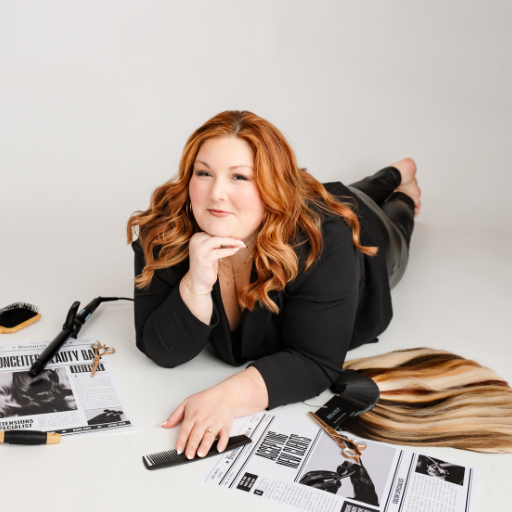
I'm Brooke Chhina, a licensed cosmetologist, cosmetology educator, hair restoration specialist, and trichology student with the International Association of Trichologists (IAT) in Lancaster, PA. I'm also the creator of The 6-Cause Restoration Method™.
Both foundation methods are part of my cosmetic restoration work because both can be appropriate for different clients.
There is no universally better option.
There is only the foundation that best fits the natural hair available for support, the coverage area, your comfort, lifestyle, maintenance preferences, and cosmetic goals.
If you want to understand custom toppers first, you can read my Hair Toppers for Perimenopause Crown Thinning guide or explore my Custom Hair Topper services.
First, the scope
I'm a licensed cosmetologist, cosmetology educator, hair restoration specialist, and trichology student, not a physician or dermatologist.
My education allows me to recognize hair and scalp patterns, understand the science behind many forms of hair change, identify factors that may be contributing to what you're experiencing, and know when something belongs with a medical provider.
It does not allow me to diagnose a medical condition.
Mesh Integration and Meshless Integration are cosmetic restoration foundation methods.
If your thinning is new, progressive, unexplained, or accompanied by scalp symptoms, I may recommend involving a physician or board-certified dermatologist before or alongside cosmetic restoration.
My work runs alongside medical care, never in place of it.
Let's clear up what's actually being compared
The hair restoration industry uses overlapping terminology in ways that make everything sound like a separate product.
Here's the simplest way to understand it.
The custom hair topper is the hairpiece.
It is the piece providing targeted coverage through the crown, part, top, hairline, or another appropriate area.
Lace, HD lace, or another appropriate base material describes how the topper may be constructed.
A "lace closure" is essentially a lace-based topper construction.
It is not a separate restoration service.
Mesh Integration and Meshless Integration describe the foundation used to support and secure the custom hair topper.
Both methods use a topper.
The difference is what sits underneath it.
So the real question is not:
"Should I get Mesh Integration or a topper?"
And it isn't:
"Should I get a topper or an integration?"
The real question is:
Which foundation is appropriate for supporting my custom hair topper, Mesh or Meshless?
That is what we're comparing.
What Meshless Integration actually is
Meshless Integration uses a customized beaded-only foundation underneath the custom hair topper.
There is no mesh layer.
I create the foundation using areas of natural hair that have enough structural strength to appropriately support the system.
Once that beaded foundation is complete, the custom hair topper is sewn onto it.
Meshless Integration may be considered when the natural hair available has sufficient structural strength for a beaded-only foundation.
The choice is not based simply on whether your thinning appears "mild" or "early."
What matters is the hair I actually have available to work with.
What Mesh Integration actually is
Mesh Integration also uses a custom hair topper.
The difference is the foundation underneath it.
With Mesh Integration:
A breathable mesh is laid over the appropriate area first.
Natural hair is carefully fed through the mesh.
That natural hair is secured with beads through or on the mesh foundation.
The custom hair topper is then sewn onto the completed mesh-and-beaded foundation.
The mesh is not the topper.
The custom hair topper is the hairpiece.
The mesh-and-beaded structure is the foundation underneath it.
Mesh Integration may be considered when additional foundation structure is appropriate for the natural hair available.
It is not automatically selected because someone has "more advanced" thinning.
How I decide between Mesh and Meshless Integration
The decision isn't based on a diagnosis alone.
It isn't because one foundation is automatically better.
And it isn't simply because your thinning looks mild, moderate, or advanced.
Instead, I look at several things during The Discovery.
How much natural hair is available for support?
I look at the visible density surrounding and within the area where the foundation may be designed.
The question isn't simply how much hair you've lost.
It's how much appropriate natural hair is available to participate in the foundation.
How strong is that natural hair?
Meshless Integration requires sufficient structural strength for a customized beaded-only foundation.
If additional foundation structure is appropriate for the available natural hair, Mesh Integration may be considered.
How large is the coverage area?
The size, shape, and location of the area you want covered affect how the foundation needs to be designed.
A larger coverage area does not automatically mean Mesh Integration.
It means I need to design the foundation around the actual support pattern.
Where is the coverage needed?
Crown thinning, widening through the part, top-of-head density changes, and hairline concerns can all require different designs.
Placement matters just as much as the total size of the area.
What will be comfortable and practical for you?
Your lifestyle matters.
I consider:
comfort
styling habits
maintenance preferences
how you wear your hair day to day
how much material you prefer in the foundation
your cosmetic goals
Neither foundation is automatically better.
The goal is to choose the foundation that makes sense for the custom topper and the natural hair available for support.
Sometimes either foundation may be possible
Not every client falls neatly into one category.
Sometimes the natural hair available could reasonably support either Mesh or Meshless Integration.
In those situations, the decision may also involve:
comfort
amount of material in the foundation
maintenance preferences
size and location of the coverage area
styling goals
how the natural hair responds over time
The foundation is reassessed during maintenance appointments.
If your natural hair changes, your comfort changes, or your restoration needs change, the foundation plan can be adjusted.
That is one reason an in-person consultation matters more than trying to choose a method from photographs online.
What both methods have in common
Although the foundations are different, the overall restoration principles are similar.
A custom hair topper
Both Mesh and Meshless Integration support a custom hair topper.
The topper is designed around the coverage you need rather than treating every client as though the same stock piece will work.
Custom topper construction
Depending on your hair, comfort, coverage needs, and desired finish, the topper may be constructed with:
lace
HD lace
another appropriate base material
The topper construction and the foundation underneath it are two separate design decisions.
Custom color and texture matching
The hair on the topper needs to blend with your natural hair.
That means considering:
base color
highlights and lowlights
tonal dimension
density
texture
length
movement
The goal is for the topper to feel like part of your overall hair, not like an obvious separate piece.
Customized support placement
Both foundations are designed around the natural hair available for structural support.
Placement is customized according to the density and structural strength of that hair rather than repeatedly relying on one small attachment area.
Ongoing maintenance
Both integrated topper systems require maintenance.
At maintenance visits, I reassess:
the foundation
natural hair being used for support
visible density
comfort
topper placement
blend
whether the current foundation still fits your hair
Your hair is not static.
Your cosmetic restoration plan shouldn't be either.
What I don't offer, and why
I don't work with clip-in toppers or snap-on hairpieces in my cosmetic restoration work.
One of the important concepts in trichology is the effect repeated mechanical tension can have on the follicle.
Repeated tension can begin as a potentially reversible, non-scarring process but may become permanently scarring when tension continues over time.
That does not mean every person who wears a clip-in topper will develop traction alopecia.
It means I prefer customized foundations that allow support to be planned around the density and structural strength of the natural hair available rather than repeatedly loading the same small attachment points.
If you've been wearing a clip-in topper and are noticing discomfort, breakage, or changes around the attachment areas, that is worth discussing with your hair professional and, when appropriate, a dermatologist.
Where hair extensions fit
Hair extensions and custom hair toppers solve different problems.
Extensions such as K-tips, tape-ins, and wefts primarily add length and fullness through existing hair.
They are not the primary solution when the area needing coverage is the crown, part, top, or hairline.
A custom hair topper provides targeted coverage through those areas.
For some women, the best restoration plan combines both.
For example:
Custom topper for crown coverage + extensions for length and fullness
The two services are complementary, not competing.
You can explore my broader Hair Restoration services here.
What you can't decide from a blog post
This is the honest limitation of any article comparing Mesh and Meshless Integration.
You cannot choose the correct foundation from a photograph alone.
And you cannot choose it based only on a description like:
"My crown is thinning."
"My part is wider."
"I still have hair around the sides."
Those details are useful.
They are not enough.
I need to visually review your hair and scalp, evaluate your visible density, look at the natural hair available for structural support, understand the coverage you're looking for, and talk through your lifestyle, maintenance preferences, comfort, and cosmetic goals.
I've had clients come in convinced they needed Mesh Integration when the natural hair available could appropriately support a Meshless foundation.
I've also had clients initially interested in Meshless Integration whose hair was better suited to a Mesh foundation.
The purpose of The Discovery is not to talk you into one method.
It is to understand what your hair can appropriately support and build the restoration around that.
When a dermatologist should be part of the conversation
If your hair loss is progressive, unexplained, or accompanied by scalp changes, a dermatologist may need to be part of your plan.
I may recommend medical evaluation if I see or hear about things such as:
sudden or substantial hair loss
well-defined bald patches
redness around follicles
scaling
tenderness or burning
smooth or shiny areas where follicular openings appear absent
a rapidly changing hairline
eyebrow loss alongside frontal hairline changes
other symptoms that may require medical evaluation
My trichology training helps me recognize patterns and know when something belongs with a medical provider.
A physician or board-certified dermatologist is the person who diagnoses and medically treats those conditions.
If you're trying to decide between Mesh and Meshless
You do not have to know which foundation you need before you come in.
That is what The Discovery is for.
The Discovery is an in-studio consultation in my private Lancaster, PA studio.
I review:
your hair history
what you've noticed changing and when
your visible density pattern
your scalp
the area where you want coverage
the natural hair available for structural support
your comfort preferences
your lifestyle
your maintenance expectations
your cosmetic goals
which contributing causes within The 6-Cause Restoration Method™ may be relevant to your hair story
From there, I create your personalized Restoration Roadmap and send it to your phone.
Your Roadmap may include:
a custom hair topper with Meshless Integration
a custom hair topper with Mesh Integration
hair extensions if length or fullness is also a goal
a combination of topper-based restoration and extensions
a cosmetic hair-care plan while your natural hair changes
a recommendation to see your dermatologist first and return to me afterward
Your Restoration Roadmap is yours to keep whether or not you decide to continue with me.
If you're in Lancaster, PA, or traveling in for cosmetic hair restoration, Begin Your Discovery.
I work by application only.
The right question isn't whether Mesh Integration is better than Meshless Integration.
The right question is:
What foundation does your natural hair appropriately support?
Once I answer that, the rest of the restoration can be designed around you.
I'm Brooke Chhina, a licensed cosmetologist, cosmetology educator, hair restoration specialist, and trichology student with the International Association of Trichologists (IAT) in Lancaster, PA. I'm the creator of The 6-Cause Restoration Method™. I am not a medical doctor. Medical diagnosis, laboratory testing, and treatment of conditions affecting the hair, scalp, or general health belong with a licensed physician or board-certified dermatologist. My cosmetic restoration work can take place alongside your medical care.
Conceited Beauty Bar · Sola Salons Studio 9A · 1500 Gilbert Way, Lancaster, PA 17601
Crowned in Confidence · Your Beauty, Elevated.