Best Hair Extensions for Volume | Lancaster, PA
Table of Contents
- How I Match an Extension Method to Your Hair, Not the Other Way Around
- Comparing the Best Hair Extensions for Volume
- Hair Extensions for Fine Hair: What Changes When Density Is Low
- When Extensions Become Part of a Hair Restoration Plan
- Hair Extension Maintenance for Thin Hair
- It is also when I reassess the natural hair.
- Pros and Cons of Each Volume Method
- Volume Without Overloading the Natural Hair
- Frequently Asked Questions
Last Updated: September 25, 2026
The best hair extensions for volume are the ones your natural hair can safely support, not the ones that simply add the most hair.
After 17 years behind the chair as a licensed cosmetologist and cosmetology educator, I have learned that volume is not just a quantity decision. It is a planning decision.
At Conceited Beauty Bar in Lancaster, PA, I look at your current density, strand strength, hair condition, scalp condition, placement options, lifestyle, and maintenance needs before I recommend an extension method.
The goal is not to recreate the thickest inspiration photo possible.
The goal is to create fullness that makes sense for the hair you actually have.
How I Match an Extension Method to Your Hair, Not the Other Way Around
Most consultations start with a goal.
Maybe you want fuller ends.
Maybe you want more density through the sides.
Maybe your ponytail feels smaller than it used to.
Maybe your hair is fine and you want more movement and body without overwhelming it.
The inspiration photo can tell me what you like visually, but it does not tell me how much added hair your current density and individual strands can safely support.
That is why I plan around:
- Natural density
- Strand strength
- Hair condition
- Scalp condition
- Where fullness is needed
- Placement options
- Attachment size
- Weight
- Tension
- Lifestyle
- Maintenance commitment
My philosophy is simple:
The method gets fitted to your natural hair, never the other way around.
Comparing the Best Hair Extensions for Volume
There is no single extension method that is automatically best for everyone.
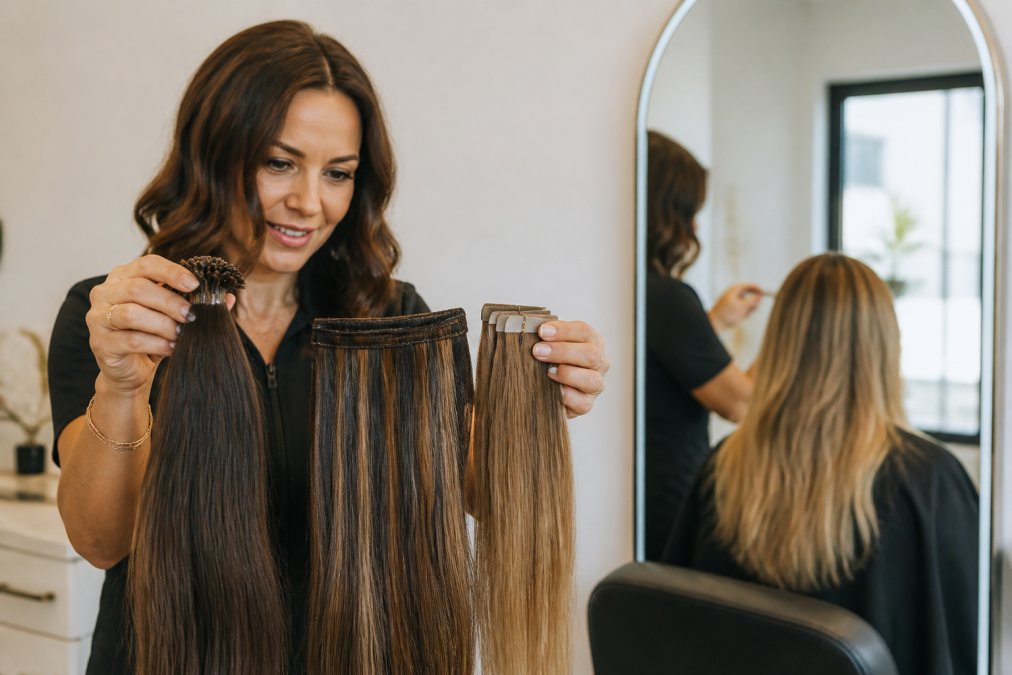
K-tips, wefts, tape-ins, and I-tips all create fullness differently.
The right choice depends on where the volume is needed and what the natural hair can reasonably support.
K-Tip Extensions
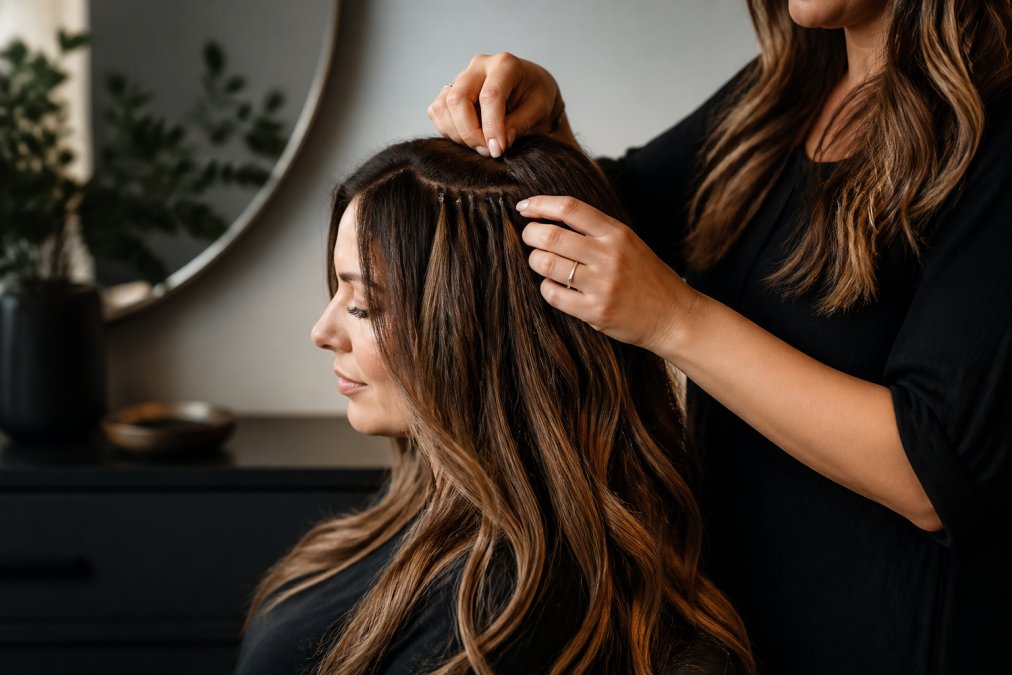
K-tip extensions use individually placed extension strands attached with small keratin bonds.
Because each attachment is placed separately, K-tips allow a high level of customization.
That can be helpful when:
- Density varies throughout the head
- Fullness needs to be added strategically
- Movement is important
- The placement needs to be adjusted from one area to another
The amount of hair, bond size, and placement still have to be planned around the natural hair.
More bonds do not automatically mean a better result.
Weft Extensions
Wefts create broader fullness across a row.
They can be a strong option when the natural hair has enough stable density to support the planned row placement and weight.
I consider:
- How much natural hair is available to support the row
- Where the row can sit comfortably
- How much density is actually needed
- How the added weight will be distributed
- How the client styles her hair
- The maintenance plan
Wefts can create beautiful fullness through the mid-lengths and ends, but they still need to be fitted to the client rather than treated like a standard row count.
Tape-In Extensions
Tape-ins use flat extension panels placed against sections of natural hair.
They can work well for certain density patterns and styling goals, but they are not automatically a fine-hair solution.
I look at:
- Attachment area
- Natural density
- Panel size
- Placement
- Home-care routine
- Desired amount of fullness
For some clients they are a good fit.
For others, a different method gives me more control over where the added hair is placed.
I-Tip Extensions
I-tips use individual extension strands secured with small beads or micro-rings.
Like K-tips, they allow for individualized placement.
I consider:
- Density in the attachment area
- Strand strength
- Bead placement
- Desired amount of hair
- Styling habits
- Maintenance needs
They can be useful when I want more control over where individual strands are added.
Hybrid Extension Plans
Sometimes one method does not solve everything.
A hybrid plan may combine more than one extension method when different areas of the head need different types of support or placement.
For example, one method may create broader fullness through stronger areas while another gives me more precision where placement needs to be more selective.
The point is not to use more methods.
The point is to use the right method in the right area.
Extension Method Comparison at a Glance
Method | How It Adds Volume | Placement Flexibility | What I Consider |
|---|---|---|---|
K-Tip | Adds fullness through individually placed extension strands | Very high | Density, strand strength, bond size, placement, and desired movement |
Weft | Adds broader fullness across a row | Moderate to high | Row placement, available density, weight, and desired fullness |
Tape-In | Adds fullness through flat extension panels | Moderate | Density, panel size, placement, attachment area, and home care |
I-Tip | Adds fullness through individually placed beaded strands | High | Density, strand strength, bead placement, and amount of added hair |
Hybrid | Combines more than one extension method | Highly customized | Uneven density, different placement needs, and how each area should be supported |
Maintenance is method-specific.
Wefts, tape-ins, I-tips, K-tips, and hybrid applications do not all follow the same maintenance or replacement schedule.
I establish that schedule based on the method, natural growth, density, attachment condition, and how the hair changes between visits.
Hair Extensions for Fine Hair: What Changes When Density Is Low
Fine or low-density hair changes how I think about the entire plan.
Sometimes that means:
- Smaller attachments
- Fewer attachments
- Lighter density
- More selective placement
- Avoiding certain areas
- Choosing a different method entirely
The sides, for example, can have less density or less hair available to support added weight than other areas.
That does not automatically mean extensions cannot be used there.
It means I have to plan more carefully.
I also look at strand condition and elasticity.
Hair that is already compromised, breaking, or changing quickly may need a more conservative plan.
Adding more extension hair is not automatically better coverage.
If the natural hair cannot comfortably support the planned weight or tension, I change the plan.
When Extensions Become Part of a Hair Restoration Plan
Traditional extensions are one way I use added hair, but they are not the only way added hair may be incorporated into a cosmetic restoration plan.
When a client needs more coverage than a traditional extension application can create, I may use Mesh Integration or Meshless Integration as the installation method.
The actual hair incorporated into that installation may include:
- Extensions
- A topper
- A lace closure
- A full lace unit
- Or a combination of hair components
For example, one client may have extension hair incorporated into a Mesh Integration plan.
Another may have a topper installed through Meshless Integration.
The installation method and the hair being installed are two separate decisions.
Both are chosen around:
- Current density
- Coverage needs
- Hair and scalp condition
- Lifestyle
- Desired result
- Maintenance
- What the natural hair can safely support
This is where my cosmetic hair restoration work overlaps with extensions.
My role is cosmetic planning and installation.
If shedding or hair loss may have a medical cause, diagnosis and treatment belong with a physician or dermatologist.
Hair Extension Maintenance for Thin Hair
Maintenance should never be treated like a one-size-fits-all calendar.
The schedule depends on:
- The extension method
- Natural growth
- Density
- Attachment condition
- Shedding changes
- Hair condition
- Home care
- Lifestyle
Wefts, tape-ins, K-tips, I-tips, and hybrid applications all have different maintenance or replacement needs.
I establish the schedule as part of the original plan and reassess it over time.
At-Home Care Matters Too
Between appointments, I recommend following the care instructions specific to your method.
That generally means:
- Brush according to the care instructions for your extension method
- Avoid unnecessary tension at attachment points
- Use heat protection when styling
- Keep attachment areas clean and properly dried
- Follow the maintenance or replacement schedule established for your method
- Contact me if you notice unusual slipping, matting, discomfort, or changes in your natural hair
It is also when I reassess the natural hair.
If your density, condition, or attachment areas have changed, I adjust the plan rather than automatically repeating the previous application.
Pros and Cons of Each Volume Method
K-tips allow very precise individual placement and natural movement because each extension strand is placed separately.
Wefts create broader fullness across a row and can be highly effective when the natural hair has enough density to support the planned placement.
Tape-ins create fullness using flat panels and require appropriate placement and home care to maintain the attachment.
I-tips allow individualized placement through small beaded attachments.
Hybrid plans combine methods when different areas of the head need different approaches.
I do not treat any method as universally best.
The right choice depends on:
- Density
- Strand strength
- Hair condition
- Scalp condition
- Lifestyle
- Desired result
- Maintenance
- What the natural hair can safely support
Some clients are not candidates for extensions at all.
If I believe extensions are asking too much of the hair in front of me, I will say so.
Volume Without Overloading the Natural Hair
Volume is achievable when the amount of added hair, placement, attachment size, and method are planned around the natural hair that is actually present.
For clients experiencing thinning or changing density, that planning may also involve my 6-Cause Restoration Method™ and consideration of whether traditional extensions are appropriate or whether the overall restoration plan should involve Mesh Integration or Meshless Integration.
In those plans, the added hair may include extensions, a topper, a lace closure, a full lace unit, or another combination depending on the coverage needed.
At Conceited Beauty Bar, every plan is fitted to the natural hair in front of me, not a template.
Start Your Inquiry to explore which approach may make sense for your hair.
Frequently Asked Questions
Which hair extensions are best for adding volume to fine hair?
There is no single extension method that is best for every person with fine hair. I look at density, strand strength, hair condition, scalp condition, placement, and how much added weight the natural hair can safely support before choosing a method. K-tips and I-tips allow individualized placement, while wefts create broader fullness across a row. Tape-ins use flat extension panels and can work well for certain density patterns. The best method is the one that fits the hair in front of me.
Can hair extensions damage thinning hair?
Extensions can place unnecessary stress on thinning or low-density hair when the weight, tension, attachment size, or placement does not match what the natural hair can reasonably support. That is why I assess the hair before deciding how much added hair to use or where to place it. Fine or thinning hair does not automatically rule out extensions, but the plan has to be more intentional.
Are K-tips or wefts better for volume?
K-tips and wefts create fullness in different ways. K-tips use individually placed extension strands, which gives me more control over precise placement. Wefts create broader fullness across a row. Which method makes sense depends on the density, strength, placement area, desired result, and amount of weight the natural hair can support.
How often do I need to maintain hair extensions for volume?
Maintenance depends on the method. Wefts, tape-ins, I-tips, K-tips, and hybrid applications all have different maintenance or replacement schedules. I establish that schedule based on your natural growth, density, attachment method, hair condition, and how your hair responds between visits.
Can I wear extensions if my hair is thinning?
Possibly. Thinning hair does not automatically rule out extensions. The important questions are where the density has changed, whether the remaining hair is stable enough to support attachments, how much weight can be added, and where that weight should be placed. For some clients, a traditional extension plan still works. For others, a broader cosmetic restoration plan may make more sense.