Hair Extensions After Baby: When Is Your Hair Ready?
You are a few months past having your baby, and your hair still does not feel like yours.
Maybe the heavy shedding has slowed.
Maybe it is finally starting to slow.
Maybe you are still very much in it.
And now you have something coming up: a wedding, family photos, a return to work, a vacation, or simply the point where you are tired of looking in the mirror and wondering when your density is coming back.
So you start researching hair extensions.
And the question you really want answered is:
When can I actually get extensions after postpartum hair loss?
The answer is not as simple as "wait six months" or "wait a year."
Postpartum recovery does not follow the exact same calendar for every woman.
What matters more than the month on the calendar is where your hair is in the shedding and recovery process, what your current density looks like, and whether your natural hair can appropriately support an extension method.
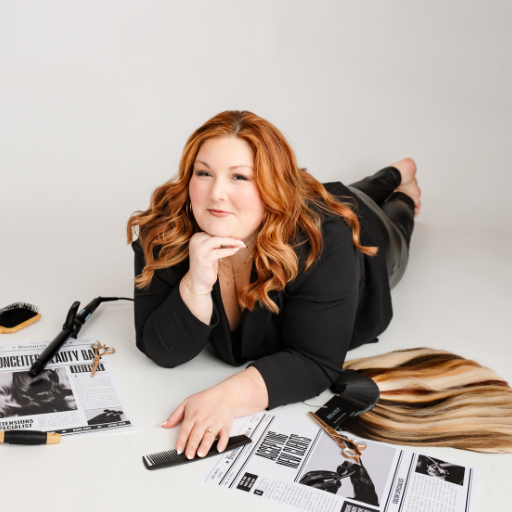
I'm Brooke Chhina, a licensed cosmetologist, cosmetology educator, hair restoration specialist, and trichology student with the International Association of Trichologists (IAT) in Lancaster, PA.
Hormonal Transitions is one of the six contributing causes I built The 6-Cause Restoration Method™ around, and postpartum hair changes sit within that cause.
If you want the bigger picture on postpartum hair changes, my postpartum hair loss guide covers that.
If you want to understand postpartum shedding and telogen effluvium more specifically, my postpartum vs. telogen effluvium guide goes deeper into the hair cycle.
This post is about one thing:
When is your hair actually ready for extensions or cosmetic restoration?
First, the scope
I'm a licensed cosmetologist, cosmetology educator, hair restoration specialist, and trichology student, not a physician or dermatologist.
Questions about postpartum recovery, hormones, medications, nutrition, breastfeeding, thyroid health, iron status, or anything else happening medically belong with your physician or board-certified dermatologist.
I do not diagnose the cause of hair loss from the studio chair.
My role is to evaluate the cosmetic and structural side of what is happening:
your current density
your visible shedding pattern
the natural hair available for support
the structural strength of that hair
where the density change is most noticeable
what cosmetic result you want
My cosmetic restoration work runs alongside medical care, never in place of it.
The short answer
I do not use a universal rule like:
"At six months postpartum, you can get extensions."
Your calendar cannot tell me whether your hair is ready.
Your hair can.
Before I recommend an installed extension method after postpartum shedding, I want the shedding to have meaningfully settled and enough appropriate natural hair to be available for support.
For one woman, that may happen sooner.
For another, it may take longer.
If you are still experiencing substantial active shedding, your density is continuing to change, or the natural hair available for support is not appropriate for the installation, I am not going to install extensions simply because you have reached a certain postpartum month.
Sometimes the answer is:
Not yet.
And sometimes the answer is:
Extensions are not actually the method that solves the area bothering you most.
That is where a custom topper or another cosmetic restoration option may enter the conversation.
Why I am cautious during active shedding
Postpartum shedding commonly reflects a temporary change in the hair-growth cycle following pregnancy.
During substantial active shedding, the support pattern of the natural hair can change quickly.
From a restoration perspective, that matters.
An extension is only as stable as the natural hair supporting it.
If the density around an attachment area is still changing significantly, retention and support can become less predictable.
I also do not want to add unnecessary mechanical stress to hair that is already going through a period of increased loss.
That does not mean hair extensions inherently cause postpartum hair loss.
It means:
timing, placement, weight, method, maintenance, and the condition of the natural hair matter.
A method that may be appropriate for stable hair may not be appropriate for that same person during substantial active shedding.
The calendar matters less than these signs
Instead of looking for a magic postpartum month, I look for signs that the hair is becoming more stable.
That may include:
a noticeable reduction in shedding compared with the heaviest phase
density that is no longer changing rapidly
visible regrowth
enough natural hair in potential support areas
adequate structural strength
a scalp and hair pattern that does not raise concerns that should be medically evaluated first
Seeing short new hairs can be encouraging.
But I do not use "baby hairs" alone as proof that someone is ready for extensions.
I look at the entire picture.
What I evaluate during The Discovery
When a postpartum client comes in, I am not just looking at whether she wants longer hair.
I am looking at what the natural hair can actually support.
Has the shedding meaningfully slowed?
You know your normal better than anyone.
I want to know what you are seeing in the shower, your brush, your clothing, and throughout your normal routine.
I also look closely at the density and condition of the hair itself.
If you tell me your shedding is still dramatic and your density is continuing to change, that matters.
What does your density look like now?
Postpartum hair changes do not look identical on everyone.
One woman may lose overall fullness but retain strong coverage through the scalp.
Another may notice the biggest visual change through her temples.
Another may be most concerned about a wider-looking part or visible crown.
Those are different cosmetic problems.
They may require different solutions.
Where is the support hair?
This is one of the biggest questions in restoration.
Any installed system needs appropriate support.
I look at:
where natural density remains
where density has changed
how strong the available support hair is
where attachment or foundation placement may make sense
The method has to fit the hair you have today, not the density you had before pregnancy.
Could something else be contributing?
Postpartum timing does not automatically explain every hair change after having a baby.
If your shedding seems unusually prolonged, severe, patterned, or accompanied by scalp symptoms or other health changes, I may recommend speaking with your physician or dermatologist before moving forward.
Other factors can overlap.
What are you actually trying to accomplish?
Do you miss the thickness of your ponytail?
Do you want your length back?
Is your primary concern a widening part?
Are you trying to feel more like yourself for an upcoming wedding?
Do you need everyday coverage through the crown?
Those goals matter because extensions and toppers solve different problems.
What about breastfeeding?
Breastfeeding by itself does not automatically make someone a candidate or non-candidate for cosmetic hair restoration.
It also does not tell me whether the hair is ready.
Every postpartum experience is different.
Nutrition, recovery, the hair cycle, medical history, current density, and overall health can all affect what the hair looks like during this period.
If you have concerns about iron, nutrition, postpartum thyroid changes, or other health factors, those are conversations to have with your medical provider.
I do not diagnose deficiencies or assume breastfeeding is the reason someone's hair has not recovered on a particular schedule.
From the restoration side, I keep coming back to the same question:
What can your natural hair appropriately support right now?
Which extension methods can work after postpartum shedding?
Once the shedding has settled enough and the natural hair is appropriate for an installation, we can start talking about methods.
There is no single best postpartum extension.
The method is selected based on the actual hair.
K-tip extensions
K-tip extensions use individual keratin bonds attached to small sections of natural hair.
One of the reasons I like K-tips is the amount of placement customization they allow.
The size, placement, density, and distribution can be tailored to the natural hair rather than treating every area the same.
But customization does not make K-tips automatically appropriate after postpartum shedding.
Each bond still relies on natural hair for support.
I want enough stable, structurally appropriate hair at the placement points before I consider them.
Weft extensions
Weft extensions add hair along rows supported by the natural hair.
They may be appropriate for some postpartum clients who have sufficient density and structural strength in the areas where the row would sit.
I evaluate:
how much natural hair is available
where the row would be placed
how density has changed
whether the support pattern makes sense
what cosmetic result we are trying to create
I do not choose wefts simply because someone wants maximum fullness.
The natural hair has to be appropriate for the foundation.
What about the crown and part?
This is where traditional extensions reach their limit.
Extensions are designed primarily to add length and fullness through existing hair.
They do not create targeted scalp coverage through a widening part or a visibly thinned crown.
If your biggest postpartum concern is that you can see more scalp through the top of your head, adding more hair through the lengths may make your ponytail fuller without solving the area that actually bothers you.
That is where a custom hair topper may make more sense.
When a custom topper may be the better cosmetic option
A custom hair topper is the actual hairpiece used to provide targeted coverage.
For a postpartum client, that may include coverage through the:
crown
part
top
another concentrated area where extensions alone cannot create the visual density you want
The topper is the coverage piece.
How that topper is supported depends on the natural hair available.
Mesh Integration
With Mesh Integration, breathable mesh is laid over the appropriate area first.
Natural hair is carefully fed through the mesh and secured with beads through or on the mesh foundation.
The custom hair topper is then sewn onto that completed foundation.
Mesh Integration may be considered when additional foundation structure is appropriate for the natural hair available.
Meshless Integration
Meshless Integration does not use a mesh layer.
Instead, I create a customized beaded-only foundation using natural hair with sufficient structural strength to support the system.
The custom hair topper is then sewn onto that completed foundation.
Neither foundation is automatically better.
The decision depends on:
support hair
structural strength
coverage area
comfort
lifestyle
maintenance
cosmetic goals
Why I do not use clip-in toppers as my restoration solution
I do not use clip-in toppers or snap-on hairpieces in my cosmetic restoration work.
Clips repeatedly load small attachment areas of natural hair.
Repeated tension can begin as a potentially reversible, non-scarring process but may become permanently scarring when tension continues over time.
That does not mean every person who wears a clip-in topper will develop traction alopecia.
It means I prefer restoration systems that allow me to intentionally design and reassess where the support comes from.
That is part of what I mean when I talk about restoration being:
anchored, not gripped.
Sometimes the answer is no installation yet
This is important.
A Discovery does not automatically end with me recommending that something be installed.
Sometimes I look at postpartum hair and the most appropriate recommendation is:
Give it more time.
If your hair is still actively changing, there is not enough appropriate support hair, or I do not believe an installed system makes sense yet, I will tell you.
That is not a failed consultation.
That is what consultation-first restoration is supposed to do.
Your Restoration Roadmap may involve:
reassessing later
choosing a different cosmetic method
adjusting hair care while the hair changes
discussing concerns with your medical provider
returning once the support pattern is more stable
Planning around a wedding, photos, or another important event
This is one of the hardest parts of postpartum hair loss because your hair cycle does not care what is on your calendar.
You might have a wedding in four months.
Your maternity leave may end soon.
Family photos may already be booked.
And you want to know whether I can make your hair look fuller by then.
The answer depends on:
what your hair can appropriately support at that point.
If you have several months before the event
That gives us more flexibility.
I can assess where you are now and create a plan based on what the hair is doing.
If the shedding settles and the hair becomes appropriate for extensions, that may become an option.
If the primary concern is targeted coverage through the crown or part, a custom topper may be the better conversation.
If your event is approaching and you are still actively shedding
I am not going to force an extension installation because there is a deadline.
If the natural hair is not ready, it is not ready.
A custom topper may sometimes provide the type of coverage you want, but an installed topper still requires an appropriate foundation and support plan.
It is not a loophole around substantial active shedding.
The topper, foundation, and support hair all still have to make sense.
If your event is very soon
Talk to me anyway.
Sometimes an installed restoration system will not be the right answer on a short timeline.
That does not mean your existing hair cannot look beautiful.
A strategic haircut, color, styling, or another temporary cosmetic approach may be the better answer for that moment.
Why two postpartum women can get completely different recommendations
Imagine two women who are both eight months postpartum.
The first is no longer experiencing significant shedding. Her top density is strong, but she misses the length and fullness she had before pregnancy.
She may be an extension candidate.
The second is also eight months postpartum, but her part still looks considerably wider and her biggest concern is crown coverage.
Extensions may not solve the problem she cares about most.
A custom topper may make more sense.
A third woman may be eight months postpartum and still experiencing substantial shedding.
My answer to her may be:
Not yet.
Same number of months postpartum.
Three different cosmetic recommendations.
That is why the calendar cannot make this decision for us.
If you want to know whether your hair is ready
That is exactly what The Discovery is for.
The Discovery is an in-studio consultation and the first step in The 6-Cause Restoration Method™.
I review:
your current density
whether substantial shedding is still happening
the natural hair available for support
structural strength
where the visible density changes are occurring
what you want your finished hair to look like
whether extensions actually solve your concern
whether a custom topper would provide more appropriate coverage
whether Mesh Integration or Meshless Integration may be appropriate if a topper is recommended
whether your hair is ready for an installed cosmetic restoration system at all
which contributing causes within The 6-Cause Restoration Method™ may be relevant to your hair story
I identify what may be contributing within my scope and tell you when something belongs with a physician or dermatologist first.
I do not medically diagnose postpartum hair loss or determine why your hair cycle has changed.
From there, I create your personalized Restoration Roadmap and send it to your phone.
Your Roadmap may include:
a custom hair topper with Meshless Integration
a custom hair topper with Mesh Integration
hair extensions if length or fullness is the primary goal
a combination of topper-based restoration and extensions
a cosmetic hair-care plan while your natural hair recovers
a recommendation to see a dermatologist first and return to me afterward
Sometimes the Roadmap says we can move forward now.
Sometimes it says a different method is better than the one you walked in asking for.
And sometimes it says:
Give your hair more time, then let me reassess it.
That is an honest answer, and sometimes it is the most valuable one I can give you.
Your Restoration Roadmap is yours to keep whether or not you decide to continue with me.
If you're in Lancaster, PA, or traveling in for cosmetic hair restoration, Begin Your Discovery.
I work by application only.
You do not need to guess which postpartum month makes you "ready."
I look at the hair in front of me, determine what it can appropriately support, and build the cosmetic plan from there.
I'm Brooke Chhina, a licensed cosmetologist, cosmetology educator, hair restoration specialist, and trichology student with the International Association of Trichologists (IAT) in Lancaster, PA, and the creator of The 6-Cause Restoration Method™. I'm not a medical doctor. For diagnosis or treatment of medical conditions affecting your hair, scalp, or general health, please consult a licensed physician or board-certified dermatologist. Cosmetic hair restoration runs alongside medical care, never in place of it.
Conceited Beauty Bar · Sola Salons Studio 9A · 1500 Gilbert Way, Lancaster, PA 17601
Crowned in Confidence · Your Beauty, Elevated.