Postpartum Hair Loss: What's Normal and When to Get Help
You're three or four months postpartum. You're standing in the shower, or running a brush through your hair, or just pulling a hair tie out at the end of the day. And you're holding what looks like half your hair in your hand.
Not a few strands. A lot.
If that's where you are right now, I want to say two things to you, in this order.
First, you're not alone. Noticeable hair shedding a few months after giving birth is extremely common, and it can be genuinely alarming to live through.
Second, for most women, postpartum shedding is temporary. It usually reflects a temporary shift in the hair-growth cycle rather than permanent follicular loss, and normal fullness gradually returns as that cycle resets.
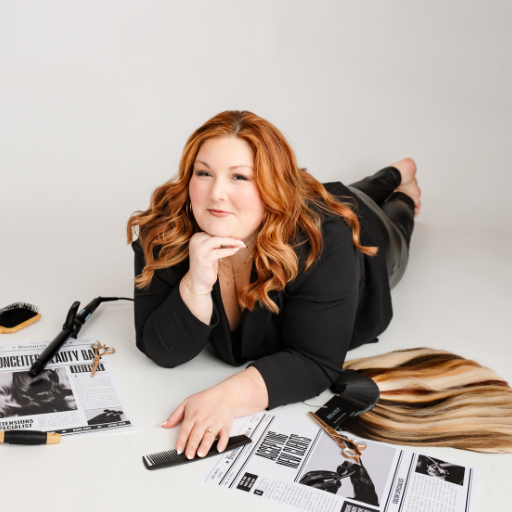
I'm Brooke, a licensed cosmetologist, cosmetology educator, hair restoration specialist, and trichology student (IAT) in Lancaster, PA.
Within The 6-Cause Restoration Method™, postpartum hair changes sit within Hormonal Transitions, one of the six contributing causes I built the Method around.
Most of the time, my honest advice is to wait and let the shedding cycle resolve. Sometimes, though, cosmetic hair restoration becomes part of the conversation. I'll explain both.
First, the scope
I'm a licensed cosmetologist, cosmetology educator, hair restoration specialist, and trichology student (IAT), not a doctor or dermatologist.
Postpartum shedding is often a normal physiologic response to childbirth and hormonal change, but other issues can sometimes overlap with it, including thyroid changes, iron deficiency, nutritional concerns, or another form of hair loss.
If your shedding feels unusual, is not improving over time, or comes with other symptoms, please talk with your OB, physician, or a board-certified dermatologist.
My cosmetic hair restoration work runs alongside medical care, never in place of it.
Why postpartum hair shedding happens
Here's what's actually happening, in the simplest terms.
During pregnancy, higher estrogen levels keep more hairs in the active growth phase for longer than usual. That is one reason many women notice fuller-looking hair and less shedding during pregnancy.
After birth, estrogen levels fall.
A larger number of hairs can then move into the resting stage of the hair cycle around the same time. A few months later, those hairs begin to release.
This pattern is called postpartum telogen effluvium.
What matters most is this:
Postpartum shedding is usually temporary
The shedding often becomes noticeable a few months after birth
Regrowth and visible fullness take longer than the shedding itself to recover
The amount of hair you see can still feel dramatic.
You're not imagining it.
When postpartum hair shedding starts and stops
This is the question I hear most.
Every woman's timeline is a little different, but there is a recognizable pattern.
Shedding often becomes noticeable around 2 to 4 months postpartum.
That delay matters. The hormonal shift happens earlier, but hair takes time to move through the resting stage before it releases.
Shedding often peaks around 4 months postpartum.
This is the stretch when you may see hair on your pillow, in your brush, in the shower drain, on your clothes, and somehow in places hair should never be.
It can feel like it is happening all at once.
Over the following months, the shedding usually begins to settle.
As the hair cycle readjusts, the amount you're losing should gradually move back toward your normal baseline.
Regrowth follows.
You may start seeing short, fine hairs around the hairline, temples, or part.
Yes, they stick up.
Yes, they can look ridiculous for a while.
They're usually a good sign.
Most women regain their normal hair fullness by around their child's first birthday.
Some notice that recovery sooner. Others take longer, especially when another hair-change factor is happening at the same time.
If you're in the middle of the heavy-shedding phase right now, the most important thing to know is that what you see today is not necessarily what your hair will look like six months from now.
When to talk to your doctor or dermatologist
For many women, postpartum shedding follows the expected pattern and gradually resolves.
Sometimes it doesn't.
Talk to your doctor or a board-certified dermatologist if:
Your shedding is not improving as you approach one year postpartum
Your shedding is increasing rather than gradually settling
You see hair loss in defined patches rather than diffuse shedding
Your part or crown continues to become more visible
You have significant fatigue, unexpected weight changes, brain fog, or temperature sensitivity
You feel dizzy, lightheaded, weak, or unusually fatigued
You have a family history of female pattern hair loss and your density is not returning as expected
Maintaining adequate nutrition postpartum has been difficult
Those signs do not automatically mean something is wrong.
They mean the pattern deserves a closer medical look instead of assuming everything is postpartum shedding.
If your doctor thinks bloodwork is appropriate, ask whether thyroid testing and ferritin should be included rather than assuming a standard panel covers everything relevant to hair shedding. Your physician can determine which tests make sense based on your history and symptoms.
What actually helps during the postpartum shedding window
The internet is full of products promising to stop postpartum shedding or make the hair grow back faster.
The reality is less exciting, but much more useful.
What may help
Adequate nutrition.
Pregnancy, delivery, recovery, and breastfeeding can all change your nutritional needs. Protein, iron, and adequate overall calorie intake matter for healthy hair growth.
Talk to your doctor about your postpartum nutrition, whether continuing a prenatal or postnatal vitamin makes sense for you, and whether any deficiencies need to be evaluated.
Being gentle with the hair you have.
Avoid tight ponytails and styles that repeatedly pull on the same areas.
Limit unnecessary high heat.
Detangle gently.
Use products and styling choices that make the hair easier to manage rather than adding more mechanical stress.
A flattering, lower-maintenance haircut.
This is underrated.
Sometimes a small change in shape, length, layering, or styling makes the temporary density change much less noticeable while the regrowth catches up.
What is unlikely to shortcut the process
Biotin supplements by themselves.
Most people are not biotin deficient, and taking extra biotin does not reverse the postpartum hair cycle. High-dose biotin can also interfere with some laboratory testing.
Miracle postpartum regrowth serums.
A topical product cannot simply cancel the underlying postpartum hair-cycle shift.
Some products may help with scalp care, conditioning, or the appearance of fullness, but that is different from stopping telogen effluvium.
Constantly checking the shedding.
Significant ongoing stress can itself be another hair-cycle stressor.
That does not mean worrying about your hair is causing your postpartum shedding. It means you do not need to turn every shower drain into a daily test of whether you're recovering.
What cosmetic hair restoration looks like during the postpartum window
Here's where I have to be careful and honest as a hair restoration specialist.
Most postpartum women do not need cosmetic hair restoration.
If the shedding is following the expected postpartum pattern and gradually slowing, waiting may genuinely be the best recommendation.
Sometimes the right plan is:
Give your hair more time. Reassess later.
When cosmetic restoration may become a conversation
If the visible thinning is significantly affecting your daily life, I can evaluate whether your natural hair is stable enough to safely support a cosmetic restoration option.
I do not decide that based only on how many months postpartum you are.
I look at the hair that is actually available for support, its structural strength, the location of the density change, whether shedding is still active, and what your natural hair can appropriately carry.
A custom hair topper can provide targeted coverage through the top, crown, part, or another affected area when the hair available for support is appropriate.
The topper may then be supported by either Mesh Integration or Meshless Integration.
Meshless Integration uses a customized beaded-only foundation created from natural hair with enough structural strength to support the system. The custom topper is sewn onto that completed foundation.
Mesh Integration uses a breathable mesh foundation. Natural hair is fed through the mesh and secured with beads through or on the mesh foundation, then the custom topper is sewn onto the completed foundation.
Neither foundation is automatically better.
The choice depends on the natural hair available for support, its structural strength, the coverage area, comfort, lifestyle, maintenance preferences, and cosmetic goals.
What about extensions?
Hair extensions and custom toppers solve different problems.
Extensions add length and fullness through existing hair.
A topper provides targeted coverage where visual density is missing through areas such as the top, part, or crown.
Some women may eventually benefit from one. Some may benefit from both. Some need neither.
The hair decides.
Why I don't use clip-in toppers during significant postpartum shedding
I do not work with clip-in toppers or snap-on hairpieces for clients navigating significant shedding.
Repeated tension can begin as a potentially reversible, non-scarring process but may become permanently scarring when tension continues over time.
During a shedding or recovery period, I would rather design support around the natural hair available than repeatedly load the same small attachment points.
A few honest things I'd tell you if you were sitting in my chair
You're not vain for caring.
Hair is connected to identity for a lot of women.
Feeling unlike yourself in the mirror while you're also navigating everything that comes with having a baby can be deeply frustrating.
Wanting your hair back does not make you a worse mother or less grateful.
Comparison is brutal during this window.
Social media is full of postpartum women with seemingly perfect hair.
Some have naturally dense hair.
Some are wearing extensions or hairpieces.
Some are styling strategically.
And some are struggling with things you cannot see from a photograph.
None of that tells you what is happening with your hair.
The baby-hair stage can look awkward.
Short regrowth around your hairline and part may stick straight up for a while.
That is not a setback.
It is new hair that needs time to gain length.
Your timeline does not need to look exactly like someone else's.
For most women, postpartum shedding improves and normal fullness returns.
If yours does not, that is not a reason to panic.
It is a reason to look more closely at what else may be contributing.
If this is you
If you're in the heavy-shedding phase right now, your hair isn't recovering the way you expected, or you simply want someone to look at the pattern with you, The Discovery is where I begin.
The Discovery is an in-studio consultation and the first step in The 6-Cause Restoration Method™.
I review your scalp and visible density pattern, talk through your timeline and hair history, identify what may be contributing to the changes you're seeing, and determine whether your hair is ready for cosmetic restoration or whether waiting or medical evaluation should come first.
Many postpartum Discoveries end with me saying:
Give it more time. Let's reassess if it isn't improving.
That's still a useful answer.
From there, I create your personalized Restoration Roadmap and send it to your phone. It's yours to keep whether or not you decide to continue with me.
If you're in Lancaster, PA, or driving in, Begin Your Discovery.
I work by application only.
You don't have to wait until something feels severe to ask questions.
And you don't need cosmetic restoration just because your hair looks different today.
Sometimes the right next step is simply understanding where you are in the process.
I'm Brooke Chhina, a licensed cosmetologist, cosmetology educator, hair restoration specialist, and trichology student (IAT) in Lancaster, PA, and the creator of The 6-Cause Restoration Method™. I'm not a medical doctor. For diagnosis or treatment of medical conditions affecting your hair, scalp, or general health, please consult a licensed physician or board-certified dermatologist. Cosmetic hair restoration runs alongside medical care, never in place of it.
Conceited Beauty Bar · Sola Salons Studio 9A · 1500 Gilbert Way, Lancaster, PA 17601
Crowned in Confidence · Your Beauty, Elevated.