FFA Hairline: Styling and Restoration Options That Help
If you are living with frontal fibrosing alopecia, the change at your hairline can affect far more than how you style your hair.
It can change the way you part it, how you wear it up, how comfortable you feel in photographs, and how often you find yourself thinking about an area of your appearance that used to feel effortless.
There are cosmetic options that may help.
Some are simple styling changes. Others involve professionally designed cosmetic hair restoration, including a custom hair topper when your natural hair can appropriately support one.
The important part is understanding where cosmetic restoration fits and where medical care begins.
Within The 6-Cause Restoration Method™, frontal fibrosing alopecia sits within Autoimmune Hair Conditions, one of the six contributing causes I built the Method around.
First, an important boundary
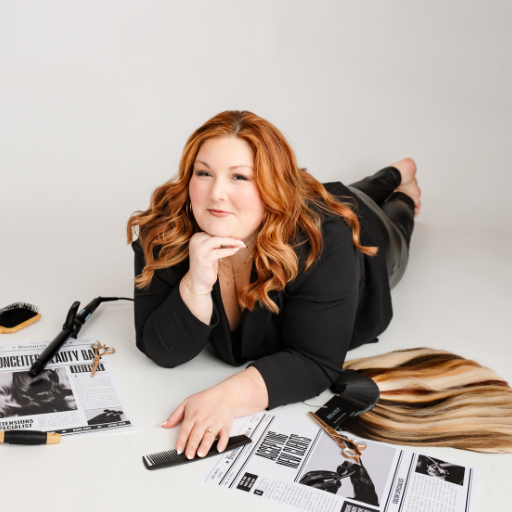
I'm Brooke Chhina, a licensed cosmetologist, cosmetology educator, hair restoration specialist, and trichology student (IAT) in Lancaster, PA.
I'm not a physician or dermatologist.
Frontal fibrosing alopecia, often shortened to FFA, is a medical form of scarring hair loss. Diagnosis, monitoring, and treatment belong with a board-certified dermatologist.
FFA can damage and scar hair follicles, which means some hair loss can become permanent. Early medical evaluation matters because treatment may help stabilize the condition and preserve hair that remains.
I cannot diagnose FFA, treat it, prescribe medication, or determine medically whether the condition is active or stable.
My work begins on the cosmetic side.
I can evaluate the natural hair that is currently present, the areas where you want visual coverage, what that hair can structurally support, and which cosmetic options may make sense alongside your medical care.
My restoration work runs alongside medical care, never in place of it.
If you want the broader picture on this category, you can also read my guide to autoimmune hair loss in women.
Styling around a changing hairline
When the front hairline is fragile, uncomfortable, or changing, aggressive styling is rarely where I want to start.
The goal is to create visual softness without repeatedly adding unnecessary mechanical stress through the frontal hairline.
That may mean reconsidering very tight ponytails, aggressively slicked-back styles, or other looks that depend on repeated tension through the same front perimeter.
If your dermatologist has told you that your scalp is inflamed or sensitive, I also want your styling choices to respect that.
Sometimes relatively small changes in haircut, part placement, and styling can make a noticeable difference.
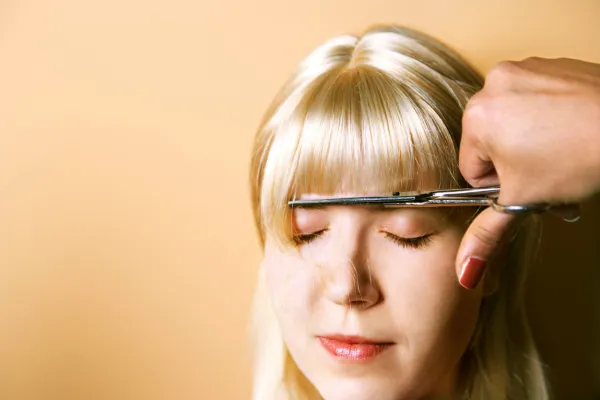
Fringe can change the visual balance
A fringe does not have to mean a heavy, straight-across bang.
Depending on the natural hair still present and where the FFA is affecting the hairline, options may include:
curtain fringe
side-swept fringe
wispy face-framing pieces
a soft textured bang
strategic layers directed forward around the face
The goal is not necessarily to cover the entire forehead.
It may simply be to soften the visual transition between the existing hairline and the rest of the style.
For some women, that is enough to make the hair feel much more wearable.
For others, there is not enough natural hair in the appropriate area to create the coverage they want through styling alone.
That is where cosmetic hair restoration may come into the conversation.
Part placement can help too
Sometimes a small shift in where the hair is parted changes how the eye reads the front and top of the hairstyle.
A rigid center part can emphasize certain areas, while a softer side part, broken part, or less structured finish may create more visual movement.
I am trying to work with the hair you currently have rather than force it to behave like the hairline you had before.
When styling alone is not enough
If haircut and styling adjustments cannot provide the amount or location of coverage you want, the cosmetic restoration piece I may consider is a custom hair topper.
A custom hair topper is the actual hairpiece.
It is designed to provide targeted coverage and blend with your existing natural hair.
For someone with FFA, that coverage may involve the front, temples, top, part, crown, or a combination of areas depending on the individual pattern.
The topper itself may be constructed with lace, HD lace, or another appropriate base material.
The base is selected around:
the area that needs coverage
the desired front finish
comfort
the natural hair that remains
lifestyle
maintenance
cosmetic goals
Lace is a topper-construction option. It is not a separate restoration service.
That is why I do not offer "lace closure integration" as its own method.
The service is cosmetic hair restoration using a custom hair topper when a topper is appropriate.
Why lace or HD lace may sometimes be useful near the hairline
When it is appropriate for the individual client, lace can create a very fine transition at the front of a topper.
HD lace is an especially fine lace option that can create a low-visibility edge when it is appropriately customized, placed, and blended.
That does not mean every client with FFA should wear a lace topper.
The diagnosis does not determine the topper construction by itself.
I still need to evaluate the location of the coverage need, the condition of the scalp, the natural hair available for support, comfort, lifestyle, and the finished look you want.
The topper and the foundation are two different things
This distinction matters.
The custom hair topper is the coverage piece.
Mesh Integration and Meshless Integration are foundation methods underneath that topper.
Both methods can support a custom topper when they are appropriate for the individual client.
Mesh Integration
With Mesh Integration, breathable mesh is laid over the appropriate area first.
Natural hair is carefully fed through the mesh and secured with beads through or on the mesh foundation.
Once the foundation is complete, the custom hair topper is sewn onto it.
Mesh may provide additional foundation structure when a beaded-only foundation is not the best fit for the natural hair available.
Meshless Integration
Meshless Integration does not use a mesh layer.
Instead, I create a customized beaded-only foundation using natural hair with sufficient structural strength to support the system.
The custom hair topper is then sewn onto that completed foundation.
Meshless is not a different kind of topper.
It is a different foundation beneath the same type of cosmetic coverage piece.
How do I decide between Mesh and Meshless?
I do not choose a foundation simply because someone has FFA.
I look at the actual hair in front of me.
That includes:
the visible density pattern
the area that needs coverage
the natural hair available for support
the structural strength of that hair
scalp comfort
lifestyle
maintenance preferences
cosmetic goals
If the available natural hair has enough structural strength for a beaded-only foundation, Meshless Integration may be considered.
If additional foundation structure is appropriate, Mesh Integration may be considered.
Sometimes neither is appropriate.
Sometimes the right cosmetic answer is a different topper configuration.
Sometimes I want medical evaluation or stabilization to remain the priority before discussing an installed system at all.
That is why the decision happens during The Discovery, not from a diagnosis or photograph alone.
Why FFA requires extra care with support hair
FFA often affects the frontal hairline and temples, which means the very area someone wants covered may not be the area I want carrying the system.
That matters.
I do not simply attach a topper to whatever hair happens to remain closest to the affected area.
I evaluate where appropriate support actually exists.
Foundation placement is selected around the natural hair's structural strength and capacity to support the cosmetic system.
No installed hair system is literally tension-free.
My goal is to minimize unnecessary mechanical stress and avoid concentrating support in small, compromised areas.
This is especially important when someone is already managing a scarring hair-loss condition.
Can extensions help with FFA?
Sometimes, but they solve a different problem.
Hair extensions add length and fullness through existing hair.
They do not replace missing visual density through the frontal hairline, temples, part, or top.
A custom topper provides targeted coverage.
For some women, a topper may address the coverage need while extensions add length or fullness through the remaining hair.
For another woman, extensions may not be needed at all.
For someone else, neither may be appropriate yet.
The restoration plan depends on the natural hair available and the cosmetic problem we are actually trying to solve.
What if your hairline is still changing?
This is an important conversation to have with your dermatologist first.
From the cosmetic side, it means I do not want to build a plan around the assumption that today's support pattern will automatically remain the same.
I evaluate what your hair can support now.
If the frontal area, temples, or another potential support area is changing, that may affect whether an integrated system is appropriate and where the foundation can be placed.
Sometimes restoration can still be considered.
Sometimes it should wait.
Sometimes a different cosmetic option makes more sense.
I do not predict how your FFA will progress.
That belongs with your dermatologist and your medical monitoring.
What I can do is reassess the natural hair and cosmetic plan over time.
What if the scalp is tender, itchy, or inflamed?
Tell your dermatologist.
Symptoms such as tenderness, itching, pain, or visible inflammation matter medically in FFA.
I do not interpret those symptoms as disease activity or decide whether treatment needs to change.
That is your dermatologist's role.
From my side, if an area is uncomfortable or visibly irritated, I do not want to ignore that information when planning an installed cosmetic system.
Comfort and scalp condition are part of the restoration decision.
Why I avoid repeated gripping at the frontal hairline
I do not want the support plan repeatedly loading the same small, fragile area of natural hair.
Repeated tension can begin as a potentially reversible, non-scarring process but may become permanently scarring when tension continues over time.
FFA itself is already a scarring alopecia.
Those are different processes, but I still want to minimize avoidable mechanical stress on the remaining support hair.
That is why customized foundation placement and continued reassessment matter.
What I want an FFA client to understand before restoration
You do not need to walk into a consultation already knowing what system you need.
You do not need to decide:
"Do I need Mesh?"
"Do I need Meshless?"
"Do I need HD lace?"
"Do I need extensions?"
That is not your job.
Your job is to tell me what has been happening with your hair, what areas bother you cosmetically, what your dermatologist has told you medically, what you want your hair to look like, and how you want it to function in everyday life.
My job is to evaluate those cosmetic needs against what your natural hair can currently support.
Where your dermatologist fits, and where I fit
Your dermatologist manages FFA medically.
That includes:
diagnosis
determining whether the condition is active or stable
monitoring progression
treatment decisions
evaluating symptoms
My work begins with cosmetic appearance and support.
I work with:
the natural hair that is currently present
the areas needing visual coverage
the structural support available
topper design
foundation selection
blending
length and fullness
maintenance
cosmetic goals
Those roles can exist at the same time.
Your dermatologist handles the condition.
I handle cosmetic restoration when it is appropriate.
How we begin
Every new restoration client begins with The Discovery.
The Discovery is an in-studio consultation in my private Lancaster studio.
I review your hair history, visible density pattern, coverage needs, scalp comfort, natural hair available for structural support, lifestyle, maintenance preferences, and cosmetic goals.
I also identify what may be contributing to the hair changes you are seeing within the scope of The 6-Cause Restoration Method™, while keeping medical diagnosis and treatment with the appropriate provider.
From there, I create your personalized Restoration Roadmap.
Your Roadmap may include:
a custom hair topper with Meshless Integration
a custom hair topper with Mesh Integration
hair extensions if additional length or fullness is a goal
a combination of topper-based restoration and extensions
a cosmetic hair-care plan while your natural hair changes
a recommendation to see your dermatologist first and return to me afterward
Your Restoration Roadmap is sent to your phone and is yours to keep whether or not you decide to continue with me.
No method is assumed before I see your hair.
If you're in Lancaster, PA, or traveling to the area for cosmetic hair restoration, Begin Your Discovery.
I work by application only.
I'm Brooke Chhina, a licensed cosmetologist, cosmetology educator, hair restoration specialist, and trichology student (IAT) in Lancaster, PA, and the creator of The 6-Cause Restoration Method™. I'm not a physician or dermatologist. For diagnosis or treatment of frontal fibrosing alopecia or any other medical condition affecting the hair, scalp, or general health, please consult a licensed physician or board-certified dermatologist. Cosmetic hair restoration runs alongside medical care, never in place of it.
Conceited Beauty Bar · Sola Salons Studio 9A · 1500 Gilbert Way, Lancaster, PA 17601
Crowned in Confidence · Your Beauty, Elevated.