Autoimmune Hair Loss: When It's Not "Just Stress"
If you've been losing hair in patches, watching your hairline recede in a way that does not look like ordinary thinning, or noticing redness, scaling, tenderness, or bumps around areas of hair loss, I want you to pay attention.
Not every hair change is stress.
Not every widening part is hormonal.
And not every patch of hair loss should be treated like ordinary shedding.
Some hair-loss conditions involve immune or inflammatory processes and require medical evaluation because they can behave very differently from female pattern hair loss or telogen effluvium.
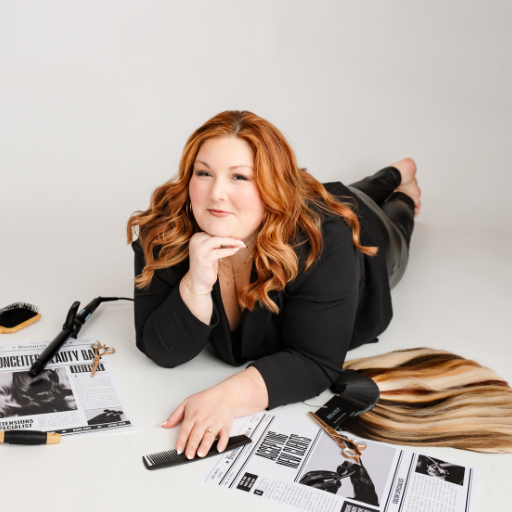
I'm Brooke Chhina, a licensed cosmetologist, cosmetology educator, hair restoration specialist, and trichology student (IAT) in Lancaster, PA.
Within The 6-Cause Restoration Method™, these conditions sit within Autoimmune Hair Conditions, one of the six contributing causes I built the Method around.
That category helps me recognize when the pattern in front of me belongs with a medical provider first.
It does not mean I diagnose or treat these conditions.
I don't.
My role is cosmetic hair restoration. Diagnosis, disease monitoring, and medical treatment belong with a physician or board-certified dermatologist.
What I mean by Autoimmune Hair Conditions
This category includes several conditions that can cause very different patterns of hair loss.
Some, such as alopecia areata, are autoimmune diseases in which the immune system attacks the hair follicles.
Others, including frontal fibrosing alopecia, lichen planopilaris, and CCCA, are inflammatory or scarring forms of hair loss in which the follicles can become permanently damaged.
Their biology is not identical.
Their treatment is not identical.
And I do not want to flatten them into one simple explanation.
What they have in common from my cosmetic-restoration perspective is that they can require medical evaluation before I ever talk about a topper, foundation, or extension method.
Alopecia areata
Alopecia areata often causes sudden patches of hair loss.
For many people, those patches are round or oval and the skin may look relatively smooth.
The condition can affect only a few areas or become much more extensive.
Alopecia areata is autoimmune. The immune system attacks the hair follicles, which disrupts normal hair growth.
Hair may regrow, but the pattern can also change over time.
That unpredictability is one reason I want a dermatologist involved before I design an installed cosmetic restoration system.
If you are specifically navigating alopecia areata, you can also read my guide to hair toppers for alopecia areata.
Frontal fibrosing alopecia
Frontal fibrosing alopecia, or FFA, is a scarring form of hair loss that commonly affects the frontal hairline and temples.
It may also involve the eyebrows.
FFA can destroy hair follicles and cause permanent hair loss. Early diagnosis and treatment may help prevent further progression and preserve the hair that remains.
Because FFA often changes slowly, it can be mistaken for ordinary aging or a naturally maturing hairline.
It is not something I diagnose in the studio.
If I see a pattern that concerns me, my job is to tell you it belongs with a dermatologist.
You can also read my guide to FFA hairline styling and restoration options.
Lichen planopilaris
Lichen planopilaris, commonly called LPP, is an inflammatory scarring alopecia that affects the scalp.
It may cause symptoms such as:
redness
small bumps around follicles
itching
burning
tenderness
patches of hair loss
LPP can cause permanent hair loss when affected follicles scar. Early medical treatment is important because treatment is aimed at controlling the inflammation and preventing additional follicular loss.
That is why scalp symptoms matter.
Hair loss plus burning, tenderness, redness, or visible inflammation is not something I want a client simply covering cosmetically without medical evaluation.
CCCA
Central centrifugal cicatricial alopecia, or CCCA, is another form of scarring hair loss.
It often begins around the center or crown of the scalp and may spread outward over time.
CCCA is most commonly diagnosed in Black women, although it can occur in other populations as well.
The cause is complex and is still being studied.
Inflammation and genetics appear to play roles, but CCCA should not simply be described as a confirmed autoimmune disease. The American Academy of Dermatology notes that it is possible there is an autoimmune component, but more research is needed.
What is clear is that CCCA can destroy hair follicles and lead to permanent scarring, which is why early dermatologic evaluation matters.
Why these conditions can be missed
These patterns do not always look like what people picture when they hear "hair loss."
They may be:
patchy
asymmetric
concentrated around the hairline
centered at the crown
accompanied by redness, scaling, bumps, burning, or tenderness
mixed with another type of hair loss
That last point matters.
A person can have more than one hair-loss process happening at the same time.
For example, the American Academy of Dermatology notes that some women with FFA also have female pattern hair loss, and some women with CCCA may also have traction alopecia or female pattern hair loss.
That is one reason I do not try to diagnose a condition based on appearance alone.
When I want you to see a dermatologist first
If you are experiencing any of the following, I want medical evaluation to be part of the conversation:
defined patches of hair loss
a progressively receding frontal hairline
loss of eyebrows along with hairline recession
visible redness or scaling around follicles
persistent scalp burning, tenderness, pain, or itching
smooth or shiny areas where hair no longer grows
crown-centered loss that appears to be expanding
a hair-loss pattern that does not fit ordinary shedding
Those signs do not tell me which diagnosis you have.
They tell me the pattern deserves medical assessment.
For scarring alopecias such as FFA, LPP, and CCCA, timing matters because once a follicle is destroyed and replaced by scar tissue, regrowth may no longer be possible.
Where I fit
Your dermatologist handles the medical side.
That includes:
diagnosis
determining whether a condition is active or stable
biopsy when appropriate
medication
medical monitoring
treatment decisions
My role begins on the cosmetic side.
I look at:
the hair that is currently present
the visible density pattern
where coverage is needed
scalp comfort
natural hair available for support
structural strength
lifestyle
maintenance preferences
cosmetic goals
I do not treat the condition.
I design cosmetic coverage when your hair and scalp are appropriate for it.
What cosmetic restoration may look like
There is no single "autoimmune hair loss system."
The cosmetic plan depends on the actual pattern in front of me.
For some women, a custom hair topper may provide the targeted coverage they want.
For others, an installed topper may not be appropriate yet.
Some clients may need to continue medical evaluation or allow the scalp to stabilize before I would consider an integrated system.
The diagnosis alone does not determine the restoration method.
The topper is the coverage piece
A custom hair topper is the actual hairpiece.
It may provide targeted coverage through areas such as:
the crown
part
top
temples
frontal area
another localized area of density loss
The topper itself may be constructed with lace, HD lace, or another appropriate base depending on the coverage area, comfort, desired finish, and cosmetic goals.
Mesh and Meshless are the foundation underneath
When an installed custom topper is appropriate, it may be supported through Mesh Integration or Meshless Integration.
Mesh Integration
With Mesh Integration, breathable mesh is laid over the appropriate area.
Natural hair is carefully fed through the mesh and secured with beads through or on the mesh foundation.
The custom topper is then sewn onto the completed foundation.
Mesh may be considered when additional foundation structure is appropriate for the natural hair available.
Meshless Integration
Meshless Integration does not use mesh.
Instead, a customized beaded-only foundation is created using natural hair with sufficient structural strength to support the system.
The custom topper is then sewn onto that foundation.
Neither foundation is automatically better for someone because of a particular diagnosis.
The decision depends on:
the natural hair available for support
structural strength
coverage area
scalp comfort
lifestyle
maintenance
cosmetic goals
Why active inflammation changes the conversation
If the scalp is painful, inflamed, tender, burning, or visibly irritated, I do not want to ignore that because someone wants coverage.
Those symptoms belong with the dermatologist.
For someone with a scarring or inflammatory hair condition, I may recommend medical evaluation or stabilization before considering an installed cosmetic system.
That is not me treating the condition.
It is me respecting the boundary between cosmetic restoration and medical care.
Why support hair matters
An installed system has to be supported by natural hair.
I am not attaching a topper directly to areas simply because they are closest to the hair loss.
I evaluate where appropriate natural support exists and what that hair can structurally carry.
No installed hair system is literally tension-free.
My goal is to minimize unnecessary mechanical stress and avoid concentrating support in compromised areas.
For clients already navigating inflammatory or scarring hair loss, that distinction matters.
What about extensions?
Hair extensions and custom hair toppers solve different cosmetic problems.
Extensions add length and fullness through existing hair.
A topper provides targeted coverage where visible density is missing.
Some women may eventually benefit from both.
Others may need only a topper.
Others may not be candidates for an installed system at all.
The method comes after the assessment.
What this is, and what it isn't
I want to be very clear about this.
I'm not a physician.
I'm not diagnosing autoimmune disease.
I'm not treating inflammation.
I'm not prescribing medication.
I'm not determining whether a scarring alopecia is medically active or stable.
My trichology training allows me to recognize hair and scalp patterns, understand the science behind many forms of hair change, identify factors that may be contributing to what you're experiencing, and know when something belongs with a medical provider.
My work is cosmetic hair restoration.
That means helping you navigate coverage, density, blending, hair design, and the everyday experience of looking in the mirror while your medical team handles the condition itself.
If this sounds like your hair
If you have been told your hair loss is "just stress," but the pattern does not look or feel like ordinary shedding, you are allowed to ask for a closer look.
Start with a physician or board-certified dermatologist when the pattern suggests a medical hair condition.
Then, when you are ready to understand what cosmetic options your current hair may support, The Discovery is where I begin.
The Discovery is an in-studio consultation and the first step in The 6-Cause Restoration Method™.
I review your hair history, scalp and visible density pattern, natural hair available for support, comfort, lifestyle, maintenance preferences, and cosmetic goals.
I identify what may be contributing to the changes you are seeing within my scope and tell you when something belongs with a medical provider.
From there, I create your personalized Restoration Roadmap.
Your Roadmap may include:
a custom hair topper with Meshless Integration
a custom hair topper with Mesh Integration
hair extensions if length or fullness is also a goal
a combination of topper-based restoration and extensions
a cosmetic hair-care plan while your natural hair changes
a recommendation to see your dermatologist first and return to me afterward
Your Restoration Roadmap is sent to your phone and is yours to keep whether or not you continue with me.
If you're in Lancaster, PA, or traveling in for cosmetic hair restoration, Begin Your Discovery.
I work by application only.
Medical care handles the condition.
Cosmetic restoration handles the part you still have to live with every day.
I'm Brooke Chhina, a licensed cosmetologist, cosmetology educator, hair restoration specialist, and trichology student (IAT) in Lancaster, PA, and the creator of The 6-Cause Restoration Method™. I'm not a medical doctor or dermatologist. For diagnosis or treatment of medical conditions affecting your hair, scalp, or general health, please consult a licensed physician or board-certified dermatologist. Cosmetic hair restoration runs alongside medical care, never in place of it.
Conceited Beauty Bar · Sola Salons Studio 9A · 1500 Gilbert Way, Lancaster, PA 17601
Crowned in Confidence · Your Beauty, Elevated.