Perimenopause Hair Changes: Why Your Hair Is Thinning and What Can Help
You're somewhere in your late thirties, forties, or early fifties.
Your cycle may not be behaving the way it used to.
Maybe your sleep has changed.
Maybe your body composition feels different.
Maybe your moods are less predictable.
And your hair, which has felt like your hair for decades, suddenly seems different too.
Your part looks wider.
Your ponytail feels smaller.
Individual strands seem finer.
Your hairline or temples look less dense.
Your blowout does not have the same fullness it used to.
And nobody really warned you that the menopause transition could affect your hair too.
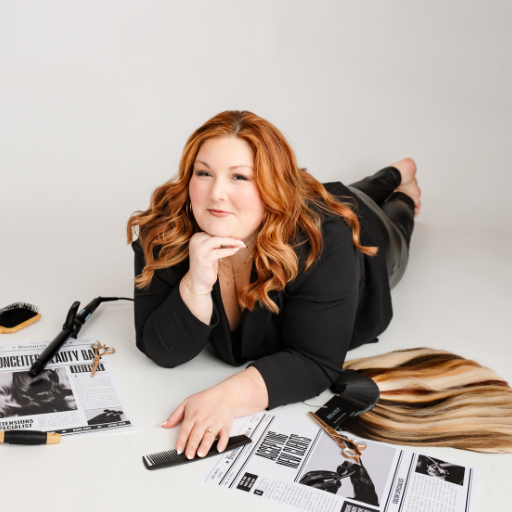
I'm Brooke Chhina, a licensed cosmetologist, cosmetology educator, hair restoration specialist, and trichology student (IAT) in Lancaster, PA.
Hormonal Transitions is one of the six contributing causes I built The 6-Cause Restoration Method™ around, and perimenopause sits within that cause.
The important thing to understand is that perimenopausal hair change is rarely one simple process.
Hormonal shifts may be part of the picture.
But female pattern hair loss, telogen effluvium, thyroid concerns, iron deficiency, inflammatory hair conditions, medications, nutrition, and ordinary aging can overlap too.
That is why I do not treat "perimenopause hair" like one diagnosis.
First, the scope
I'm not a physician or dermatologist.
Perimenopause is a medical life stage, and decisions about hormone therapy, prescription medication, nutritional deficiencies, thyroid disease, or other health conditions belong with the appropriate medical provider.
My role is different.
I evaluate the hair and scalp in front of me, identify factors that may be contributing within my scope, determine what cosmetic options the natural hair can currently support, and refer to a physician or board-certified dermatologist when the pattern needs medical evaluation.
My cosmetic restoration work runs alongside medical care, never in place of it.
What perimenopause actually is
Perimenopause is the transition surrounding the end of the reproductive years.
It often begins when menstrual cycles start changing or other menopause-related symptoms appear.
During this transition, ovarian hormone production becomes more variable.
Estrogen levels can fluctuate significantly.
Progesterone patterns change too.
Eventually, menopause is reached.
Menopause itself is confirmed after 12 consecutive months without a menstrual period, assuming there is not another cause for the absence of periods.
The timing varies widely from person to person.
For some women, changes begin in their thirties.
For many, they become more noticeable in their forties.
The average age of menopause in the United States is around 51.
Can perimenopause really change your hair?
Yes.
Research supports that the hormonal transition around menopause can affect the hair follicle and hair shaft.
Women may notice changes in:
density
strand diameter
texture
manageability
growth patterns
visible scalp
the way hair responds to styling
But there is not one universal "perimenopause hair-loss mechanism."
The changes can come from several overlapping processes.
Female pattern hair loss can become more noticeable
One of the most important patterns I look for is female pattern hair loss, or FPHL.
This commonly presents as:
a widening center part
reduced density through the top
more visible scalp at the crown
finer hairs in the affected area
The follicles gradually miniaturize, meaning the hairs they produce become progressively finer and shorter.
AAD notes that widening of the center part is one of the most common early signs of female pattern hair loss in women.
Perimenopause does not automatically mean you have FPHL.
But the hormonal transition can coincide with the time when a genetic pattern becomes more noticeable.
If your thinning looks patterned through the part or crown rather than simply diffuse, that distinction matters.
Diffuse shedding can happen too
Not every woman in perimenopause has patterned thinning.
Some experience more generalized shedding.
That may be related to telogen effluvium, a temporary excessive-shedding pattern that can follow a physiologic or emotional stressor.
Perimenopause often overlaps with other things that can affect the hair cycle:
illness
surgery
significant weight change
major psychological stress
medication changes
poor nutrition
sleep disruption
another hormonal transition
So you may have a temporary shed layered on top of a slower density change.
That is one reason the hair can seem to change very quickly even when another process has been developing gradually.
The hair shaft itself may change
Sometimes the biggest complaint is not:
"I'm losing handfuls of hair."
It is:
"My hair just isn't the same anymore."
You may notice that the strands feel:
finer
drier
less resilient
more difficult to style
different in texture
Research on menopause-related hair changes describes reductions in hair caliber and density as well as texture changes during the hormonal transition.
That means you can have a meaningful cosmetic change even if you are not experiencing dramatic shedding.
What about androgens?
You will often hear perimenopausal hair loss explained as:
"Estrogen drops, so testosterone takes over."
That is an oversimplification.
Androgens do matter in female pattern hair loss, especially in genetically susceptible follicles.
But many women with FPHL do not have abnormally high blood androgen levels.
The follicle's sensitivity and the broader hormonal environment matter too.
So I do not assume that a wider part means you have "too much testosterone."
That is a medical question, and it requires more than looking at a scalp.
Thyroid issues can overlap
Thyroid disease can also affect the hair.
Symptoms of thyroid dysfunction can overlap with symptoms people attribute to perimenopause, including fatigue, weight changes, temperature sensitivity, and hair changes.
That is why unexplained or prolonged shedding sometimes deserves a medical workup rather than automatically being labeled hormonal.
Iron and ferritin can matter
Heavy or irregular bleeding during perimenopause can contribute to iron deficiency in some women.
Ferritin reflects stored iron and may be relevant when a physician is evaluating diffuse hair shedding.
That does not mean every woman with thinning hair needs iron supplements.
Iron supplementation should be based on actual medical need.
If your doctor thinks bloodwork is appropriate, ask whether thyroid testing and ferritin should be included rather than assuming a standard panel covers everything relevant to hair shedding.
Your physician can determine which tests make sense based on your history and symptoms.
How perimenopausal hair changes can show up
There is no one pattern.
A widening part or thinner crown
This can suggest female pattern hair loss and deserves a closer look, especially if the change is progressive.
Diffuse loss of volume
Your whole head may feel less dense without one obvious area being dramatically worse.
A thinner ponytail
Sometimes the first thing you notice is simply less mass through the lengths.
Changes at the temples or hairline
Some women notice reduced density through the temples or front.
That can occur for several reasons.
A noticeably receding hairline, eyebrow loss, scalp symptoms, or an unusual pattern deserves dermatologic evaluation because conditions such as frontal fibrosing alopecia can also occur around and after menopause.
A change in texture
The number of hairs may not seem dramatically different, but the hair feels finer or behaves differently.
That still counts as a real hair change.
When I want you to see a doctor or dermatologist
I would involve a physician or board-certified dermatologist if:
the thinning is sudden or rapidly progressing
your center part continues to widen
the crown becomes increasingly visible
you develop defined bald patches
your hairline noticeably recedes
you lose eyebrow hair
your scalp burns, hurts, itches, scales, or looks inflamed
you are shedding heavily and it is not improving
you have significant fatigue, temperature sensitivity, or other systemic symptoms
you have heavy or irregular bleeding and are concerned about iron status
you have a strong family history of female pattern hair loss
the pattern simply does not make sense to you
Not every one of these signs means something serious.
They mean the pattern deserves evaluation instead of guessing.
What actually helps?
The answer depends on what is causing the change.
There is no one universal "perimenopause hair fix."
Medical evaluation when appropriate
If the pattern suggests female pattern hair loss, thyroid disease, iron deficiency, inflammatory hair loss, or another medical issue, the most useful step may be getting the correct diagnosis.
That can matter far more than changing shampoo.
Adequate nutrition
Hair growth depends on adequate energy and nutrients.
Protein, iron, and overall nutritional intake matter.
But I do not recommend chasing arbitrary supplement targets without knowing whether there is actually a deficiency or need.
Gentle hair care
Hair that is finer or less dense may be less forgiving of repeated mechanical stress.
I recommend:
avoiding consistently tight hairstyles
detangling gently
using heat thoughtfully
minimizing unnecessary friction
keeping the scalp clean
choosing products based on the actual hair and scalp rather than menopause marketing
Updating the haircut and styling strategy
Sometimes the hair you have now simply needs a different shape than the hair you had ten years ago.
That might mean:
changing the length
altering the part
adding strategic movement
using color placement to create dimension
adjusting styling products
choosing a shape that makes the density look fuller
That is cosmetic, but it can make a significant difference.
What I would not overpromise
I would be cautious with anyone promising that one serum, supplement, scalp massage, shampoo, or lifestyle habit will reverse "menopause hair loss."
Scalp care can absolutely support comfort and hair manageability.
Good nutrition matters.
Sleep and overall health matter.
But those things do not replace diagnosis when the issue is female pattern hair loss, thyroid disease, iron deficiency, or a scarring or inflammatory alopecia.
And they do not guarantee regrowth.
Where cosmetic hair restoration fits
Some women navigate perimenopausal hair changes with haircut adjustments, medical care, and styling changes alone.
Others reach a point where the visible density change is affecting them every day.
That is where cosmetic restoration becomes a reasonable conversation.
The method depends on the problem we are trying to solve.
When extensions may make sense
Hair extensions add length and fullness through existing hair.
They may be appropriate when the natural hair is stable enough and there is sufficient support hair in the areas where the extensions would be placed.
If your main concern is a thinner perimeter, less volume through the lengths, or loss of fullness, extensions may help.
I do not select the method simply because you're in perimenopause.
I select it based on the actual hair.
When a custom topper may make more sense
If your primary concern is visible scalp through the part, crown, top, or another targeted area, extensions may not address what you actually see in the mirror.
A custom hair topper provides targeted coverage.
The topper is the actual hairpiece.
It may be constructed with lace, HD lace, or another appropriate base depending on the coverage area, desired finish, comfort, and cosmetic plan.
When an installed topper is appropriate, it may be supported by Mesh Integration or Meshless Integration.
Mesh Integration
With Mesh Integration, breathable mesh is laid over the appropriate area.
Natural hair is carefully fed through the mesh and secured with beads through or on the mesh foundation.
The custom topper is then sewn onto the completed foundation.
Mesh may be considered when additional foundation structure is appropriate for the natural hair available.
Meshless Integration
Meshless Integration does not use a mesh layer.
Instead, a customized beaded-only foundation is created using natural hair with sufficient structural strength to support the system.
The custom topper is then sewn onto that completed foundation.
Neither foundation is automatically "for more advanced hair loss."
The choice depends on:
support hair
structural strength
coverage area
comfort
lifestyle
maintenance
cosmetic goals
Extensions and toppers can also work together
Some women have two different cosmetic concerns.
They need targeted coverage through the top and want more length or fullness through the rest of the hair.
In that case, a restoration plan may combine a custom topper with extensions.
Again, the method comes after the assessment.
Why I don't use clip-in toppers
I do not use clip-in toppers or snap-on hairpieces in my cosmetic restoration work.
Clips repeatedly load small attachment areas.
Repeated tension can begin as a potentially reversible, non-scarring process but may become permanently scarring when tension continues over time.
That does not mean every person who wears a clip-in will develop traction alopecia.
It means I prefer to intentionally plan and reassess how an installed system is supported.
A few things I want you to know
You do not need to assume every hair change is "just aging."
Midlife can absolutely change the hair.
It can also be the point when another hair-loss condition becomes more visible.
Those are not the same thing.
You are allowed to care about your hair.
Hair affects how many women recognize themselves.
Wanting to understand why it changed or wanting cosmetic coverage does not make the concern trivial.
You do not need to choose between medical care and cosmetic restoration.
They solve different problems.
Your medical provider handles diagnosis and treatment.
I handle cosmetic coverage and hair design when your hair can appropriately support it.
If this sounds like your hair
If you're noticing a wider part, thinner crown, smaller ponytail, texture changes, or an overall loss of density during perimenopause, The Discovery is where I begin.
The Discovery is an in-studio consultation and the first step in The 6-Cause Restoration Method™.
I review:
your hair history
visible density pattern
scalp
shedding history
natural hair available for support
structural strength
areas where you want more length, fullness, or coverage
lifestyle
maintenance preferences
cosmetic goals
other factors that may be contributing to what you're seeing
I identify what may be contributing within my scope and tell you when something belongs with a physician or dermatologist first.
From there, I create your personalized Restoration Roadmap.
Your Roadmap may include:
a custom hair topper with Meshless Integration
a custom hair topper with Mesh Integration
hair extensions if length or fullness is the primary goal
a combination of topper-based restoration and extensions
a cosmetic hair-care plan while your natural hair changes
a recommendation to see a dermatologist first and return to me afterward
Your Restoration Roadmap is sent to your phone and is yours to keep whether or not you continue with me.
Sometimes the answer is a haircut and a different styling strategy.
Sometimes it is medical evaluation.
Sometimes it is extensions.
Sometimes it is a custom topper.
Sometimes it is a combination.
The point is to understand what your hair actually needs before choosing the method.
If you're in Lancaster, PA, or traveling in for cosmetic hair restoration, Begin Your Discovery.
I work by application only.
I'm Brooke Chhina, a licensed cosmetologist, cosmetology educator, hair restoration specialist, and trichology student (IAT) in Lancaster, PA, and the creator of The 6-Cause Restoration Method™. I'm not a medical doctor. For diagnosis or treatment of medical conditions affecting your hair, scalp, or general health, please consult a licensed physician or board-certified dermatologist. Cosmetic hair restoration runs alongside medical care, never in place of it.
Conceited Beauty Bar · Sola Salons Studio 9A · 1500 Gilbert Way, Lancaster, PA 17601
Crowned in Confidence · Your Beauty, Elevated.