How to Hide Thinning Hair Naturally: 8 Ways to Create Fuller-Looking Hair
Table of Contents
- Thinning hair can change the way your hair looks, moves, and feels, but that does not always mean the first answer should be more hair.
- 1. Start With an Honest Assessment of Your Hair
- 2. Use Haircut Shape to Create the Illusion of Fullness
- 3. Use Dimensional Color Strategically
- 4. Create Volume Without Overworking the Hair
- 5. Consider a Hair Topper When You Need More Top-of-Head Coverage
- 6. Understand the Difference Between a Topper and a Lace Closure
- 7. Consider Extensions Only When the Natural Hair Can Support Them
- 8. Know When Mesh Integration or Meshless Integration Belongs in the Plan
- When Styling Alone May Be Enough
- When Medical Evaluation Matters
- Hair Thinning During GLP-1 Use or Hormonal Changes
- The Goal Is Fuller-Looking Hair Without Forcing the Hair
- Frequently Asked Questions
Last Updated: September 29, 2026
Thinning hair can change the way your hair looks, moves, and feels, but that does not always mean the first answer should be more hair.
Sometimes the biggest visual difference comes from changing the haircut, color placement, part, or styling.
Other times, cosmetic coverage such as a topper, extensions, Mesh Integration, or Meshless Integration may make more sense.
I am Brooke Chhina, a licensed cosmetologist, cosmetology educator, and trichology student with 17 years behind the chair. At Conceited Beauty Bar in Lancaster, PA, I work with women experiencing fine, thinning, or changing hair and help them build cosmetic plans around the hair they actually have.
The question I come back to again and again is:
What can your hair safely carry?
That question matters whether we are talking about a haircut, extensions, a topper, or a broader cosmetic hair restoration plan.
1. Start With an Honest Assessment of Your Hair
Before choosing a haircut, extension method, topper, or other cosmetic solution, I look at the hair that is physically present.
I consider:
- Current density
- Strand thickness
- Hair condition
- Scalp condition
- Where the scalp is most visible
- Where fullness is actually needed
- How quickly the density has been changing
- Lifestyle
- Maintenance
- Desired result
Thinning hair does not look the same on everyone.
One client may notice a wider part.
Another may feel like her ponytail has become smaller.
Another may have good density through the back but less coverage through the crown.
Another may be navigating changes after a hormonal transition, medication change, weight loss, or another shift in her health.
The cosmetic plan should be based on what the hair looks like now, not on a method someone saw online.
My philosophy is simple:
The method gets fitted to your natural hair, never the other way around.
2. Use Haircut Shape to Create the Illusion of Fullness
Haircut shape can change how full the hair appears, but the right approach depends on where density has changed and how the hair naturally falls.
For some clients, maintaining a stronger perimeter helps the ends look fuller.
For others, carefully placed layers can create movement without removing too much visual density.
I look at:
- Where the hair appears most transparent
- How much density remains through the perimeter
- Natural texture
- Overall length
- Part placement
- Styling routine
Part placement can also make a noticeable difference.
A slightly different part, softer part line, or less defined separation may reduce how much scalp is visible in certain areas.
The goal is not to follow a universal “thin-hair haircut.”
It is to create a shape that makes the most of the density you already have.
No haircut creates hair that is not there.
It changes how the density you do have is shaped, distributed, and seen.
3. Use Dimensional Color Strategically
Color can influence how full hair appears because placement, contrast, and dimension affect how the eye sees the overall shape.
For some clients, dimensional color helps create movement and keeps the hair from looking visually flat.
For others, keeping the scalp and root area from having an extreme contrast with the hair can make density changes feel less obvious.
I plan color around:
- Natural base color
- Existing density
- Hair condition
- Where the scalp is most visible
- Desired maintenance
- How much lightening the natural hair can reasonably tolerate
The most important part is protecting the condition of the natural hair.
If the hair is already fine, fragile, or compromised, I adjust the color plan rather than forcing a dramatic transformation that asks too much of it.
Dimensional color should support the overall plan, not become another source of stress for the hair.
4. Create Volume Without Overworking the Hair
Styling can create temporary fullness without adding hair at all.
For fine or thinning hair, I usually think about:
- Creating lift at the root
- Keeping heavy products away from areas that collapse easily
- Using heat protection
- Avoiding unnecessary pulling or repeated tension
- Styling the part in a way that softens visible scalp
- Choosing products that create movement without weighing the hair down
A round brush, root-lifting product, rollers, or changing the direction in which the hair dries may help create more volume.
The goal is not to force fine hair into a shape it cannot maintain.
It is to work with the texture you already have.
5. Consider a Hair Topper When You Need More Top-of-Head Coverage
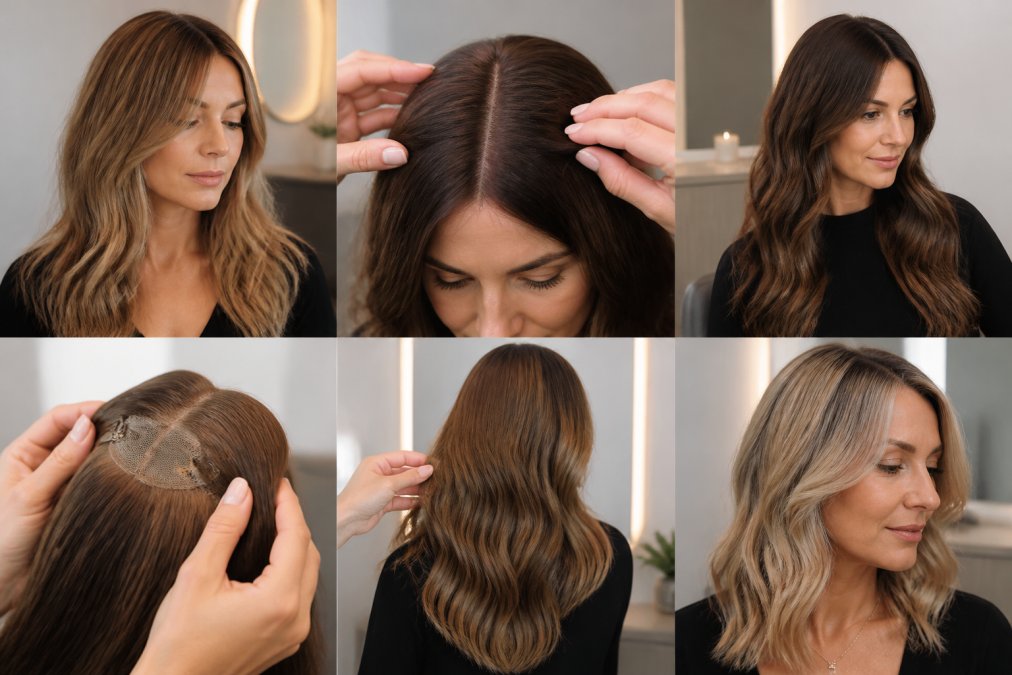
A hair topper may make sense when the primary coverage need is through the part, crown, or top of the head and there is enough surrounding natural hair to create the desired blend.
If most of the change is showing up through the crown or part, especially during perimenopause, I also have a deeper guide on hair toppers for perimenopause and crown thinning.
A topper is a hair component.
Most traditional toppers are removable, clip-on and clip-off pieces that are worn over the top of the head.
Common topper base constructions include:
- Monofilament
- Silk
- Silicone
The right topper depends on:
- Coverage area
- Base size
- Density
- Part placement
- Color
- Texture
- Length
- How much natural hair remains visible around the piece
- Lifestyle
- How the client wants to wear and maintain it
More hair is not automatically better.
A topper that is dramatically denser than the surrounding natural hair can make the transition more noticeable rather than less.
The goal is believable coverage.
6. Understand the Difference Between a Topper and a Lace Closure
A topper and a lace closure are both hair components, but they are not the same thing.
Hair Component | Typical Construction | Primary Role |
|---|---|---|
Topper | Commonly monofilament, silk, or silicone | Removable top-of-head coverage through the part, crown, or upper area |
Lace Closure | Lace | Top-of-head coverage designed around the part or crown area |
A topper is typically a removable clip-on and clip-off piece.
A lace closure is a lace-based top-of-head coverage piece.
The exact parting flexibility depends on the construction of the individual piece.
Neither one is an installation method.
That distinction becomes especially important when we start talking about Mesh Integration and Meshless Integration.
7. Consider Extensions Only When the Natural Hair Can Support Them
Extensions can create beautiful fullness, but only when the natural hair has enough density and strength to support the planned weight, placement, and attachment method.
That is the question I start with before I recommend any extension method:
What can your hair safely carry?
I look at:
- Density at the attachment area: Is there enough natural hair in that area to support added weight?
- Strand condition: Is the natural hair strong enough to support an attachment there?
- Hair and scalp condition: Are there signs that the area needs a more conservative plan?
- Placement needs: Where is fullness actually needed?
- Lifestyle and maintenance: Does the method fit how you wear, wash, and care for your hair?
Different extension methods give me different options for placement and weight distribution, but no method is automatically appropriate just because the hair is fine.
K-tip extensions use individually placed attachments, which gives me a high level of control over placement, attachment size, and the amount of hair added in each area.
Weft extensions create broader fullness across a row and can work well when there is enough natural density to support the planned placement.
Tape-ins use flat extension panels and may be appropriate for certain density patterns when the attachment area can comfortably support them.
I-tips use individual beaded attachments and also give me flexibility in where added hair is placed.
The goal is never to fit the client into a favorite extension method.
The method has to fit the natural hair.
Too much weight, tension, or inappropriate placement can place unnecessary stress on already limited natural hair.
If I do not believe extensions are the right choice for the hair in front of me, I will recommend a different cosmetic plan instead.
8. Know When Mesh Integration or Meshless Integration Belongs in the Plan
Mesh Integration and Meshless Integration are installation methods.
They are not hair pieces.
The actual hair used within a cosmetic restoration plan may include:
- Extensions
- A topper
- A lace closure
- A full lace unit
- Or a combination of hair components
For example, a topper may be installed through Meshless Integration.
In that situation, the topper is the hair component and Meshless Integration is the installation method.
Mesh Integration uses a mesh-based foundation to create the installation.
Meshless Integration creates the installation without that traditional mesh foundation.
I do not choose between them because one sounds newer or more advanced.
I choose the method based on:
- Current density
- Coverage needs
- Hair and scalp condition
- Lifestyle
- Maintenance
- Desired result
- What the natural hair can safely support
This is where my cosmetic hair restoration work overlaps with extensions, toppers, and other hair components.
When Styling Alone May Be Enough
Sometimes a haircut, color adjustment, part change, or better styling approach creates the amount of visual fullness someone wants.
If that is enough, there may be no reason to add hair.
That is important.
More complicated does not automatically mean better.
If styling alone does not create enough coverage, then I may begin looking at:
- A topper
- Extensions
- A lace closure
- A full lace unit
- Mesh Integration
- Meshless Integration
- Or a combination of approaches
The right plan depends on how much coverage is needed and what the natural hair can reasonably support.
When Medical Evaluation Matters
There are also times when the medical side needs attention.
I recommend involving a dermatologist or appropriate medical provider when hair loss is:
- Persistent
- Progressive
- Patchy
- Painful
- Associated with burning or itching
- Accompanied by redness or scaling
- Changing rapidly
- Otherwise unexplained
My role is cosmetic planning.
I can evaluate the density, condition, coverage needs, and what the natural hair can safely support.
I do not diagnose or treat the underlying cause of hair loss.
A dermatologist or appropriate medical provider can evaluate whether an underlying medical condition is contributing to the hair changes.
Cosmetic planning can then run alongside appropriate medical care.
Hair Thinning During GLP-1 Use or Hormonal Changes
Some women begin noticing changes in density during periods of significant physical or hormonal change.
That may include women navigating hair thinning during GLP-1 use, hormonal transitions, postpartum changes, menopause, or other shifts.
Those situations do not automatically tell me what is causing the hair change.
They give me context.
Through my 6-Cause Restoration Method™, I look at the larger picture while staying within my cosmetic scope.
I consider the context of the hair change, what the client has noticed, how long it has been happening, whether she is already under medical care, what the hair looks like now, and what she wants cosmetically.
From there, I determine what the hair can safely support and whether cosmetic coverage makes sense now or later.
The goal is not to diagnose the cause.
The goal is to create a thoughtful cosmetic plan around the hair that is present today.
The Goal Is Fuller-Looking Hair Without Forcing the Hair
There is no single answer for how to hide thinning hair naturally.
For one woman, the answer may be a stronger haircut and dimensional color.
For another, it may be a different part and more intentional styling.
Another may need a removable topper.
Another may be able to wear extensions safely.
Another may need a topper installed through Meshless Integration.
Another may need a broader Mesh Integration plan using different hair components.
And sometimes the right answer is to wait.
The goal is not to hide hair loss at any cost.
It is to create believable fullness and coverage while respecting the natural hair that is still there.
At Conceited Beauty Bar, every plan starts with the same question:
What can your hair safely carry?
Start Your Inquiry to explore which cosmetic approach may make sense for your hair.The goal is not to hide hair loss at any cost. It's believable coverage that respects the natural hair you still have. Sometimes that's a haircut. Sometimes it's a topper fitted through meshless integration. The right answer depends on your density, not on a trend.
Frequently Asked Questions
What are the best hairstyles for thinning hair?
There is no single haircut that works for every person with thinning hair. The goal is usually to preserve visual density where the hair is most transparent while creating a shape that complements the client’s texture and natural movement. For some clients, that means maintaining a stronger perimeter. For others, carefully placed layers or a change in part placement can create more fullness. The right haircut depends on where density has changed, hair texture, length, and styling routine.
How can I make my hair look thicker without medical treatments?
Cosmetic approaches focus on visual fullness and coverage, not regrowth. A strategic haircut, dimensional color, part placement, and gentle volume techniques may make the hair appear fuller. When styling alone does not create enough coverage, a topper or another hair component may be considered. Traditional extensions may also be appropriate when the natural hair has enough density and strength to support them. Every option should be planned around the hair that is actually present.
What is the difference between a hair topper and a lace closure?
A topper is typically a removable clip-on and clip-off top-of-head piece, commonly constructed with monofilament, silk, or silicone. A lace closure is a lace-based top-of-head coverage piece designed for the part or crown area. Both are hair components, not installation methods. A topper may also be installed through Meshless Integration as part of a cosmetic restoration plan.
What is the difference between a topper and Meshless Integration?
A topper is the hair component. Meshless Integration is the installation method. A topper may remain completely removable, or it may be installed through Meshless Integration depending on the client’s cosmetic restoration plan. They are not competing versions of the same thing.
Can I wear hair extensions if my hair is thinning?
Possibly. Thinning hair does not automatically rule out extensions. I look at how much natural hair is available in the attachment areas, strand condition, density, hair and scalp condition, desired placement, and how much weight each area can reasonably support. If extensions would ask too much of the natural hair, I recommend a different cosmetic approach.
When should I see a dermatologist for hair thinning?
I recommend medical evaluation when hair loss is persistent, progressive, patchy, painful, rapidly changing, unexplained, or accompanied by symptoms such as itching, burning, redness, or scaling. My role is cosmetic. A dermatologist or appropriate medical provider can evaluate whether an underlying medical condition is contributing to the hair changes. Cosmetic planning can run alongside that care.
What if styling is no longer enough to hide my thinning?
If haircut, color, part placement, and styling no longer create the amount of coverage you want, I may begin looking at added-hair options. That could include a removable topper, extensions, a lace closure, a full lace unit, Mesh Integration, Meshless Integration, or a combination depending on the coverage needed and what the natural hair can safely support.