Hair Loss Solutions for Women: A 2026 Guide
Table of Contents
- Understanding Hair Loss Patterns in Women
- When to See a Dermatologist Before Pursuing Cosmetic Coverage
- Comparing Hair Loss Solutions for Women
- Protecting Your Existing Hair Before Adding Anything
- Hair Loss After Weight Loss and GLP-1 Shedding
- Hormonal Transitions, Genetics, and Autoimmune Contexts
- Choosing Hair Extensions for Thinning Hair
- Hair Toppers for Thinning Hair
- How to Choose a Hair Topper
- What Mesh Integration Is Designed For
- Meshless Integration
- Trichotillomania Recovery and Patchy Density Coverage
- When Waiting or Avoiding Added Hair Is the Better Choice
- Medical Care and Cosmetic Planning Are Two Different Lanes
- Frequently Asked Questions
Last Updated: September 25, 2026
Hair loss solutions for women are not one product, one treatment, or one appointment.
For one woman, the next step may be a dermatologist. For another, it may be protecting the hair she currently has while shedding stabilizes. For someone else, the cosmetic plan may involve traditional extensions, a topper, a lace closure, a full lace unit, or another hair component installed through Mesh Integration or Meshless Integration.
The important part is knowing which problem you are actually trying to solve and how the hair needs to be installed.
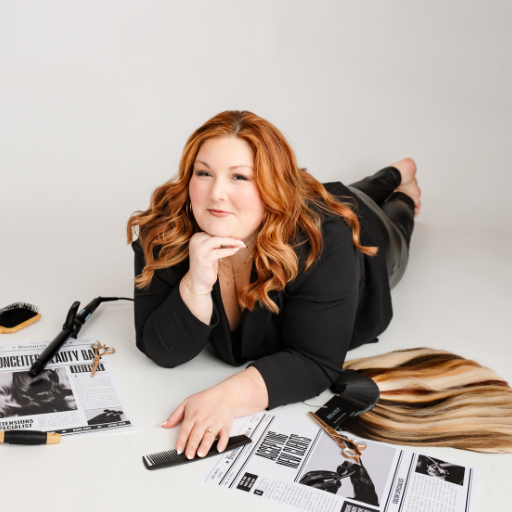
I am Brooke Chhina, a licensed cosmetologist, cosmetology educator, and trichology student. At Conceited Beauty Bar in Lancaster, Pennsylvania, I work with women experiencing fine, thinning, changing, or hair-loss-affected hair and help them understand which cosmetic options may fit the hair they have right now.
My role is not to diagnose why your hair is changing.
My role is to assess your current density, hair condition, scalp, coverage needs, lifestyle, and goals so I can determine what your hair can safely carry and where coverage needs to come from.
Understanding Hair Loss Patterns in Women
Hair loss does not always look the same.
Diffuse shedding throughout the scalp is different from a gradually widening part. Concentrated thinning through the crown is different from smooth patches. Hair that has broken from repeated chemical or mechanical stress creates a different cosmetic problem than hair that has shed from the root.
Those differences matter because they affect whether the next step should be medical evaluation, cosmetic coverage, or both.
Some commonly discussed patterns and contexts include:
- Telogen effluvium, which can present as increased diffuse shedding after a significant physical stressor
- Genetic or pattern hair thinning, which often develops more gradually
- Autoimmune hair-loss conditions, which require medical evaluation and management
- Hormonal transitions, including perimenopause, menopause, and postpartum changes
- Hair changes associated with significant weight loss or medication use
- Mechanical or chemical damage
- Trichotillomania and uneven regrowth during recovery
These are contexts I discuss with clients. They are not diagnoses I make in the studio.
A physician or dermatologist determines the medical cause of hair loss. I look at what is physically present and determine how cosmetic coverage can be designed around it.
If shedding is active or density is changing quickly, I become much more conservative about adding weight or attachment points until I understand what the hair can safely support.
Assessment comes first.
When to See a Dermatologist Before Pursuing Cosmetic Coverage
There are times when cosmetic planning should not be the first step.
I recommend involving a dermatologist or appropriate medical provider when hair loss is persistent, progressive, painful, patchy, unexplained, or accompanied by significant scalp symptoms.
That can include:
- Sudden or rapid shedding that continues
- Smooth or expanding bald patches
- Scalp pain or tenderness
- Burning or persistent itching
- Redness or scaling
- Progressive widening of the part
- Recession around the hairline
- Hair loss that begins after a medication change
- Hair loss accompanied by other significant physical symptoms
Medical diagnosis and treatment belong with a physician or dermatologist.
Cosmetic planning belongs with me.
Those two lanes can absolutely exist at the same time.
A diagnosis does not instantly restore density, and cosmetic coverage does not treat the underlying medical condition. Many women need support from both sides while their hair changes.
Comparing Hair Loss Solutions for Women
There is no single cosmetic hair loss solution that is right for every woman.
It helps to separate the plan into three different decisions.
Part of the Plan | Examples | What It Addresses |
|---|---|---|
Hair component | Topper, lace closure, full lace unit, extensions | Creates coverage, fullness, length, or density |
Installation method | Traditional extension installation, Mesh Integration, Meshless Integration | Determines how the hair is attached, supported, and incorporated |
Medical care | Dermatologist or physician evaluation | Diagnoses and treats medical hair or scalp conditions |
A topper is a hair piece.
Mesh Integration and Meshless Integration are installation methods.
For example, a topper may remain a removable clip-on and clip-off piece, or it may become the hair component installed through a Meshless Integration.
A lace closure, full lace unit, extensions, or a combination of hair components may also be used depending on the coverage plan.
Medical evaluation addresses a completely different question: why the hair may be changing in the first place.
That distinction matters because choosing the hair and choosing how that hair should be installed are two separate parts of the planning process.
Protecting Your Existing Hair Before Adding Anything
Before I think about adding hair, I think about protecting what is already there.
Extension and restoration planning is not determined by one factor.
I look at:
- Natural density
- Strand strength
- Hair condition
- Scalp condition
- Attachment location
- Weight
- Tension
- Placement
- Attachment size
- Lifestyle
- Maintenance requirements
- Home care
- Whether the density is stable or still changing
My philosophy is simple:
The method gets fitted to your natural hair, never the other way around.
Some women have enough stable density to support traditional extensions.
Some need a lighter or more strategically placed approach.
Some need coverage through the crown rather than additional length through the ends.
And sometimes the safest recommendation is to add nothing yet.
The goal is never to attach the maximum amount of hair possible.
The goal is to create the fullness or coverage you want without asking your natural hair to carry more than it reasonably should.
Hair Loss After Weight Loss and GLP-1 Shedding
Significant weight loss is one recognized trigger for excessive shedding, and some women using GLP-1 medications report increased shedding during periods of weight change.
I want to be careful with the distinction here.
I do not determine whether Ozempic, Wegovy, another medication, weight loss, nutrition, hormones, or another factor caused someone's shedding.
That belongs with the medical provider managing her care.
From a cosmetic standpoint, I am looking at different questions:
- Is the hair still actively shedding?
- Has the overall density changed?
- Where has the density changed most?
- Is the crown becoming more visible?
- Has the ponytail become smaller?
- Is there enough stable hair available to support an attachment?
- Would a coverage-based option make more sense right now?
Sometimes traditional extensions still make sense.
Sometimes a topper may make more sense when the primary need is coverage through the part, crown, or top of the head. Depending on the overall plan, that topper may remain removable or may be installed through Meshless Integration.
Sometimes the most appropriate plan is simply to wait and reassess as the shedding changes.
If you are specifically navigating shedding while using a GLP-1 medication, you can also read my guide, Does Hair Grow Back After Ozempic?, for a deeper look at recovery and cosmetic options during that process.
Hormonal Transitions, Genetics, and Autoimmune Contexts
Different hair-loss contexts can create very different cosmetic needs.
A woman experiencing diffuse density changes may need something completely different from someone whose thinning is concentrated through the part or crown.
Someone with isolated patches may need another approach entirely.
That is why I do not choose a cosmetic method based on a diagnostic label alone.
I look at the actual hair.
Perimenopause and menopause can coincide with noticeable changes in density and texture.
Genetic or pattern thinning may develop more gradually.
Autoimmune hair conditions require medical care and may create very specific areas where cosmetic coverage is needed.
The cosmetic question remains:
Where is the density now, where is coverage needed, and what can the remaining hair safely support?
That is where an individualized consultation matters.
A method that works beautifully for one pattern of thinning may be completely wrong for another.
Choosing Hair Extensions for Thinning Hair
Fine or thinning hair does not automatically rule out extensions.
But it also does not mean every extension method, placement, or amount of added hair is appropriate.
When I consider extensions for lower-density hair, I look closely at:
- How much hair is available in each attachment area
- Strand strength
- Hair condition
- Whether shedding is stable
- Where fullness is actually needed
- How much weight each area can reasonably support
- How the client wears and styles her hair
- The maintenance commitment
Different extension methods distribute added hair differently.
K-Tip Extensions
K-tips allow highly customized placement because each attachment is placed individually.
That flexibility can be helpful when density varies throughout the head or when fullness needs to be added strategically rather than evenly.
Weft Extensions
Wefts create broader density across a row.
They can be beautiful for adding fullness through the mid-lengths and ends when the natural hair has enough stable density to support the planned placement.
Tape-In Extensions
Tape-ins use flat attachment sections and can work well for certain hair types and density patterns.
They are not automatically a fine-hair solution, and they are not appropriate for every thinning pattern.
I-Tip Extensions
I-tips allow individualized placement using small attachment points.
As with every other method, suitability depends on the client's current density, strand condition, desired result, and placement area.
Hybrid Extension Plans
Sometimes one extension method does not solve everything.
A hybrid plan may use one technique through stronger areas and another through areas that need more flexibility or precise placement.
The consultation matters more than the method name.
I have no problem telling someone that extensions are not the right choice for her current hair.
That is not a lost sale.
That is responsible planning.
Hair Toppers for Thinning Hair
A topper is a top-of-head hair piece used to create coverage through areas such as the part or crown.
Most traditional toppers are removable and clip on and off.
Common topper base constructions include:
- Monofilament
- Silk
- Silicone
A lace closure is another type of top-of-head coverage piece, but it uses lace construction and is designed specifically for the part or crown area.
For some women, a removable topper is enough.
For others, a topper may become the hair component installed through Meshless Integration.
The hair piece and the installation method are two separate decisions.
A topper should not look like a separate piece sitting on top of the hair.
Natural blending depends on several factors, including:
- Coverage area
- Base construction
- Density
- Part placement
- Color
- Dimension
- Texture
- Length
- Cut
- How much natural hair remains visible around the piece
When toppers look obvious, common reasons include density that does not match the surrounding hair, a base that does not sit naturally, or color and dimension that do not blend well with the client's own hair.
The goal is not simply to cover an area.
It is to create coverage that makes sense with the hair surrounding it.
How to Choose a Hair Topper
Choosing a topper involves much more than selecting a length and color from a catalog.
I look at three major things first.
Density
The topper density should make sense beside the client's existing hair.
More hair is not always better.
A piece that is dramatically denser than the surrounding natural hair can make the transition more noticeable.
Base and Coverage Area
The topper base needs to cover the area that actually needs coverage while working naturally with the hair that remains around it.
Common topper constructions include:
Monofilament: A common topper construction that can create a natural-looking part area and allow flexibility in how the hair is styled.
Silk: A base construction that can create a realistic scalp appearance through the parting area.
Silicone: A different type of topper foundation with its own fit and wear characteristics depending on the piece and the person wearing it.
A lace closure is different from a traditional topper base. It is a lace-based top-of-head coverage piece designed specifically for the part or crown area.
The right choice depends on the coverage area, part placement, desired density, lifestyle, natural hair, and how the piece will be worn.
Lifestyle
The right topper also has to fit someone's real life.
I consider:
- Styling habits
- Work routine
- Travel
- Exercise
- Washing frequency
- How much maintenance the client wants to do herself
- How often she is comfortable returning for professional care
Priority | What Matters Most |
|---|---|
Natural-looking blend | Density, color, cut, and transition |
Comfortable daily wear | Base construction, fit, and weight |
Easier upkeep | Removal, home care, and professional maintenance needs |
Active lifestyle | Security, durability, and styling routine |
A topper that looks beautiful but does not fit someone's lifestyle is not the right topper.
What Mesh Integration Is Designed For
Mesh Integration is an installation method used when a cosmetic restoration plan requires an integrated foundation for the hair being added.
The hair incorporated into that plan may include:
- Extensions
- A lace closure
- A full lace unit
- Another combination of hair components
Mesh Integration is not the hair itself.
It is the work used to create and support the finished system.
When I consider Mesh Integration, I evaluate:
- Where natural hair remains
- How strong that hair is
- Hair and scalp condition
- Coverage area
- Desired density
- Lifestyle
- Maintenance commitment
- How the finished system will interact with the client's natural hair over time
If the hair cannot safely support the planned system, I change the plan.
Coverage should work with the hair that is growing underneath, not against it.
Meshless Integration
Meshless Integration is also an installation method.
It creates an integrated result without using the same type of traditional mesh foundation used in Mesh Integration.
One example in my work is a topper installed through Meshless Integration.
In that situation:
- The topper is the hair component
- Meshless Integration is the installation method
Other hair components may also be used depending on the coverage plan.
Meshless Integration is not automatically better than Mesh Integration.
Mesh Integration is not automatically better than Meshless Integration.
The choice depends on:
- The location of density loss
- How much natural hair remains
- Hair and scalp condition
- Desired coverage
- Desired finished result
- Lifestyle
- Styling preferences
- Maintenance needs
I do not choose an integration method because one sounds newer or more advanced.
I choose it because it makes sense for the hair in front of me.
Trichotillomania Recovery and Patchy Density Coverage
Trichotillomania recovery can create a very specific cosmetic challenge because density may be uneven and hair can be growing at several different lengths at once.
One area may have established longer hair.
Another may contain shorter regrowth.
Another may still have limited density.
That means coverage cannot be designed the same way I would approach uniform crown thinning or diffuse shedding.
The cosmetic plan has to account for:
- Where stable density remains
- Where regrowth is occurring
- Hair length differences
- Areas that should not carry attachment weight
- How the coverage will blend as the natural hair changes
For clients recovering from trichotillomania, mental-health support should remain part of the overall picture.
Cosmetic coverage may help someone feel more comfortable while the hair changes, but it does not treat the pulling behavior itself.
When appropriate, I encourage clients to continue working with a therapist or other qualified mental-health professional experienced with body-focused repetitive behaviors while I handle the cosmetic side.
Depending on the location and stability of the hair, the cosmetic plan may involve a topper, lace closure, full lace unit, extensions, or another hair component.
That hair may remain removable or may be installed through Mesh Integration or Meshless Integration.
In some cases, waiting is the most appropriate choice.
When Waiting or Avoiding Added Hair Is the Better Choice
Sometimes the most responsible recommendation is no added hair yet.
I may recommend waiting when:
- Shedding is actively and rapidly changing
- Attachment areas do not have enough stable density
- The scalp needs medical evaluation
- The hair is too compromised to comfortably support the desired amount of weight
- The coverage goal would require more than the existing hair should reasonably carry
- I do not yet have enough information to create a responsible long-term plan
Waiting does not mean there is no plan.
It may mean:
- Protecting the natural hair
- Working alongside a dermatologist
- Using temporary cosmetic coverage
- Adjusting styling
- Watching how density changes
- Reassessing later
Sometimes the best thing I can do for someone's hair is not attach anything to it yet.
Medical Care and Cosmetic Planning Are Two Different Lanes
Hair loss solutions for women are not one product or one method.
Sometimes the next step is medical evaluation.
Sometimes it is protecting the hair you currently have.
Sometimes it is carefully designed traditional extensions.
Sometimes the hair component is a topper, lace closure, full lace unit, or another combination of added hair.
Sometimes that hair remains removable.
Sometimes it is installed through Mesh Integration or Meshless Integration.
And sometimes the best plan is to wait.
My role is not to diagnose why your hair is changing.
My role is to understand what is physically in front of me and determine:
What can your hair safely carry?
Where does the coverage need to come from?
Which hair component and installation approach fit your current density, lifestyle, and goals?
That is what I do during The Discovery.
If you are navigating thinning, shedding, or changing density and want to understand your cosmetic options, Start Your Inquiry.
Frequently Asked Questions
When should I see a dermatologist for hair loss?
See a dermatologist or appropriate medical provider when hair loss is persistent, progressive, painful, patchy, unexplained, or accompanied by significant scalp symptoms. Sudden shedding, scalp pain, scaling, or continued loss without improvement can also warrant medical evaluation. Medical evaluation determines whether there is an underlying condition that requires treatment. Cosmetic coverage should not replace that evaluation. When something falls outside the cosmetic scope of my work, I refer the client back to an appropriate medical provider before proceeding.
What is the difference between hair extensions and hair toppers?
Hair extensions add length or fullness by attaching added hair to existing natural hair, so there must be enough stable density to support the planned weight and placement. A topper is typically a removable clip-on and clip-off top-of-head piece used to create coverage through areas such as the crown or part. Common topper base constructions include monofilament, silk, and silicone. A lace closure is another top-of-head coverage piece, but it uses lace construction and is designed specifically for the top or part area. Depending on the restoration plan, a topper may also be installed through Meshless Integration. The right choice depends on where density has changed, how much natural hair remains, desired coverage, lifestyle, and what the hair can safely support.
Can GLP-1 medications cause hair shedding?
Some women using GLP-1 medications report increased shedding, particularly during periods of significant weight change. There can be several possible contributors, and I do not determine whether a medication caused someone's hair loss. A physician or dermatologist can evaluate the medical side. From a cosmetic perspective, I assess the client's current density, determine whether the hair is stable enough to support added weight, and discuss coverage options while the hair changes.
What is mesh integration for hair loss?
Mesh Integration is a cosmetic hair restoration installation method that creates a foundation for added hair when the client needs an integrated coverage plan. The hair installed within that system may include extensions, a lace closure, a full lace unit, or another combination of hair components. Whether Mesh Integration is appropriate depends on the client's natural density, hair and scalp condition, coverage needs, lifestyle, desired result, and maintenance requirements.
What is Meshless Integration?
Meshless Integration is an installation method that creates an integrated cosmetic hair restoration result without using the same traditional mesh foundation used in Mesh Integration. A topper may be installed through Meshless Integration. In that situation, the topper is the hair piece and Meshless Integration is the installation method. Other hair components may also be used depending on the client's individual coverage plan.
How do I know if my hair can support extensions?
That depends on more than whether your hair is fine or thin. I evaluate density, strand strength, hair condition, scalp condition, attachment areas, shedding stability, placement, and how much added weight the natural hair would need to support. Fine hair does not automatically rule out extensions. But not every client is a candidate for traditional extensions. Sometimes the better plan involves a topper or another hair component, sometimes that hair is installed through Mesh Integration or Meshless Integration, and sometimes waiting is the safest choice.
What are the common causes of hair thinning in women?
Women can experience hair changes in many different contexts, including hormonal transitions, genetics and pattern thinning, autoimmune conditions, significant weight changes, medication use, mechanical or chemical damage, and trichotillomania recovery. Those contexts are not diagnoses. A physician or dermatologist determines the medical cause of hair loss. My role is cosmetic planning based on the client's current density, condition, coverage needs, lifestyle, and what her hair can safely carry.