Hair Extensions for Fine Hair: What Actually Determines the Right Method
You've wanted hair extensions for a while.
Maybe you've always had naturally fine hair.
Maybe your hair used to feel fuller and has changed after postpartum shedding, perimenopause, medication changes, chemical processing, or another period of stress.
Maybe you've been told:
"Your hair is too fine for extensions."
Or maybe you've been told the opposite:
"This method is perfect for fine hair."
Neither statement tells me enough.
Fine hair can absolutely be compatible with extensions in some cases.
But the decision depends on far more than strand diameter.
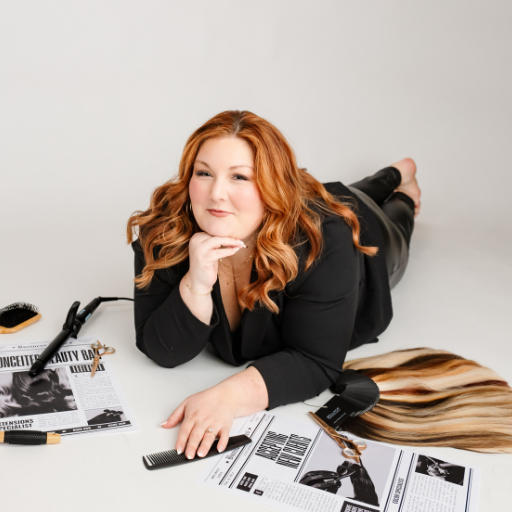
I'm Brooke Chhina, a licensed cosmetologist, cosmetology educator, hair restoration specialist, and trichology student with the International Association of Trichologists (IAT) in Lancaster, PA.
I work with women whose hair is fine, thinning, changing, or recovering, and the question I care about most is not:
Which extension method is best for fine hair?
It is:
What can the natural hair available today appropriately support?
First, the scope
I'm a licensed cosmetologist, cosmetology educator, hair restoration specialist, and trichology student, not a physician or dermatologist.
My trichology education allows me to recognize hair and scalp patterns, understand the science behind many forms of hair change, identify factors that may be contributing to what you're experiencing, and know when something belongs with a medical provider.
It does not allow me to diagnose a medical condition.
If your hair has recently become significantly thinner, more fragile, or more prone to shedding and you do not know why, a physician or board-certified dermatologist may need to be part of the conversation.
My cosmetic hair restoration work can take place alongside medical care, never in place of it.
Fine hair, low-density hair, and fragile hair are not the same thing
These terms get lumped together constantly.
They describe different things.
Fine hair
Fine hair describes the diameter of the individual strand.
You can have very fine strands and still have a lot of hair.
Low-density hair
Density describes how much hair is present in a given area.
Someone can have:
fine hair with high density
fine hair with low density
coarse hair with low density
any combination in between
Fragile hair
Fragile hair refers to hair that has reduced structural integrity and is more vulnerable to breakage.
That may be associated with:
chemical processing
heat
repetitive mechanical stress
overlapping damage
another change in the hair's condition
So when someone tells me:
"I have fine hair."
that is only the beginning of the conversation.
What actually determines whether extensions make sense
I look at several things together.
Natural density
How much hair is available in the area where the extension would be supported?
Fine hair with adequate density may behave very differently from fine hair with significant density loss.
Structural strength
What condition is the natural hair in?
Hair that has been heavily lightened, repeatedly exposed to high heat, or is actively breaking may need a very different plan from fine hair that is structurally healthy.
Current shedding pattern
If your density is changing quickly or you are experiencing substantial active shedding, that matters.
I do not use one universal rule that says extensions are always off-limits during shedding.
But I do need to understand whether the support pattern is stable enough for an installation to make sense.
Placement area
The hair available through the sides and back may be different from the hair at the temples, hairline, or crown.
An extension plan should reflect that.
Desired result
Do you want:
more length
more fullness through the ends
greater overall density
coverage through the crown or part
Those are not the same problem.
And extensions do not solve all of them.
Lifestyle and maintenance
How you wear your hair, style it, care for it, and maintain your extensions all influence the plan.
There is no single "best extension method for fine hair"
I would be cautious of anyone who tells you that one extension method is universally best for fine hair.
Different methods create different attachment patterns.
What matters is how that specific method is customized to the actual hair in front of me.
K-tip extensions
K-tip extensions use individual keratin bonds attached to small sections of natural hair.
One advantage of K-tips is placement flexibility.
Bond size, distribution, density, and placement can be customized.
That can be useful when working with fine hair because I do not have to treat every section of the head the same.
But K-tips are not automatically appropriate simply because the bonds are small.
Each bond still relies on natural hair for support.
I need enough appropriate hair at each placement point.
Weft extensions
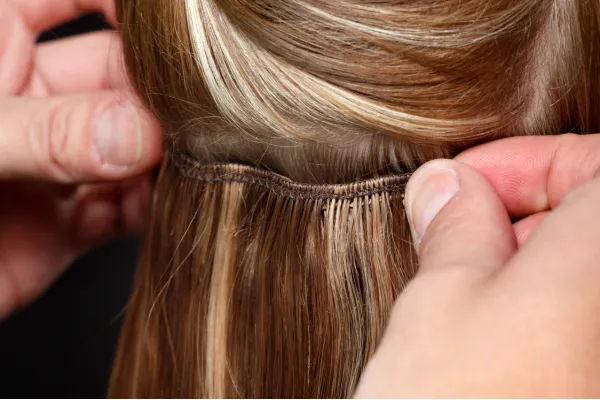
Wefts add hair along rows supported by the natural hair.
For some clients with fine hair, a weft may be appropriate.
For others, it may not be.
I consider:
the hair available to support the row
structural strength
placement
amount of added hair
the cosmetic result we are trying to create
The goal is not to install the maximum amount of hair possible.
It is to create the result the natural hair can appropriately support.
Tape-in extensions
Tape-ins use adhesive panels placed around sections of natural hair.
Like every extension method, they may work for some fine-hair clients and not for others.
The decision depends on the condition, density, placement area, maintenance needs, and individual hair.
I would not choose tape-ins simply because someone has fine hair.
I-tip extensions
I-tips use beads to secure individual extension strands to sections of natural hair.
Again, fine hair does not automatically make them appropriate or inappropriate.
The important questions are:
how much hair is being used for support
how that hair responds to the bead
placement
weight
whether the natural hair remains appropriate for the method over time
What about clip-in extensions or toppers?
I do not work with clip-in toppers or snap-on hairpieces in my cosmetic restoration work.
Clips repeatedly load relatively small attachment areas.
Repeated tension can begin as a potentially reversible, non-scarring process but may become permanently scarring when tension continues over time.
That does not mean every person who uses clip-ins will develop traction alopecia.
It means I prefer systems where the support pattern can be intentionally designed and reassessed.
If you've worn clip-in pieces and noticed breakage, discomfort, or reduced density around the attachment areas, that is worth addressing.
When I may tell you extensions are not the right move yet
A Discovery does not automatically end with an extension recommendation.
Sometimes my answer is:
Not yet.
The hair is actively breaking
If the hair shaft is significantly compromised, adding more mechanical load may not make sense.
Addressing the breakage source may need to come first.
Density is changing quickly
If substantial shedding is still happening and the support pattern is changing, I may recommend waiting and reassessing rather than installing based on a density pattern that is still shifting.
The natural hair available is not appropriate for the method
No extension method can manufacture support hair that is not there.
If the installation would rely on hair I do not believe should be carrying additional weight, I am not going to force the method.
Your main concern is actually coverage
This is one of the biggest distinctions.
Extensions primarily add:
length + fullness through existing hair
They do not create targeted scalp coverage through a visibly thinned crown or widening part.
If coverage is the concern, a custom hair topper may make more sense.
When a custom hair topper may be the better answer
A custom hair topper is the actual hairpiece used to provide targeted coverage.
That might include coverage through the:
crown
part
top
hairline
The topper may be supported by either Meshless Integration or Mesh Integration.
Meshless Integration
Meshless Integration uses a customized beaded-only foundation underneath the custom hair topper.
There is no mesh layer.
The foundation is created using natural hair with enough structural strength to appropriately support the system.
The custom hair topper is then sewn onto that completed foundation.
Mesh Integration
Mesh Integration also uses a custom hair topper.
The difference is the foundation underneath it.
With Mesh Integration:
A breathable mesh is laid over the appropriate area.
Natural hair is carefully fed through the mesh.
That natural hair is secured with beads through or on the mesh foundation.
The custom hair topper is sewn onto the completed mesh-and-beaded foundation.
Mesh Integration may be considered when additional foundation structure is appropriate for the natural hair available.
Neither foundation is automatically better.
The decision depends on:
natural hair available for support
structural strength
coverage area
comfort
lifestyle
maintenance preferences
cosmetic goals
Extensions and toppers can work together
Sometimes the best cosmetic plan is not one or the other.
It may be: a custom topper for coverage + extensions for additional length or fullness
That is especially useful when the top needs coverage but the sides or back still have appropriate hair for extension support.
For another client, extensions alone may be enough.
For another, a topper alone may solve the entire cosmetic concern.
The plan should match the problem.
What I look for before installing extensions on fine hair
I want to know:
how much natural hair is available
where that hair is located
whether the shaft is structurally appropriate
whether the density is stable
whether there is active breakage
whether there is significant shedding
whether the proposed attachment areas make sense
what result you are trying to achieve
how much maintenance you realistically want to manage
That is why I do not choose extension methods from photos or from a sentence like:
"My hair is fine."
Fine describes one characteristic.
It does not describe the entire head of hair.
If this sounds like your hair
If you have fine, thinning, fragile, or changing hair and want to know whether extensions, a topper, or a combination makes sense, Begin Your Discovery.
The Discovery is an in-studio consultation in my private Lancaster, PA studio.
I review:
your hair history
what you've noticed changing and when
visible density
your scalp
structural condition of the natural hair
areas available for support
your desired length, fullness, or coverage
lifestyle
maintenance preferences
cosmetic goals
which contributing causes within The 6-Cause Restoration Method™ may be relevant to your hair story
I do not medically diagnose why your hair has changed.
If something needs medical evaluation first, I will tell you.
From there, I create your personalized Restoration Roadmap and send it to your phone.
Your Roadmap may include:
hair extensions selected around the natural hair available
a custom hair topper with Meshless Integration
a custom hair topper with Mesh Integration
a combination of topper-based restoration and extensions
a cosmetic hair-care plan while your natural hair changes
a recommendation to see your physician or dermatologist first and return to me afterward
Your Restoration Roadmap is yours to keep whether or not you continue with me.
I work by application only.
Having fine hair does not automatically rule extensions in or out.
The right question is: What can the hair you have today appropriately support?
That is where the plan starts.
I'm Brooke Chhina, a licensed cosmetologist, cosmetology educator, hair restoration specialist, and trichology student with the International Association of Trichologists (IAT) in Lancaster, PA, and the creator of The 6-Cause Restoration Method™. I'm not a medical doctor. Medical diagnosis, laboratory testing, prescription medication, and treatment of conditions affecting the hair, scalp, or general health belong with a licensed physician or board-certified dermatologist. My cosmetic restoration work can take place alongside your medical care.
Conceited Beauty Bar · Sola Salons Studio 9A · 1500 Gilbert Way, Lancaster, PA 17601
Crowned in Confidence · Your Beauty, Elevated.