Best Hair Integration Systems for Fine, Fragile Hair
Table of Contents
- What Makes a Hair Integration System Safe for Fine, Fragile Hair
- Mesh Integration for Thinning Hair: Coverage and Weight Distribution
- Meshless Hair Integration: A Lighter Option for Delicate Density
- Custom Hair Toppers for Women: When They Beat a Full Integration System
- Hair Integration System Maintenance: What Keeps Hair Healthy Long Term
- How I Choose Between Systems Without Adding Tension
- What to Ask During a Hair Integration Consultation
- Frequently Asked Questions
Last Updated: October 8, 2026
What Makes a Hair Integration System Safe for Fine, Fragile Hair
The best hair integration systems for fine, fragile hair are the ones built around what your natural hair can safely carry, not around a standard attachment method applied to every head. I'm Brooke, a licensed cosmetologist and cosmetology educator with 17 years behind the chair, and at Conceited Beauty Bar in Lancaster, PA, I've learned that fine, fragile hair needs systems designed specifically for it. Safety comes down to weight, tension, placement, and density matching, assessed before anything is attached.
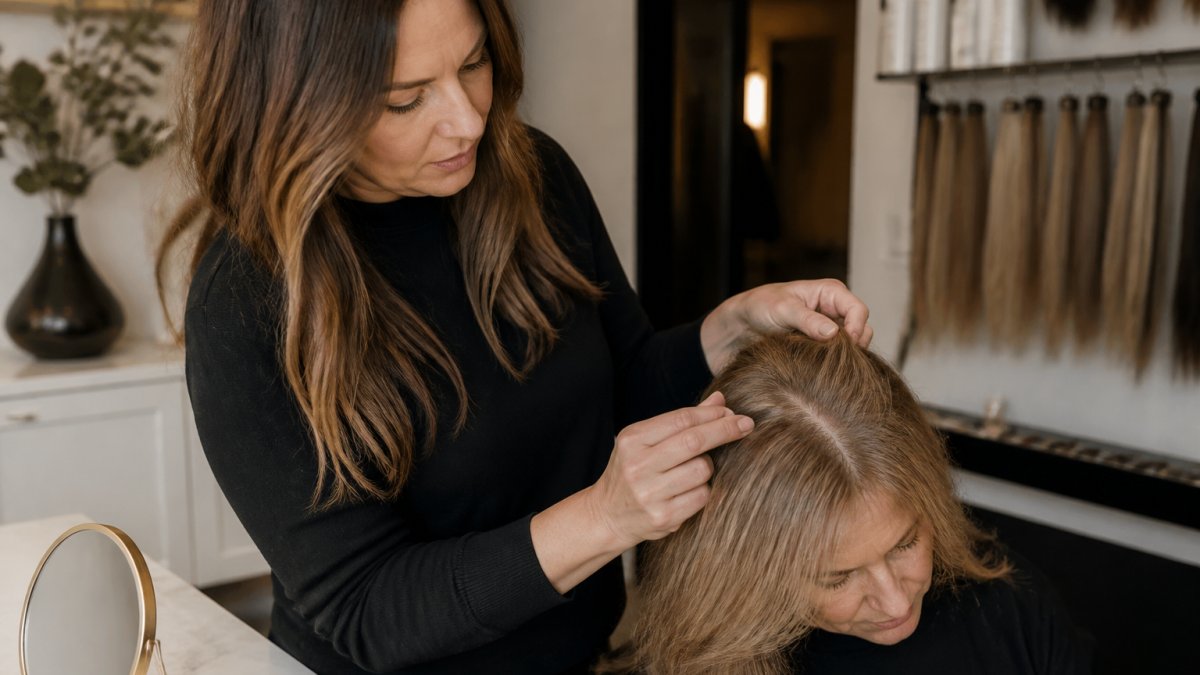
Hair integration systems are cosmetic coverage methods that blend supplemental hair with your own to add density and coverage, using mesh, meshless, or topper formats rather than a full wig. The distinction matters: these are cosmetic tools for coverage and fullness. Diagnosis and medical care belong to physicians and dermatologists.
The Four Factors I Assess Before Recommending Anything
- Weight: how much supplemental hair the natural strands can carry without stress
- Tension: whether attachment points pull at the follicle
- Placement: where coverage is needed versus where hair is strongest
- Density matching: whether the added density looks and behaves like your own hair
Mesh Integration for Thinning Hair: Coverage and Weight Distribution
Mesh integration for thinning hair works by distributing the weight of added hair across a breathable mesh base, which spreads tension instead of concentrating it at a few points. For fragile hair, that distribution is the whole advantage: fewer isolated stress points means less strain on individual strands.
The mesh base sits against the scalp and the natural hair is blended through it, which makes it a strong fit for crown and part-area thinning where coverage needs to look seamless. What most guides miss is that mesh isn't automatically gentler. A heavier density on a mesh base still loads fragile hair. I plan density around what the hair can safely carry.
Meshless Hair Integration: A Lighter Option for Delicate Density
Meshless hair integration skips the mesh base entirely, using a lighter construction for clients whose hair tolerates very little added weight. When density is delicate and the scalp is sensitive, that reduced bulk can make the difference between a system that stays comfortable and one that has to come out early.
Meshless designs tend to suit targeted thinning better than large, diffuse areas, and they demand precise placement to stay secure. I recommend meshless when the priority is lightness over maximum coverage, and mesh when broader coverage is needed and the hair can carry it.
| System | Best For | Weight Feel | Coverage Area |
|---|---|---|---|
| Mesh integration | Crown and part thinning | Distributed across base | Broader |
| Meshless integration | Delicate density, sensitive scalp | Lightest | Targeted |
| Custom topper | Specific thinning zones | Moderate | Localized |
Custom Hair Toppers for Women: When They Beat a Full Integration System
Custom hair toppers for women often beat a full integration system when thinning is concentrated in one zone rather than spread across the whole head. A topper covers a defined area, which means less attachment, less weight, and less daily handling for hair that tires easily.
If your thinning sits at the crown or along the part and the rest of your hair is stable, a topper is frequently the smarter cosmetic plan. It also suits clients who want coverage without committing to a full system, or who travel and need something manageable. I build custom toppers around your density, color, and lifestyle so the result blends rather than sits on top.
Hair Integration System Maintenance: What Keeps Hair Healthy Long Term
Hair integration system maintenance is where long-term hair health is won or lost. Even a perfectly fitted system will stress fragile hair if it's maintained on a schedule built for denser hair. I set maintenance intervals around your growth rate, oil production, and how much tension your hair tolerates, then adjust as we go.
Between appointments, the habits that protect your natural hair are simple: gentle brushing from the ends up, no pulling at attachment points, and keeping heat tools away from the bond or base area. Clients who travel or work long hours need a plan that fits their real week, not an idealized one. If maintenance becomes a burden, the system is wrong for your lifestyle, and I'd rather change the plan than have you fight it.
How I Choose Between Systems Without Adding Tension
Choosing between systems comes down to matching the method to your hair's capacity, not the other way around. I start with an assessment of density, strand quality, scalp condition, and where coverage is actually needed. From there, the method follows.
My rule is simple: if I can't place and weight a system without tension I'm not comfortable with, I don't recommend it. That sometimes means a lighter density than a client pictured, or a topper instead of a full integration. It also means being honest when extensions aren't the right call at all. When a client's natural hair is strong enough for added length as well as coverage, K-tip extensions or weft hair extensions can complement an integration plan, but only where the hair can safely carry them.
What to Ask During a Hair Integration Consultation
A good consultation answers your questions before anything is ordered. Ask how the system will be attached, how much weight it adds, how often it needs maintenance, and what happens if your hair changes. A provider who can't explain the tension and weight plan in plain language isn't planning around your hair.
Ask, too, whether you're a candidate at all. The right answer is sometimes no. I also walk through realistic expectations: coverage and density can be improved cosmetically, but no system regrows hair, and medical questions about shedding or loss belong with your doctor or dermatologist. If you're searching for a hair integration consultation near me in Lancaster, look for a private, one-on-one setting where you can ask these questions without an audience. You can review the American Academy of Dermatology's guidance on hair loss to understand what should be evaluated medically before cosmetic planning begins.
Fine, fragile hair doesn't rule out coverage, but it does rule out one-size-fits-all systems. The challenge is finding a method fitted to your density, tension tolerance, and lifestyle rather than a standard attachment applied to every head. That's the work I do at Conceited Beauty Bar, using my 6-Cause Restoration Method, mesh and meshless integration, and custom toppers to build a plan around what your hair can safely carry. Begin Your Discovery and we'll assess whether an integration system is right for you.
Frequently Asked Questions
What should I ask during a hair integration consultation?
Ask how the provider plans to distribute weight across your natural hair, what tension points the system creates, and how they will protect your existing density. Ask how many of your own strands the attachment area can safely carry, how often maintenance is required, and what the removal process looks like. A consultation-led studio should assess your hair first and tell you honestly whether you are a candidate, rather than fitting the same system to every client.
Can you wear hair extensions if your hair is shedding or thinning?
Sometimes, but not always. It depends on how much density remains, where the thinning sits, and how fragile the strands are. In my studio I assess the hair first and build a cosmetic plan around what it can safely carry. For active shedding, a lighter option such as a custom topper or meshless integration may suit you better than a full weft installation. If your hair is not a candidate, I will say so.
Is meshless integration gentler than mesh integration?
Meshless hair integration skips the mesh base, so it can feel lighter and sit more flatly against the scalp, which many clients with delicate density prefer. Mesh integration for thinning hair spreads weight across a wider base, which can offer more coverage in the crown and part areas. Neither is universally gentler. The right choice depends on how much natural hair you have, where the density loss sits, and how much coverage you want.
Are custom hair toppers a good option for thinning hair?
For many women with thinning at the crown or part, a custom topper is the most protective option because it covers the area without attaching weight to fragile strands. Custom hair toppers for women are matched to your density, color, and part placement, so they blend rather than sit on top. They also suit clients who travel or work long hours, since maintenance is lighter than a full integration system.