7 Ways Hair Extensions and Autoimmune Flare-Ups Connect
Last Updated: October 28, 2026
Quick Summary
Hair extensions are not a treatment for autoimmune conditions, and a physician or dermatologist should evaluate any autoimmune condition before cosmetic planning begins. Stylists can then assess what the natural hair and scalp can safely carry, including adhesives, weight, tension and placement, for any autoimmune flare concerns.
- Hair extensions are not a treatment for autoimmune conditions.
- Ask for a list of all products used during installation and removal.
- Mention any known sensitivities before the appointment.
- Consider the scalp's current condition, whether stable or actively irritated.
- Discuss your plans with your physician before booking.
Table of Contents
- Can Hair Extensions Cause an Autoimmune Flare-Up?
- How Extension Materials and Adhesives Enter the Picture
- Tension, Traction and the Scalp: What to Watch For
- Choosing the Best Hair Extensions for Volume With a Sensitive Scalp
- Factors to Weigh if You Have an Autoimmune Condition
- How My Consultation Process Assesses Scalp Health
- Talking With Your Doctor Before Your Next Appointment
- Frequently Asked Questions
Can Hair Extensions Cause an Autoimmune Flare-Up?
Hair extensions are not a treatment for autoimmune conditions. For women with an autoimmune diagnosis, cosmetic planning should consider what their hair and scalp can safely carry. I'm Brooke, a licensed cosmetologist and cosmetology educator with 17 years of experience. My job is to help you understand what your hair and scalp can safely carry, not to tell you what your body is doing.
A physician or dermatologist should evaluate any autoimmune condition. Cosmetic planning can then consider what your hair can safely carry.
How Extension Materials and Adhesives Enter the Picture
Different methods put different loads on the scalp. Tape-ins use an adhesive, K-tip and I-tip extensions use a bonding element, and weft extensions are sewn onto a braided base. Each one has its own considerations for sensitivity.
Adhesives and bonds are the first things I look at with clients who have a sensitive scalp. Some people react to adhesives, and that reaction is worth discussing before any appointment. Ask about every product that will touch your scalp, including the bonding agent and any removal solvent.
- Ask for a list of all products used during installation and removal.
- Mention any known sensitivities before the appointment.
- Schedule a patch test discussion with your physician if you have a history of reactions.
Tension, Traction and the Scalp: What to Watch For
When considering extensions, weight, tension, placement, and the condition of your natural hair are important factors.
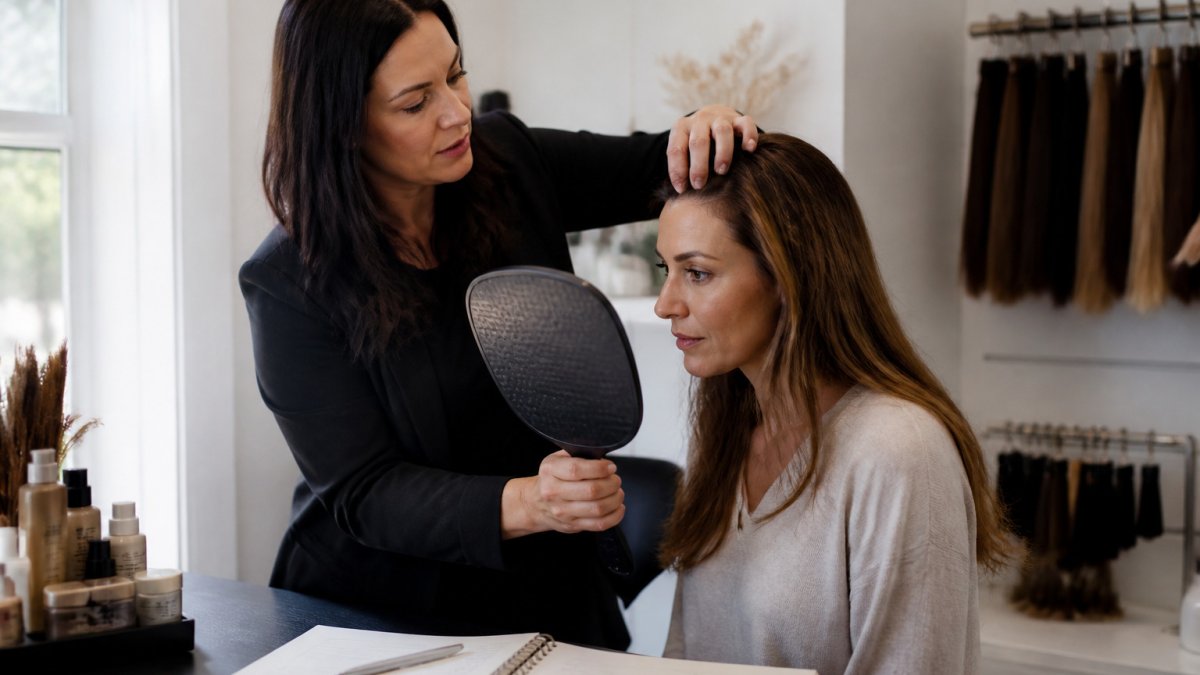
A stylist in a private, softly lit studio gently examining a client's hairline and scalp with a hand mirror, a consultation notebook open on the counter
A physician or dermatologist should evaluate medical concerns.
The article points to several scalp-related factors to keep in mind when extensions are considered.
| Factor | What to consider | Who to involve |
|---|---|---|
| Weight | How much the natural hair can carry | Stylist assessment |
| Tension | Where tension falls on the scalp | Stylist assessment |
| Placement | Where extensions are positioned | Stylist assessment |
| Natural hair condition | Health of the hair being worn with extensions | Stylist and physician |
| Scalp condition | Whether the scalp is stable or irritated | Physician or dermatologist |
Choosing the Best Hair Extensions for Volume With a Sensitive Scalp
When volume is the goal, the method should be fitted to your natural hair and what it can safely carry.
Weft extensions are one option I often discuss. Flexible wefts are sewn onto discreet beaded rows and designed around your natural hair for fullness and length. You can see how weft extensions are designed around fine or thinning natural hair in our Lancaster studio.
A comparison of methods can also help you decide. Compare K-tips, wefts, tape-ins, and I-tips to find the best hair extensions for volume on fine or thinning hair before you book.
Factors to Weigh if You Have an Autoimmune Condition
A physician or dermatologist should evaluate autoimmune conditions. Cosmetic planning can consider your scalp's condition and what your natural hair can safely carry.
Here are the factors I weigh with every client who has an autoimmune diagnosis:
- Current scalp condition: Is the scalp stable, or is it actively irritated?
- Density and weight: How much can your natural hair carry?
- Method and placement: Where does tension fall on the scalp?
- Maintenance: How often will the extensions need adjusting?
- Physician input: Has your doctor reviewed your plans?
Restoration and cosmetic coverage can be part of the conversation, but they do not treat an autoimmune condition. That is a question for your physician. You can read more about autoimmune hair loss and how restoration works alongside your dermatologist.
How My Consultation Process Assesses Scalp Health
At my studio, every plan starts with a private consultation. Before I recommend any method, I assess your density, scalp condition, lifestyle, and goals. I ask about your medical history and any products you've reacted to, and I encourage you to bring your physician's notes if you have them.
I evaluate your density, lifestyle, and goals as part of personalized cosmetic planning. I do not diagnose conditions or determine the cause of hair loss. I consider what your hair can safely carry, and not every client is a candidate for extensions.
Talking With Your Doctor Before Your Next Appointment
For medical questions, consult your physician or dermatologist.
Discuss medical questions with your physician or dermatologist.
Frequently Asked Questions
Can tension from hair extensions trigger scalp inflammation?
Tension, weight, and placement are factors to consider when evaluating what your natural hair can safely carry. I do not diagnose medical conditions; discuss medical concerns with your physician or dermatologist.
Are there specific hair extension methods that suit sensitive scalps better?
The method should be fitted to your natural hair, not the other way around. I consider natural density, hair condition, lifestyle, and what your hair can safely carry when planning cosmetic options.
How does Brooke at Conceited Beauty Bar assess scalp health before extensions?
I provide personalized cosmetic planning based on natural density, lifestyle, hair condition, and aesthetic goals. I do not diagnose medical conditions, and not every client is a candidate for extensions.
Ready to see what your natural hair can safely carry? Begin Your Discovery with a private consultation at Conceited Beauty Bar in Lancaster, PA, where your density, lifestyle, and goals shape every plan I design for you.