Luxury Hair Extensions for Thinning Hair: A 2026 Guide
Table of Contents
- Luxury Hair Extensions for Thinning Hair: A 2026 Guide
- What Luxury Hair Extensions for Thinning Hair Should Actually Mean
- What Your Hair Can Safely Carry: How I Assess Candidacy
- The Factors That Decide the Method: Attachment Size, Placement, Weight, and Density
- K-Tip, I-Tip, Tape-In, and Weft Extensions: How Each Method Adds Hair
- Hair Extensions for Fine Hair in Lancaster, PA: What Changes in a Private Studio
- When Extensions Are Not Enough for Top-of-Head Coverage
- Maintaining Hair Integrity With Extensions
- When a Broader Cosmetic Restoration Plan Makes More Sense
- Luxury Means the Plan Fits Your Hair
- Frequently Asked Questions
Last Updated: September 30, 2026
Luxury Hair Extensions for Thinning Hair: A 2026 Guide
Luxury hair extensions for thinning hair are not defined by a higher price or by simply adding more hair.
For me, luxury means thoughtful planning, high-quality hair, intentional placement, natural blending, private one-on-one care, and a maintenance plan built around the hair you already have.
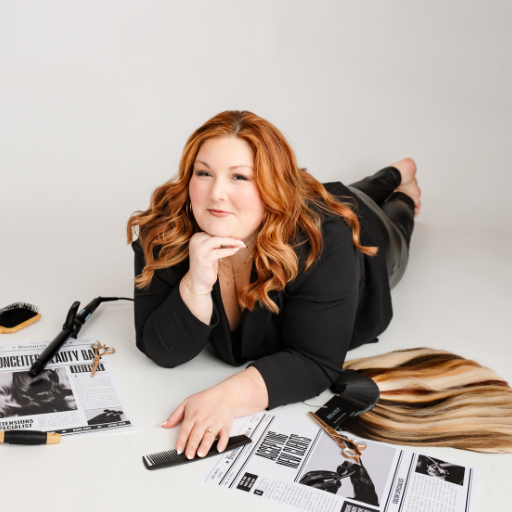
I am Brooke Chhina, a licensed cosmetologist, cosmetology educator, and trichology student with 17 years behind the chair at Conceited Beauty Bar in Lancaster, Pennsylvania.
Many of the women who sit with me are not simply chasing length. They are navigating fine, thinning, or changing hair and want more fullness without asking their natural hair to carry more than it safely should.
The question I come back to again and again is:
What can your hair safely carry?
That question matters more than the extension method itself.
What Luxury Hair Extensions for Thinning Hair Should Actually Mean
Luxury should not mean the most hair possible.
It should mean the right amount of hair, in the right places, using a method that makes sense for the natural density and condition in front of me.
When I plan extensions for thinning hair, I think about:
- Natural density
- Strand condition
- Attachment areas
- Weight
- Tension
- Placement
- Desired fullness
- Desired length
- Lifestyle
- Home care
- Maintenance
- How the finished result needs to move and blend
That is what separates a personalized extension plan from simply choosing a method off a menu.
The method comes after the assessment.
What Your Hair Can Safely Carry: How I Assess Candidacy
Thinning hair does not automatically rule out extensions.
It also does not automatically mean extensions are the right answer.
I assess:
- Density at the attachment area: Is there enough natural hair in that area to support added weight?
- Strand condition: Is the natural hair strong enough to support an attachment there?
- Hair and scalp condition: Are there areas that need a more conservative plan?
- Weight distribution: How much added hair can each area reasonably support?
- Placement needs: Where is fullness actually needed?
- Lifestyle and maintenance: Does the method fit how the client wears, washes, styles, and maintains her hair?
- Desired result: Is the goal length, fullness, coverage, or some combination?
I do not choose an extension method simply because someone has fine hair.
I choose it based on the specific hair in front of me.
The method gets fitted to the natural hair, never the other way around.
The Factors That Decide the Method: Attachment Size, Placement, Weight, and Density
Several variables shape every extension recommendation I make.
Attachment size is one of them, but smaller is not automatically better.
The attachment still has to be appropriately sized for the amount and condition of natural hair supporting it.
Placement matters just as much.
I consider:
- Where the natural hair has enough density to support added weight
- Where fullness is actually needed
- How the client wears her hair
- How the attachments will blend
- How much movement is desired
- How much added hair each area can reasonably carry
The goal is not to use the smallest attachment possible or add the greatest amount of hair possible.
It is to create the right balance between coverage, fullness, movement, and what the natural hair can safely support.
K-Tip, I-Tip, Tape-In, and Weft Extensions: How Each Method Adds Hair
Different extension methods give me different options for placement, attachment size, and how added hair is distributed.
None is automatically the best method for thinning hair.
Method | How Hair Is Added | Placement Flexibility | What I Consider |
|---|---|---|---|
K-Tip | Individually placed strands attached with keratin bonds | Very high | Density, strand condition, bond size, placement, movement, desired fullness |
I-Tip | Individually placed strands secured with beads or micro-rings | High | Density, strand condition, bead placement, amount of added hair |
Tape-In | Flat extension panels | Moderate | Attachment area, panel size, placement, density, home care |
Weft | Hair added across a planned row | Moderate to high | Row placement, available density, weight, desired fullness |
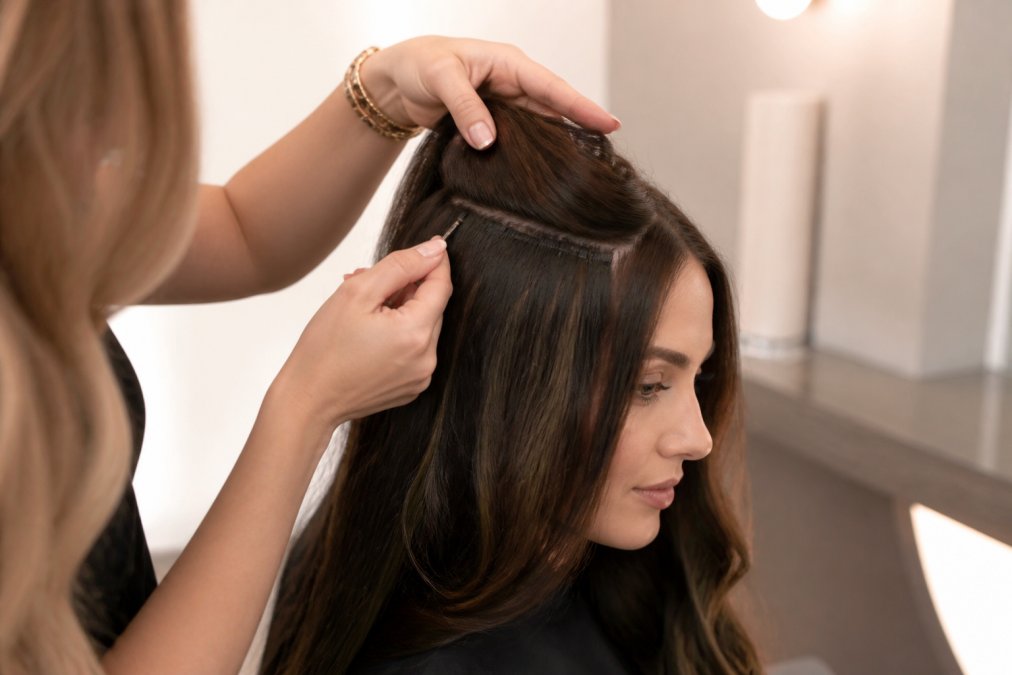
K-tip extensions give me a high level of control because each attachment is placed individually.
That can be helpful when density varies from one area to another or when fullness needs to be added selectively.
I-tips also allow individualized placement using small beaded attachments.
Tape-ins add hair through flat panels and may work for certain density patterns when the attachment area can appropriately support them.
Weft extensions create broader fullness across a row and can work beautifully when there is enough natural density to support the planned placement.
Sometimes a hybrid plan makes sense when different areas need different approaches.
The consultation matters more than the method name.
If you want a deeper comparison of how these methods create fullness, I also break that down in [Best Hair Extensions for Volume: Which Method Is Right for Your Hair?](/post/best-hair-extensions-for-volume-which-method-is-right-for-your-hair).
Important: Too much weight, tension, or inappropriate placement can put unnecessary stress on natural hair, especially when density is already limited. That is why I assess the attachment areas before deciding how much hair to add or whether extensions belong in the plan at all.
Hair Extensions for Fine Hair in Lancaster, PA: What Changes in a Private Studio
At my private Lancaster studio, extension planning begins with the individual client rather than a predetermined amount of hair or extension method.
The one-on-one environment gives me room to look closely at:
- Natural density
- Strand condition
- Attachment areas
- Coverage needs
- Desired length and fullness
- Lifestyle
- Home care
- Maintenance expectations
It also gives clients privacy to talk about changes in their hair without having that conversation on an open salon floor.
For women navigating fine, thinning, or changing hair, that privacy matters.
There are no explanations required.
The goal is to understand what you want, assess what your natural hair can reasonably support, and build the transformation from there.
When Extensions Are Not Enough for Top-of-Head Coverage
Traditional extensions are primarily used to create length, fullness, and additional density where the natural hair can support attachment points.
They do not always solve a coverage concern through the part, crown, or top of the head.
When the primary goal shifts from adding fullness to creating coverage, I may begin looking at other hair components.
Those may include:
- A topper
- A lace closure
- A full lace unit
- Extensions
- Or a combination of hair components
It is important to separate the hair being used from the method used to install it.
Mesh Integration and Meshless Integration are installation methods.
They are not hair pieces.
For example, a topper may remain removable, or a topper may become the hair component installed through Meshless Integration.
Another restoration plan may use extensions, a lace closure, a full lace unit, or another combination through Mesh Integration.
This is where traditional extensions can begin overlapping with my broader cosmetic hair restoration work.
The question changes from:
“Which extensions should I get?”
to:
“What combination of hair and installation method creates the coverage I actually need?”
Maintaining Hair Integrity With Extensions
Maintenance is part of the original extension plan.
It is not something I decide after the installation.
Different methods have different maintenance, move-up, removal, and replacement requirements.
At home, I generally want clients to:
- Brush according to the instructions for their extension method
- Avoid unnecessary pulling or tension at attachment points
- Keep the hair and attachment areas appropriately cleansed and dried
- Use heat protection when styling
- Follow the maintenance or replacement schedule established for their method
- Let me know about unusual slipping, matting, discomfort, or changes in the natural hair
I also reassess the natural hair during maintenance.
If density, strand condition, attachment areas, or shedding patterns have changed, I may adjust the placement, amount of hair, or overall plan rather than automatically repeating the previous installation.
Maintenance frequency is method-specific.
K-tips, I-tips, tape-ins, wefts, and hybrid applications do not all follow the same schedule.
That schedule should be based on the method, natural growth, attachment condition, lifestyle, and how the client’s own hair changes over time.
When a Broader Cosmetic Restoration Plan Makes More Sense
Sometimes traditional extensions are only one piece of the conversation.
A broader cosmetic hair restoration plan may make more sense when:
- The primary concern is coverage rather than length
- Density has changed through the part, crown, or top of the head
- There is not enough natural hair in certain areas to support traditional extension placement
- Different areas of the head require different approaches
- The client’s density or hair condition has changed since a previous extension installation
- The desired result cannot realistically be created with extensions alone
That broader plan may involve a topper, lace closure, full lace unit, extensions, Mesh Integration, Meshless Integration, or a combination.
Through my 6-Cause Restoration Method™, I consider the context surrounding the hair changes alongside the cosmetic result the client wants.
The framework helps guide consultation and cosmetic planning.
It is not a medical diagnostic system.
If hair loss is persistent, rapidly changing, patchy, painful, or accompanied by scalp symptoms, I may also recommend evaluation by a dermatologist or appropriate medical provider.
Medical care and cosmetic restoration can run alongside one another.
Luxury Means the Plan Fits Your Hair
Luxury hair extensions for thinning hair should not mean simply adding more hair.
For me, luxury means:
- Thoughtful planning
- High-quality hair
- Intentional placement
- Appropriate weight
- Natural blending
- Private one-on-one care
- A maintenance plan that fits your life
- The willingness to choose something other than extensions when that is what the hair needs
Thinning hair does not automatically rule out extensions.
It does mean I need to look more carefully at what your natural hair can safely carry.
Sometimes the answer is K-tips.
Sometimes it is a weft, tape-in, I-tip, or hybrid plan.
Sometimes the answer is a topper or another hair component.
Sometimes Mesh Integration or Meshless Integration becomes part of the plan.
And sometimes I recommend waiting.
The method comes second.
Your natural hair comes first.
Start Your Inquiry to begin your personalized plan.
Frequently Asked Questions
Are hair extensions safe for thinning hair?
Thinning hair does not automatically rule out extensions, but whether they are appropriate depends on what the natural hair can safely support. I look at density at the attachment area, strand condition, weight, placement, and how much added hair each area can reasonably carry before recommending a method. No single extension method is universally appropriate for fine or thinning hair. If I believe extensions would ask too much of the hair in front of me, I will recommend a different cosmetic approach.
What is the best type of hair extension for fine hair?
There is no single best extension method for fine hair. K-tips, I-tips, tape-ins, and wefts all add hair differently. Which one makes sense depends on natural density, strand condition, placement, desired fullness, lifestyle, and maintenance. A method that works beautifully for one client with fine hair may not make sense for another. The method should be fitted to the natural hair, never the other way around.
Can hair extensions help with hair loss on the top of the head?
Traditional extensions can create fullness and length, but they may not provide the amount of coverage someone wants through the crown or part. When top-of-head coverage is the priority, I may look at hair components such as a topper, lace closure, full lace unit, or another combination. Those components may remain removable or become part of an installation method such as Mesh Integration or Meshless Integration depending on the plan.
How do I know if I am a candidate for hair extensions?
Candidacy comes down to what your natural hair can safely carry. During The Discovery, I look at density at the attachment area, strand condition, hair and scalp condition, desired result, lifestyle, and how much added weight each area can reasonably support. Not every client is a candidate for extensions at every stage. Sometimes a different cosmetic approach makes more sense.
What is the difference between hair toppers and extensions for thinning hair?
Toppers and extensions are both hair components, but they serve different primary purposes. Extensions generally add length, fullness, or density where the natural hair can support attachments. A topper provides top-of-head coverage through areas such as the part or crown. Installation methods such as Mesh Integration and Meshless Integration are separate from the hair components themselves. A topper may also be installed through Meshless Integration as part of a broader cosmetic restoration plan.
What does luxury actually mean for thinning hair extensions?
Luxury is not simply more hair, longer hair, or a higher price. For me, it means personalized planning, high-quality hair, thoughtful weight and placement, private one-on-one care, natural blending, and maintenance that respects the client’s existing hair. It also means being willing to recommend something other than traditional extensions when another cosmetic approach makes more sense.
How much maintenance do luxury hair extensions require?
Maintenance depends on the method, natural growth, density, attachment condition, lifestyle, and how the hair changes over time. K-tips, I-tips, tape-ins, wefts, and hybrid applications do not all follow the same maintenance or replacement schedule. I establish that schedule based on the method and the individual client rather than using one universal timeline.
I've had extensions damage my hair before. How is this different?
A previous negative extension experience is something I take seriously. Before recommending another installation, I look at current density, strand condition, attachment areas, the previous method, and what the hair can reasonably support now. Weight, tension, attachment size, placement, home care, maintenance, and the condition of the natural hair can all influence how an extension plan performs. I do not automatically repeat the method someone wore before. If I believe traditional extensions are asking too much of the current hair, I will recommend a different cosmetic approach.