Hair Loss After GLP-1 Medication: Shedding, Density Changes, and Cosmetic Options
Table of Contents
- Hair Loss After GLP-1 Medication: Shedding, Density Changes, and Cosmetic Options
- What Hair Changes Can Look Like During GLP-1 Use
- Does Hair Grow Back After Ozempic or Other GLP-1 Medications?
- Start With Your Current Density
- What Can Your Hair Safely Carry?
- Cosmetic Option 1: Haircut, Color, and Styling
- Cosmetic Option 2: Extensions When the Hair Can Support Them
- When Extensions Are Not Enough
- Cosmetic Option 3: A Hair Topper
- Cosmetic Option 4: Lace Closures and Full Lace Units
- Mesh Integration and Meshless Integration: Installation Methods
- How I Choose a Topper That Blends Naturally
- The 6-Cause Restoration Method™ and GLP-1 Hair Changes
- Medical Care and Cosmetic Restoration Can Happen Together
- You Do Not Have to Wait to Talk About Coverage
- The Goal Is a Cosmetic Plan That Can Change With You
- Frequently Asked Questions
Last Updated: September 30, 2026
Hair Loss After GLP-1 Medication: Shedding, Density Changes, and Cosmetic Options
If you are noticing more shedding, a smaller ponytail, a wider-looking part, or more visible scalp while using a GLP-1 medication, you are not alone in wondering what is happening to your hair.
Some people report increased shedding during GLP-1 medication use, but that does not mean the medication itself is automatically the direct cause of every hair change.
Rapid or significant weight loss, changes in nutrition, illness, stress, hormonal changes, medications, and other factors can all be part of the larger picture.
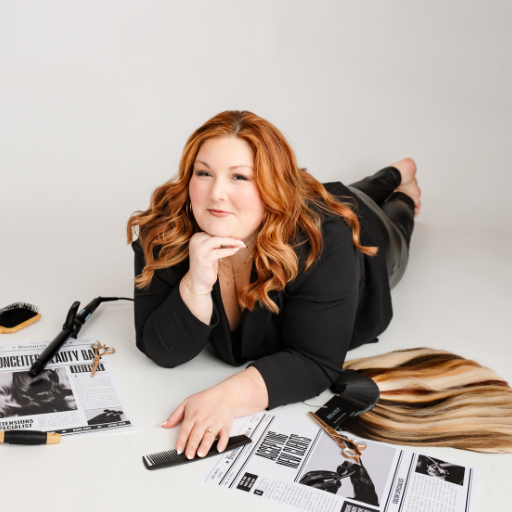
I am Brooke Chhina, a licensed cosmetologist, cosmetology educator, and trichology student with 17 years behind the chair. At Conceited Beauty Bar in Lancaster, PA, I work cosmetically with women experiencing fine, thinning, or changing hair.
My role is not to diagnose why the hair is shedding.
My role is to look at the hair you have today and ask:
What can your hair safely carry, and what cosmetic options can give you the coverage or fullness you want right now?
Medical care and cosmetic restoration are two different lanes, and they can run alongside one another.
What Hair Changes Can Look Like During GLP-1 Use
Hair changes do not look the same on everyone.
Some women notice:
- More hair in the shower or brush
- A smaller-feeling ponytail
- Thinner-looking ends
- More visible scalp through the crown
- A wider-looking part
- Less density through the sides
- A general feeling that the hair does not look as full as it used to
The context matters, but the visible change matters too.
From a cosmetic standpoint, I am looking at what has changed in the density, where the hair appears most transparent, and how much natural hair remains available to support styling, extensions, or added coverage.
If shedding is persistent, rapidly changing, unexplained, patchy, painful, or accompanied by scalp symptoms such as burning, itching, redness, or scaling, I recommend involving a dermatologist or appropriate medical provider.
I do not diagnose the cause of hair loss or advise clients to stop or change prescribed medication.
Does Hair Grow Back After Ozempic or Other GLP-1 Medications?
This is one of the most common questions women ask when they begin seeing a change in density.
The answer depends on why the shedding is happening in the first place.
Some people may see improvement as their body, weight, nutrition, or other contributing factors stabilize.
Others may have additional factors influencing their hair, including hormonal transitions, genetic pattern thinning, autoimmune conditions, or something else that needs medical evaluation.
That is why I do not promise regrowth or tell someone exactly when her hair will return to its previous density.
If you want a deeper look at the timeline side of this conversation, I break it down further in [When Does GLP-1 Hair Shedding Stop? A Month-by-Month Timeline](/post/when-does-glp-1-hair-shedding-stop).
Cosmetically, however, you do not necessarily have to wait for a final answer about future regrowth before deciding how you want your hair to look now.
A cosmetic plan can run alongside appropriate medical care.
Start With Your Current Density
Before I recommend an extension method, topper, or integration plan, I look at the hair that is physically present today.
I consider:
- Current density
- Strand condition
- Hair diameter
- Hair and scalp condition
- Where the scalp is most visible
- Where fullness is needed
- Whether density is still changing quickly
- What areas have enough hair to support attachments
- Lifestyle
- Maintenance
- Desired result
The goal is not to force the hair back into the same plan someone may have worn before her density changed.
The plan has to change when the hair changes.
My philosophy is simple:
The method gets fitted to your natural hair, never the other way around.
What Can Your Hair Safely Carry?
This question guides almost everything I do with fine, thinning, or changing hair.
A client may want extensions because she misses the amount of hair she used to have.
But wanting more density does not automatically mean the natural hair should carry more extension weight.
I look at:
- How much natural hair is available in each attachment area
- The condition of those strands
- Where the density is strongest
- Where it is more limited
- How much added hair is actually necessary
- Where the desired fullness needs to appear
- Whether coverage or length is the real goal
Sometimes traditional extensions still make sense.
Sometimes the plan has to become lighter or more selective.
Sometimes extensions are not the right answer at all.
That is responsible cosmetic planning, not a limitation.
Cosmetic Option 1: Haircut, Color, and Styling
Sometimes the visual change can be improved without adding hair.
A strategic haircut can help preserve the appearance of density through the perimeter and create a shape that works better with the hair that remains.
Color can also affect how full hair appears.
I may use dimension, thoughtful placement, or a lower-contrast approach depending on the natural hair, current density, and how much chemical processing the hair can reasonably tolerate.
Styling can also help through:
- Root lift
- Softer part placement
- Lightweight styling products
- Heat protection
- Avoiding excessive tension
- Creating movement without overworking fragile hair
These approaches do not regrow hair.
They are cosmetic tools for making the hair you already have look fuller.
Cosmetic Option 2: Extensions When the Hair Can Support Them
Hair extensions may still be appropriate for some women experiencing reduced density.
The important word is may.
No extension method is automatically best for thinning hair.
Different methods give me different options for placement and how added hair is distributed.
K-Tip Extensions
K-tip extensions use individually placed strands attached with keratin bonds.
That individual placement gives me a high degree of control over:
- Where hair is added
- Attachment size
- How much hair is added in each area
- Movement
- Blending
K-tips can be useful when density varies from one area to another, but the natural hair still has to be able to support the planned attachment.
I-Tip Extensions
I-tips also use individually placed extension strands, secured with beads or micro-rings.
They allow selective placement, but suitability still depends on the natural density, strand condition, bead placement, desired fullness, and maintenance plan.
Tape-In Extensions
Tape-ins use flat extension panels.
They may work for certain density patterns when there is enough natural hair in the attachment area to support them appropriately.
Weft Extensions
Weft extensions create broader fullness across a planned row.
They can work beautifully when there is enough natural density to support the placement and planned weight.
No method gets chosen simply because someone has fine hair.
The consultation matters more than the method name.
When Extensions Are Not Enough
Extensions are excellent at creating length, fullness, and added density in areas where the natural hair can support attachments.
They do not always solve a top-of-head coverage concern.
If the biggest change is through the:
- Part
- Crown
- Upper head
- Hairline area
- Broader top-of-head region
then I may need to think beyond traditional extensions.
That is where other hair components can become part of the plan.
Cosmetic Option 3: A Hair Topper
A hair topper is a top-of-head hair component.
Most traditional toppers are removable clip-on and clip-off pieces.
They may be useful when someone wants more coverage through the part, crown, or upper portion of the head.
Common topper base constructions include:
- Monofilament
- Silk
- Silicone
A topper needs to be selected around:
- Coverage area
- Base size
- Density
- Part placement
- Color
- Texture
- Length
- The surrounding natural hair
- Lifestyle
- How the client wants to wear it
More density is not automatically better.
The goal is to create a believable transition between the topper and the natural hair.
Cosmetic Option 4: Lace Closures and Full Lace Units
A lace closure is another type of hair component used for top-of-head coverage.
It is lace-based and is typically designed around the part or crown area.
A full lace unit provides broader coverage.
These are separate from traditional removable toppers and may become part of a larger cosmetic restoration plan depending on how much coverage is needed.
The important distinction is this:
Topper, lace closure, full lace unit, and extensions describe the hair being used.
They do not describe the installation method.
Mesh Integration and Meshless Integration: Installation Methods
Mesh Integration and Meshless Integration are installation methods.
They are not hair pieces.
That distinction matters.
The hair incorporated into a cosmetic restoration plan may include:
- Extensions
- A topper
- A lace closure
- A full lace unit
- Or a combination of hair components
For example, a topper may remain completely removable.
Or a topper may become the hair component installed through Meshless Integration.
In that situation:
The topper is the hair.
Meshless Integration is the installation method.
A Mesh Integration plan may use different hair components depending on the coverage required.
This is where my broader cosmetic hair restoration work comes in.
I am not choosing between “a topper or Meshless” as though they are competing products.
I am deciding:
- What hair component creates the coverage we need?
- How should that hair be worn or installed?
- What can the natural hair safely support?
- What maintenance plan makes sense for the client?
How I Choose a Topper That Blends Naturally
A topper should not look like a separate piece sitting on top of the hair.
Natural-looking coverage depends on several things working together.
I look at:
- Coverage area: Does the base actually cover the area that needs help?
- Density: Does the amount of hair make sense beside the surrounding natural hair?
- Color: Does the piece have the right depth and dimension?
- Texture: Does the added hair move like the natural hair?
- Part placement: Does it work with how the client naturally wears her hair?
- Length and cut: Does it transition naturally into the existing hair?
- Base construction: Does the construction make sense for how the piece will be worn?
The right topper is not simply the one that looks best on a mannequin.
It has to work with the individual client.
The 6-Cause Restoration Method™ and GLP-1 Hair Changes
I created the 6-Cause Restoration Method™ as a consultation framework for women navigating fine, thinning, or changing hair.
It is not a diagnostic system.
It helps me organize the context surrounding the hair changes so I can build a better cosmetic plan.
The six causes I consider are:
- GLP-1 & Medication
- Hormonal Transitions
- Genetics & Pattern Hair Loss
- Autoimmune Hair Conditions
- Trichotillomania Recovery
- Mechanical & Chemical Damage
GLP-1 & Medication is one of those six contexts.
During The Discovery, I may ask what the client has noticed, how long the changes have been happening, whether she is receiving medical care, what she has already tried, what result she wants cosmetically, and what kind of maintenance realistically fits her life.
Then I look at the hair itself.
The framework helps me understand the context.
It does not replace medical evaluation.
Medical Care and Cosmetic Restoration Can Happen Together
Someone experiencing hair changes during GLP-1 use does not have to choose between seeing a physician and wanting her hair to look fuller.
Those are different needs.
A physician or dermatologist handles:
- Medical evaluation
- Diagnosis
- Medication decisions
- Treatment
- Investigation of persistent or unexplained hair changes
My role is cosmetic.
I focus on:
- Current density
- Coverage
- Hair condition
- What the natural hair can safely support
- Added-hair options
- Installation planning
- Maintenance
- The finished cosmetic result
Those two forms of care can happen at the same time.
You Do Not Have to Wait to Talk About Coverage
One of the hardest parts of changing density is feeling like you have to wait indefinitely before you are “allowed” to do anything cosmetically.
That is not how I approach it.
You may not know yet what your density will look like six months from now.
That does not mean we cannot evaluate what is appropriate today.
Sometimes the right answer is styling.
Sometimes it is a haircut or color adjustment.
Sometimes it is a removable topper.
Sometimes extensions are appropriate.
Sometimes Mesh Integration or Meshless Integration becomes part of the plan.
And sometimes I recommend waiting before adding hair.
There is no single correct path for every woman experiencing hair changes during GLP-1 use.
The plan has to fit the hair that is actually present.
The Goal Is a Cosmetic Plan That Can Change With You
Hair changes can evolve.
Your cosmetic plan should be able to evolve too.
What works when density first starts changing may not be the same thing you need later.
That is why I do not build restoration plans around a single product or method.
I build them around the client.
If your density changes, the plan changes.
If your coverage needs change, the hair component may change.
If the natural hair can no longer support the same installation, the method changes.
The goal is not to force your hair to keep up with a predetermined plan.
It is to keep adjusting the plan to the hair in front of me.
Start Your Inquiry to explore which cosmetic approach may make sense for your current hair.
Frequently Asked Questions
Why does shedding happen during GLP-1 medication use?
Some people report increased shedding while using GLP-1 medications. Rapid or significant weight change, nutritional changes, illness, stress, hormonal changes, medications, and other factors may contribute to hair shedding. That does not mean every case of hair loss during GLP-1 use has the same cause. If shedding is persistent, unexplained, rapidly changing, or accompanied by scalp symptoms, I recommend discussing it with a physician or dermatologist.
Does hair grow back after Ozempic and other GLP-1 medications?
It depends on what is contributing to the hair change. Some people may see improvement as contributing factors stabilize, while others may continue to experience density changes for different reasons. I do not diagnose the cause or promise regrowth. A physician or dermatologist can evaluate the medical side, while I can help assess the current density and build a cosmetic plan around the hair that is present now. For more detail on timing, read When Does GLP-1 Hair Shedding Stop? A Month-by-Month Timeline. https://conceitedbeautybar.com/post/when-does-glp-1-hair-shedding-stop
Can I wear hair extensions if I am experiencing thinning during GLP-1 use?
Possibly. Thinning hair does not automatically rule out extensions. I look at current density, strand condition, attachment areas, how much weight each area can reasonably support, desired fullness, and whether density is still changing. If traditional extensions would ask too much of the natural hair, I may recommend a different cosmetic option.
Will a topper look natural on thinning hair?
A topper can look very natural when the coverage area, density, base construction, color, texture, part placement, cut, and surrounding natural hair all work together. The goal is not simply to cover visible scalp. It is to create coverage that belongs with the client's own hair.
What is the difference between a topper and Meshless Integration?
A topper is a hair component. Meshless Integration is an installation method. A topper may remain removable, or it may be installed through Meshless Integration depending on the client's cosmetic restoration plan. They are not competing versions of the same thing.
What is the difference between Mesh Integration and Meshless Integration?
Both are installation methods used within cosmetic hair restoration. Mesh Integration uses a mesh-based foundation. Meshless Integration creates the installation without that traditional mesh foundation. The hair used within the plan may include extensions, a topper, lace closure, full lace unit, or another combination depending on the desired coverage and what the natural hair can safely support.
Should I stop my GLP-1 medication if I am losing hair?
Medication decisions belong with the prescribing medical provider. I do not recommend stopping, starting, or changing a prescription medication because of hair changes. If you are concerned about shedding or other changes while taking a GLP-1 medication, discuss them with your physician or dermatologist. My role is to help with the cosmetic side while appropriate medical care continues.
Do I need to wait for my hair to grow back before considering cosmetic coverage?
Not necessarily. You can have a cosmetic consultation while medical evaluation or recovery is still happening. Whether adding hair makes sense now depends on your current density, hair condition, coverage needs, and what the natural hair can safely support. Sometimes the right answer is temporary styling or a removable piece. Sometimes a more involved restoration plan makes sense. And sometimes waiting is the safest cosmetic decision.