Hair Density Treatments for Women Over 50
Last Updated: October 23, 2026
Quick Summary
Hair density treatments for women over 50 include toppers, integration systems, and extensions, each designed to restore coverage while protecting your natural hair's integrity. The right approach depends on your hair's capacity, lifestyle, and what outcome matters most to you.
- Toppers provide immediate coverage at the crown and part line without the commitment of full extensions.
- Integration systems blend added hair directly into your natural strands for seamless results that work with what you have.
- Extensions require honest assessment of your natural hair's density and strength before placement.
- All density treatments require maintenance, from weekly washing for toppers to refresh appointments every 8-12 weeks for integration systems.
- The method should be fitted to your hair, never the other way around, to protect integrity and ensure realistic results.
Table of Contents
- Understanding Hair Density Changes After 50
- Hair Toppers for Women Over 50: Coverage Without Commitment
- Hair Integration Systems for Thinning Hair
- Extensions for Thinning Hair: What Your Natural Hair Can Safely Carry
- Hair Thinning After 50: Assessing Your Starting Point
- What to Expect: Maintenance, Longevity, and Realistic Outcomes
- Finding the Right Approach for Your Hair and Lifestyle
- Frequently Asked Questions
Understanding Hair Density Changes After 50
Hair density treatments for women over 50 address a reality that many of us face: our hair changes as we age. The texture shifts. The volume drops. What once felt full at the roots now shows scalp in ways that feel sudden and frustrating.
I've worked with many women navigating this transition in Lancaster. Some are managing hormonal shifts from perimenopause or menopause. Others are dealing with density loss tied to autoimmune factors, medication side effects, or simple genetics. A few are recovering from trichotillomania or other conditions that have affected their hair's fullness. Each situation is different, but the core concern stays the same: how do I restore the coverage and density I had?
The good news is that hair density treatments have evolved far beyond what most people imagine. This isn't about hiding the problem, it's about creating real, lasting solutions that work with your natural hair, not against it.
Hair Toppers for Women Over 50: Coverage Without Commitment
A hair topper is a partial hairpiece that covers the crown, part line, or thinning areas without replacing your entire head of hair. It sits on top of your existing hair and blends with it for seamless coverage.
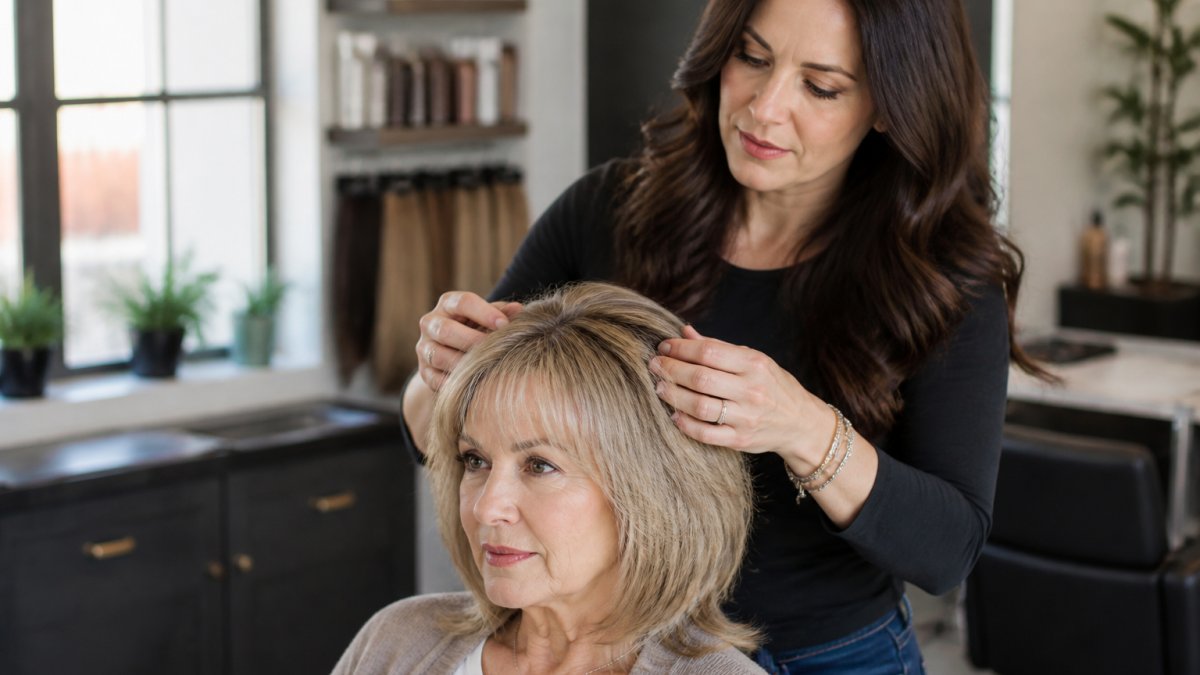
Toppers work well for women who want to add density without the commitment of full extensions. You get immediate coverage where you need it most. The crown. The part line. The areas that show the most when light hits your hair from above.
What makes a topper effective is how it's customized to match your hair. The color needs to blend. The texture needs to complement what you have. The base needs to sit securely without slipping or pulling.
I design custom toppers at Conceited Beauty Bar that account for your natural density, your lifestyle, and how much maintenance you're willing to do. Some clients wear theirs daily. Others rotate between wearing it and going without, depending on the day or event.
The reality: toppers require care. You'll wash them on a schedule. You may need to refresh the color as your natural hair changes.
Hair Integration Systems for Thinning Hair
Integration systems are different from toppers. Instead of sitting on top of your hair, they work with your natural hair, blending the added hair directly into what you have. This creates a seamless result where the line between your hair and the added hair is invisible.
There are two main approaches: mesh integration and meshless integration.
Mesh Integration
Mesh integration uses a fine mesh base that sits against your scalp. Your natural hair threads through the mesh, anchoring the system in place. The mesh holds the added hair while allowing your natural hair to grow and move freely underneath.
This method works especially well if you have very fine or low-density hair. The mesh distributes weight evenly, so there's no concentration of tension on any single area. Your natural hair carries what it can safely carry without strain.
I assess each client's hair density and diameter before recommending mesh integration. If your natural hair is fragile or already compromised, this method respects those limitations. The system is designed to enhance what you have, not overload it.
Mesh integration requires refresh or maintenance appointments. During that time, your natural hair grows, and the system needs adjusting to maintain seamless blending.
Meshless Integration
Meshless integration skips the mesh base entirely. Instead, the added hair is woven or integrated directly into sections of your natural hair using a bonding or braiding technique. This creates an even more natural appearance because there's no base material visible at the scalp.
Meshless integration works best for clients with moderate to good hair density. Your natural hair needs enough strength and thickness to support the integration without excessive tension. The added hair is attached to your natural strands, so the integrity of those strands matters.
This method offers a more seamless blend than mesh, especially if you wear your hair up or in styles that expose your scalp. The integration points are subtle, and the transition from your hair to the added hair is nearly invisible.
Like mesh integration, meshless systems require maintenance as your natural hair grows and the integration points need refreshing.
Extensions for Thinning Hair: What Your Natural Hair Can Safely Carry
Extensions add length and density, but here's what I need to be clear about: not every client with thinning hair is a candidate for extensions. The foundation matters.
If your natural hair is very fine, very fragile, or extremely low-density, extensions may place too much weight and tension on what you have. That's not a judgment, it's physics.
For women who do have enough density to support extensions, the options at Conceited Beauty Bar include K-tip extensions, weft extensions, and tape-in extensions. Each method distributes weight differently and requires different maintenance.
K-tip extensions use individual bonds to attach strands to your natural hair. This method allows precise placement and works well for adding density throughout the head or length to specific areas.
Weft extensions use a woven track that attaches to your natural hair. This method is efficient for adding significant density quickly.
Tape-in extensions use adhesive tape to attach sections of hair to your natural strands. This method is reversible and doesn't require heat or bonds. For clients concerned about damage, tape-ins offer a gentler approach.
The method I recommend depends on your natural hair's density, diameter, and condition. It also depends on your lifestyle. If you travel constantly, you need a method that's easy to maintain between appointments.
Hair Thinning After 50: Assessing Your Starting Point
Before recommending any hair density treatment, I spend time evaluating what you're working with. This assessment determines everything else.
I look at your hair's density, how many strands you have per square inch. I evaluate the diameter of your individual strands. I consider the overall health and condition of your hair. Are there breakage patterns? Is the hair fragile or resilient? Has it been color-treated or chemically processed?
I also listen to your story. Are you experiencing thinning from hormonal changes? From an autoimmune condition? From medication side effects? From genetics? From recovery from trichotillomania? The context matters because it shapes realistic expectations and the best approach.
Many women come in thinking they need full extensions when what they really need is a topper or integration system. Others assume they can't do anything about their density and are surprised to learn about options designed specifically for fine or thinning hair.
The assessment takes time. It's not a quick consultation where I'm already thinking about the next client. At Conceited Beauty Bar in Lancaster, I work one-on-one with you to understand your hair, your concerns, and your goals. That conversation determines the right path forward.
What to Expect: Maintenance, Longevity, and Realistic Outcomes
Every hair density treatment requires maintenance. The amount varies, but it's important to understand what you're committing to.
Toppers need washing and styling on a regular schedule. Depending on how often you wear yours, that might be weekly or every other week.
Integration systems, both mesh and meshless, need maintenance appointments every 8-12 weeks. As your natural hair grows, the integration points shift. The system needs adjusting to keep the blend seamless and to prevent tension buildup on your natural hair.
Extensions require touch-up appointments as your natural hair grows. The frequency depends on how fast your hair grows and how noticeable the gap becomes between your roots and the bonds or tape. Most clients return every 6-8 weeks.
The longevity of these systems also varies. A topper can last several years with proper care. Integration systems can be refreshed and maintained, you're not replacing the added hair, just adjusting the attachment points.
Realistic expectations matter more than anything else. You won't look like you did at 30. But you can look like the best version of yourself at 50, 55, 60. You can have the coverage and density you want.
What you won't get is a miracle. Hair density treatments work because they're designed specifically for what you need. They're not a cure for anything.
Finding the Right Approach for Your Hair and Lifestyle
The best hair density treatment for you depends on three things: your natural hair's capacity, your lifestyle, and your expectations.
Start with an honest assessment of your hair. Is it fine or thick? Fragile or resilient? Low-density or moderate-density? This determines what methods are actually safe for your hair to carry.
Consider your lifestyle next. How much time can you dedicate to maintenance? Do you travel frequently? Do you prefer minimal upkeep or are you willing to come in for regular appointments? Do you want to wear the same thing every day, or do you like flexibility?
Then align your expectations. What outcome matters most to you? Coverage at the crown? Length? Overall density? A specific look or style? The clearer you are about what you want, the easier it is to find the method that delivers it.
I approach every consultation with one philosophy: the method gets fitted to your hair, never the other way around. That's how I work at Conceited Beauty Bar in Lancaster.
That process starts with a consultation. No pressure. No sales pitch. Just an honest conversation about what you're experiencing, what you want, and what's realistic for your specific situation.
Hair density changes after 50 are common, but they don't have to define how you feel about your appearance.
Frequently Asked Questions
Can hair extensions work with thinning hair?
Yes, but the method matters. Extensions must be chosen based on what your natural hair can safely carry, not the other way around. Lighter application methods like tape-ins or mesh integration work better with fine or low-density hair than heavier systems. During a consultation, I assess your hair's density, texture, and condition to determine which approach will respect your hair's integrity while giving you the coverage and length you want.
What's the difference between a hair topper and a mesh integration system?
A hair topper sits on top of your head and covers the crown and part area, you can remove it daily. Mesh integration anchors to small sections of your natural hair, creating a more permanent blend that you wear continuously. Toppers offer flexibility and lower daily maintenance; integration systems provide seamless coverage and don't require daily application, but they do need regular upkeep.
How do I know whether my hair can safely support extensions?
That's determined during a one-on-one consultation. I evaluate your hair's density, elasticity, and overall health to see what weight and tension your natural hair can handle. If your hair is very fine, fragile, or low-density, lighter methods work better. The goal is always to enhance your appearance without compromising the hair you have. Not every client is a candidate for every method, and that's honest planning, not a limitation.
How long do hair toppers and integration systems last?
Longevity depends on the hair quality, how often you wear it, your maintenance routine, and how well you follow care instructions. I'll walk you through exactly what upkeep looks like so you can decide if the maintenance fits your lifestyle.