Trichotillomania Regrowth: What Affects Whether Hair Comes Back
You've asked yourself this question more times than you can count.
Maybe you've asked it out loud once.
Maybe you've only asked it silently while looking at the same spot in the mirror.
Will my hair grow back?
There isn't one answer that applies to every person with trichotillomania.
Hair often can regrow when follicles in the affected area remain capable of producing hair. But the amount of regrowth, how long it takes, and whether an area returns to its previous density can vary.
I'm Brooke Chhina, a licensed cosmetologist, cosmetology educator, hair restoration specialist, and trichology student (IAT) in Lancaster, PA.
Trichotillomania Recovery is one of the six hair-change contexts within The 6-Cause Restoration Method™.
If you want the broader conversation about regrowth and cosmetic restoration, start with my Does Hair Grow Back After Trichotillomania? guide.
This article goes deeper into one question:
What actually affects regrowth after pulling?
The short answer
Several things may influence what recovery looks like after trichotillomania.
They include:
how long an area has been repeatedly pulled
how often the same area has been affected
whether pulling in that area has stopped
whether follicular scarring has developed
whether another hair or scalp condition is also present
your individual hair cycle and biology
There is no blog post, photo, or timeline that can tell you with certainty whether every follicle in a particular area will recover.
If an area remains bare after pulling has stopped, or you are concerned about possible scarring, a board-certified dermatologist is the appropriate person to evaluate your scalp.
First, the scope
I'm a licensed cosmetologist, cosmetology educator, hair restoration specialist, and trichology student, not a physician, dermatologist, or mental health professional.
My trichology education allows me to recognize hair and scalp patterns, understand the science behind many forms of hair change, identify factors that may be contributing to what you're experiencing, and know when something belongs with a medical or mental health provider.
It does not allow me to diagnose a medical condition, determine whether individual follicles are permanently damaged, or treat trichotillomania.
My cosmetic restoration work runs alongside medical and mental health care, never in place of it.
How hair regrowth works after pulling
Hair grows through a repeating cycle.
The main stages are:
anagen, the growth phase
catagen, the transitional phase
telogen, the resting phase
exogen, the shedding phase
When a hair is pulled from the scalp, the visible hair shaft is removed.
That does not automatically mean the follicle itself has been permanently destroyed.
If the follicle remains capable of producing hair and the pulling stops, new growth may occur.
The complication is repeated trauma.
Over time, repeatedly pulling from the same area can sometimes contribute to follicular damage or scarring, which may limit regrowth.
That is why two people with trichotillomania can stop pulling at the same time and have very different recovery experiences.
What affects trichotillomania regrowth?
How long the area has been repeatedly pulled
Duration matters, but it does not create a simple formula.
Someone who has pulled from an area for many years may still experience meaningful regrowth.
At the same time, longer-term repeated trauma can increase concern about follicular damage in some areas.
The history gives context.
It does not allow me to predict the outcome.
How repeatedly the same area has been affected
Trichotillomania patterns vary.
Some people pull across a larger area.
Others repeatedly return to a specific spot.
Repeated trauma to the same region may affect the follicles differently than a more dispersed pulling pattern.
Again, that does not tell us with certainty what will regrow.
It tells us why the pulling history matters.
Whether pulling in that area has stopped
Hair needs time to grow.
If new hairs are repeatedly pulled again, it becomes difficult for visible length and density to return.
This is why the behavioral side of trichotillomania recovery matters so much.
Habit-reversal-based behavioral therapy is one of the best-supported treatment approaches for trichotillomania.
That care belongs with a qualified mental health professional.
Whether scarring has developed
Repeated trauma can, in some people, eventually lead to scarring that limits the follicle's ability to produce hair.
This is not something I diagnose from the studio chair.
If an area stays bare, looks unusually smooth or shiny, or simply is not behaving the way you expected after pulling has stopped, a dermatologist can evaluate what is happening.
Whether another hair-loss pattern is present
Not every area of thinning on someone with trichotillomania is necessarily caused by pulling.
Female pattern hair loss, telogen effluvium, inflammatory scalp conditions, thyroid-related changes, nutritional factors, and other causes can overlap.
If your thinning looks patterned through the part or crown rather than limited to historical pulling areas, you may also want to read my female pattern hair loss guide.
Nutrition and general health
Hair growth depends on normal biological processes, and nutrition can be part of that picture.
But I would not assume a vitamin deficiency simply because regrowth seems slow.
If your doctor thinks bloodwork is appropriate, ask whether thyroid testing and ferritin should be included rather than assuming a standard panel covers everything relevant to hair shedding.
Your physician can determine which tests make sense based on your history and symptoms.
Individual biology
There is natural variation in hair growth from one person to another.
Two people with similar pulling histories may not experience identical regrowth.
That uncertainty can be frustrating.
It is also why I am cautious about promising a specific timeline.
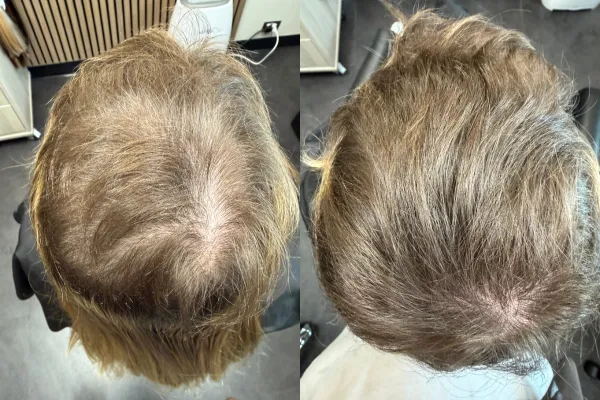
What can regrowth look like?
Regrowth does not always happen evenly.
You may see one area filling in faster than another.
Some new hairs may initially be shorter, finer, or visually different from the surrounding hair simply because they are at an earlier point in their growth.
Over time, some areas may return to density that looks similar to the surrounding hair.
Other areas may remain thinner.
And some areas may show very limited regrowth.
Those outcomes require context.
A thinner area does not automatically prove permanent follicular damage, and an area that has not filled in yet should not automatically be labeled scarred.
That is where medical evaluation can be useful.
When to see a dermatologist
Consider seeing a board-certified dermatologist if:
pulling has stopped in an area but regrowth is not occurring as expected
the scalp looks unusually smooth or shiny
follicular openings appear reduced or absent
you have redness, scaling, tenderness, burning, or inflammation
the pattern does not seem to match where you historically pulled
you are experiencing substantial or unexplained shedding
you want a medical evaluation of an area that has remained bare
A dermatologist can evaluate the scalp and determine whether another condition or scarring process may be involved.
Where cosmetic hair restoration fits
Cosmetic hair restoration does not cause a follicle to regrow.
What it can do is provide coverage while natural hair changes underneath or provide cosmetic coverage for an area that remains visibly thinner.
If you're specifically trying to cover a pulling-affected area, read my Trichotillomania Bald Spot Coverage guide.
For some clients, a custom hair topper may provide targeted coverage.
The topper is the actual hairpiece.
It may be supported by either Meshless Integration or Mesh Integration, depending on:
the natural hair available for support
structural strength
coverage area
comfort
lifestyle
maintenance
cosmetic goals
Neither foundation is automatically better.
If this is you
If you're navigating trichotillomania recovery and want to understand what cosmetic options may be appropriate for the hair you have today, Begin Your Discovery.
The Discovery is an in-studio consultation in my private Lancaster, PA studio.
I review your hair and scalp, pulling history, visible density, areas of concern, natural hair available for support, and cosmetic goals.
I do not determine whether your follicles are medically viable.
If something belongs with a dermatologist or mental health professional first, I will tell you.
From there, I create your personalized Restoration Roadmap and send it to your phone.
Your Roadmap may include:
a custom hair topper with Meshless Integration
a custom hair topper with Mesh Integration
hair extensions if length or fullness through unaffected hair is also a goal
a combination of topper-based restoration and extensions
a cosmetic hair-care plan while your recovery continues
a recommendation to connect with the appropriate medical or mental health professional first and return to me afterward
Your Restoration Roadmap is yours to keep whether or not you continue with me.
I work by application only.
The regrowth question does not always have an immediate answer.
But you do not have to make assumptions about what an area means just because it has not filled in yet.
I'm Brooke Chhina, a licensed cosmetologist, cosmetology educator, hair restoration specialist, and trichology student (IAT) in Lancaster, PA, and the creator of The 6-Cause Restoration Method™. I'm not a medical doctor or mental health professional. For diagnosis, treatment, or care of any medical or mental health condition, please consult an appropriately licensed professional. Cosmetic hair restoration runs alongside medical and mental health care, never in place of it.
Conceited Beauty Bar · Sola Salons Studio 9A · 1500 Gilbert Way, Lancaster, PA 17601
Crowned in Confidence · Your Beauty, Elevated.