Autoimmune Hair Loss Treatment Options: A Guide
Table of Contents
- Understanding Autoimmune Hair Loss and Your Treatment Options
- Alopecia Areata Treatment Options: What to Expect
- Hair Loss Treatment Timeline: How Long Recovery Takes
- Medical Treatments vs. Cosmetic Solutions
- Hair Toppers for Thinning Hair: Immediate Coverage While You Explore Options
- Mesh Integration for Hair Loss: A Customized Approach to Density
- Choosing the Right Path for Your Hair and Your Life
- Frequently Asked Questions
Last Updated: October 19, 2026
Understanding Autoimmune Hair Loss and Your Treatment Options
When your immune system attacks hair follicles, it creates a specific kind of hair loss that deserves a thoughtful approach. Autoimmune hair loss treatment options range from medical interventions prescribed by dermatologists to cosmetic solutions that address coverage and density right now. The difference between these paths matters, not because one is always better, but because your choice depends on your timeline, your natural hair's capacity, and what you're actually trying to achieve.
I've worked with women in Lancaster navigating autoimmune-related hair changes for years. What I've learned is this: the medical side and the cosmetic side aren't competing. They're complementary. A dermatologist can evaluate the condition and recommend medical treatments. Meanwhile, I can assess your natural hair's density and design a restoration plan that respects what it can safely carry while you explore medical options or wait for results to show.
The most common autoimmune condition affecting hair is alopecia areata, but there are others. Regardless of diagnosis, your treatment decision depends on three things: whether you want to address the medical cause, whether you need coverage now, and what your natural hair can handle.
Alopecia Areata Treatment Options: What to Expect
Alopecia areata is an autoimmune condition where the body attacks hair follicles, causing patchy or widespread hair loss. A dermatologist can evaluate whether this is your diagnosis and recommend medical treatments. That's their role. My role is different.
Medical treatments for alopecia areata typically include:
- Topical corticosteroids - Applied directly to affected areas to reduce inflammation
- Intralesional corticosteroid injections - Injected into the scalp to target specific patches
- Oral medications - Prescribed by a dermatologist to address the immune response
- Topical immunotherapy - A specialized treatment applied by a dermatologist
- Newer biologic medications - Emerging options that target specific immune pathways
These are medical decisions. I don't prescribe or recommend them. What I do is work with you while you're pursuing these options or if you decide medical treatment isn't your path.
Here's what matters for your cosmetic planning: while medical treatments take time to work, sometimes months, you may want immediate coverage. That's where my expertise comes in. I can assess your current density, evaluate what your natural hair can safely carry, and design a restoration system that blends seamlessly with what you have.
Hair Loss Treatment Timeline: How Long Recovery Takes
Medical treatments for autoimmune hair loss don't work overnight. Most dermatologists will tell you to expect results over three to six months, sometimes longer. Some treatments take six to twelve months to show meaningful regrowth. This timeline is important because it shapes your decision.
If you're waiting for medical treatment to work, you have options:
- Months 1-3 - Medical treatment begins; cosmetic coverage can start immediately
- Months 3-6 - You'll see if the medical approach is responding; cosmetic solutions continue
- Months 6-12 - Clearer picture of medical treatment effectiveness; cosmetic plan may adjust based on changes
This is why I separate medical timeline from cosmetic timeline. You don't have to wait six months to feel like yourself. I can create coverage that works for you right now.
The realistic expectation: if your dermatologist recommends medical treatment, commit to that timeline. Don't jump between treatments. And while you're giving it time to work, a well-designed cosmetic solution keeps you feeling confident and covered.
Medical Treatments vs. Cosmetic Solutions
These aren't opposites. They're different tools for different purposes.
Medical treatments address the immune system. They're prescribed by dermatologists. They take time. They may work, they may not, response varies widely. They're appropriate if you want to pursue the medical cause of your hair loss.
Cosmetic solutions address coverage, density, and appearance. They work immediately. They're appropriate whether or not you're pursuing medical treatment. They don't interfere with medical options. They're what I specialize in.
Here's the practical reality: some women pursue medical treatment and see results. Some pursue it and don't. Some choose not to pursue it at all. Regardless of your medical choice, if you have visible hair loss or density changes, cosmetic planning is worth considering.
| Approach | Timeline | Requires Dermatologist | Works Immediately | Addresses Cause |
|---|---|---|---|---|
| Medical treatment | 3-12 months | Yes | No | Yes (attempts to) |
| Hair toppers | N/A | No | Yes | No |
| Mesh integration | N/A | No | Yes | No |
| Meshless integration | N/A | No | Yes | No |
The question isn't which is better. It's which one fits your situation. Many women do both: they see a dermatologist for medical evaluation while I design a cosmetic solution for coverage and confidence.
Hair Toppers for Thinning Hair: Immediate Coverage While You Explore Options
A hair topper is a partial hairpiece that clips or attaches to your natural hair to add volume, coverage, and length at the crown, part line, or areas of visible thinning. It's not a full wig. It works with what you have.
I custom-design toppers for women with autoimmune hair loss because they solve an immediate problem: visible density loss or patchy areas. While you're waiting for medical treatment to work, or while you're deciding whether to pursue medical treatment, a topper gives you back your appearance.
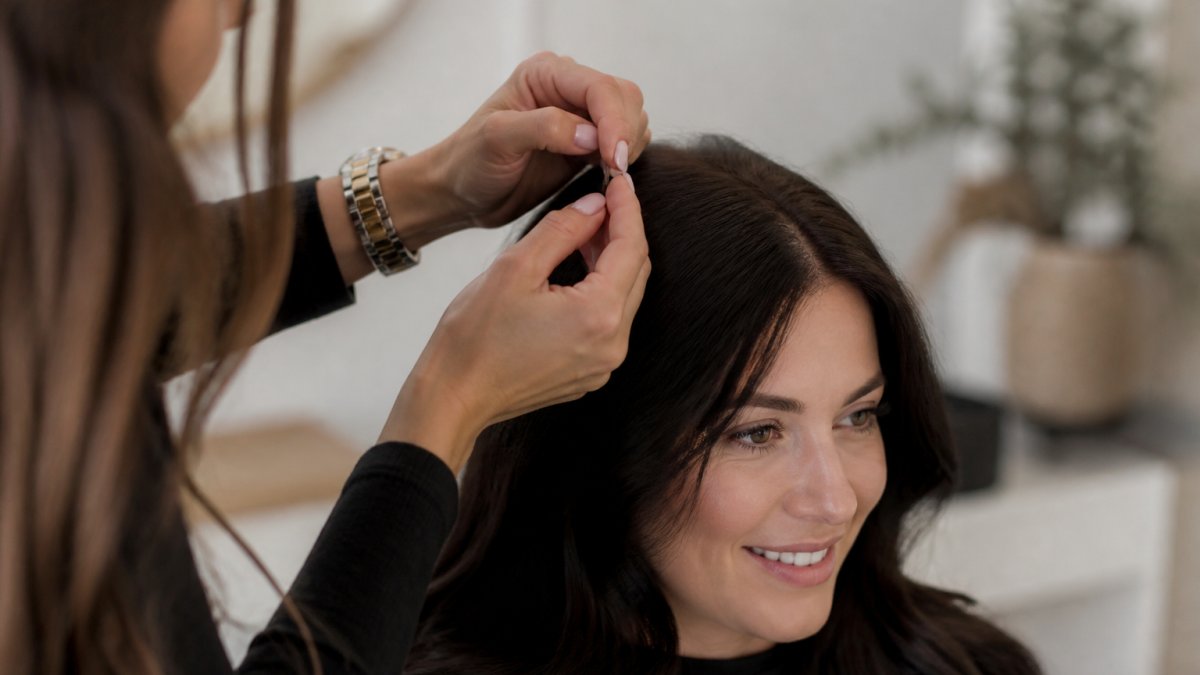
The key word here is custom. A topper from a generic retailer won't blend because it's not made for your specific hair color, texture, or density. I create toppers that match your natural hair exactly. The result looks like your hair, not like you're wearing something.
What a topper can do:
- Cover visible thinning at the crown or part line
- Add length without damaging fragile natural hair
- Work with your existing hair texture and color
- Come off whenever you want
- Allow you to assess what coverage feels right before committing to longer-term solutions
What a topper can't do:
- Stay on during swimming or intense exercise
- Require zero maintenance
- Work if your natural hair is too fragile to support attachment
The reality: a topper is temporary coverage. It's ideal if you want flexibility, if you're in the early stages of hair loss, or if you're deciding whether a more permanent restoration method makes sense for you.
Mesh Integration for Hair Loss: A Customized Approach to Density
Mesh integration is a semi-permanent restoration system where I integrate hair into a custom mesh base that sits against your scalp, adding density and coverage to your existing hair. It's different from a topper because it works with your natural hair structure, not just clipping on top.
This method is designed for women who want more permanence than a topper but need a system that respects their natural hair's capacity. Here's how it works:
- I assess your natural hair's density, texture, and what it can safely carry
- A custom mesh base is created to fit your scalp exactly
- Hair is integrated into the mesh in a pattern that creates natural density
- The system attaches to your natural hair using a secure but gentle method
- You wear it for weeks at a time, then return for maintenance
Mesh integration works well for autoimmune hair loss because it:
- Doesn't depend on having thick natural hair to attach to
- Distributes weight across the scalp rather than concentrating it in one area
- Creates a natural hairline and part line
- Allows your natural hair to breathe between appointments
- Can be adjusted as your natural hair changes
The trade-off: it requires regular maintenance appointments. You're committing to a system that needs professional care. But many women find that trade-off worth it because the coverage is seamless and the results look completely natural.
I also offer meshless integration for women whose natural hair is too fragile or sparse for traditional mesh.
Choosing the Right Path for Your Hair and Your Life
This decision isn't about which treatment is objectively best. It's about which approach fits your specific situation.
Ask yourself these questions:
- Do I want to pursue medical treatment? If yes, see a dermatologist. Give it time. While you wait, consider cosmetic coverage.
- Do I need coverage now, or can I wait? If now, cosmetic solutions are immediate. If you can wait, you might see medical results first.
- How much maintenance am I willing to do? Toppers require minimal upkeep. Integration systems require regular appointments.
- What does my natural hair look like? Fine, fragile hair needs a different approach than thicker hair. The method must fit what you have.
- What's my lifestyle? If you swim frequently, travel, or prefer maximum flexibility, a topper might work better. If you want seamless, long-term coverage, integration might be right.
Here in Lancaster, I work with women navigating all of these decisions. What I've learned is that the right choice is the one that respects your hair's integrity, fits your realistic expectations, and works with your life, not against it.
The women who feel most confident aren't the ones who chose the most expensive option or the most permanent one. They're the ones who chose the option that actually fit their situation.
If you're dealing with autoimmune hair loss and want to explore your options, I'm here to help. At Conceited Beauty Bar, I specialize in assessment and cosmetic planning for women navigating density changes and hair loss. I don't diagnose or treat medical conditions, that's your dermatologist's role. But I can evaluate your natural hair, discuss what it can safely carry, and design a customized restoration plan that works for you.
Begin Your Discovery and schedule a consultation. Let's talk about what coverage and confidence look like for your specific situation.
Frequently Asked Questions
What are the main autoimmune hair loss treatment options available?
Autoimmune hair loss treatment typically falls into two categories: medical treatments managed by a dermatologist (including topical and oral medications, injections, and immunosuppressants) and cosmetic solutions like hair toppers, extensions, and integration systems. Medical treatments address the underlying condition, while cosmetic options provide immediate coverage and density. Many people combine both approaches, pursuing medical evaluation while using restoration methods to address visible thinning. The right choice depends on your diagnosis, the extent of hair loss, your lifestyle, and what your natural hair can safely support.
How long does alopecia areata treatment typically take to show results?
Hair loss treatment timeline varies significantly based on the treatment type and individual factors. Medical treatments can take 3 to 6 months to show visible regrowth, though some people see results sooner. Topical treatments often require consistent application for several months. Cosmetic solutions like hair toppers and mesh integration provide immediate results, you see the coverage and density change the same day. If you're pursuing medical treatment while waiting for results, cosmetic restoration allows you to maintain your appearance and confidence throughout the process without waiting.
Can hair grow back after autoimmune hair loss?
Whether hair regrows depends on the specific autoimmune condition, treatment response, and individual factors, questions best discussed with a dermatologist. Some people experience regrowth with appropriate medical treatment, while others may have ongoing or recurring hair loss. This uncertainty is why many people combine medical evaluation with cosmetic planning. Hair toppers for thinning hair and integration systems offer a practical solution regardless of regrowth outcomes, giving you control over your appearance while you work with your healthcare provider on the medical side.
What's the difference between hair toppers and mesh integration for hair loss coverage?
Hair toppers sit on top of your head and cover the crown and part area, they're removable, require daily styling, and work best for moderate thinning. Mesh integration for hair loss is a semi-permanent system that integrates with your existing hair, providing coverage that moves with you naturally. Mesh integration requires less daily maintenance and creates a more seamless blend, but it's a bigger commitment. The right choice depends on your density, lifestyle, how much time you want to spend on maintenance, and what your natural hair can safely carry without tension or damage.