How to Choose Hair Extensions for Thinning Hair
Table of Contents
- Assess Your Natural Hair Before Choosing Extensions
- Hair Extensions for Fine Hair: Matching Method to Texture
- Hair Toppers for Thinning Hair: Coverage Without Commitment
- Tape-in Extensions for Fine Hair: A Lighter Approach
- How to Care for Hair Extensions to Protect Thin Hair
- What to Discuss During Your Consultation
- Frequently Asked Questions
Last Updated: October 18, 2026
Assess Your Natural Hair Before Choosing Extensions
The first step in how to choose hair extensions for thinning hair isn't picking a method, it's understanding what your natural hair can actually support.
Your hair has limits. That's not weakness. It's physics. Fine or thinning hair carries less weight safely than thick, dense hair. Tension matters. Placement matters.
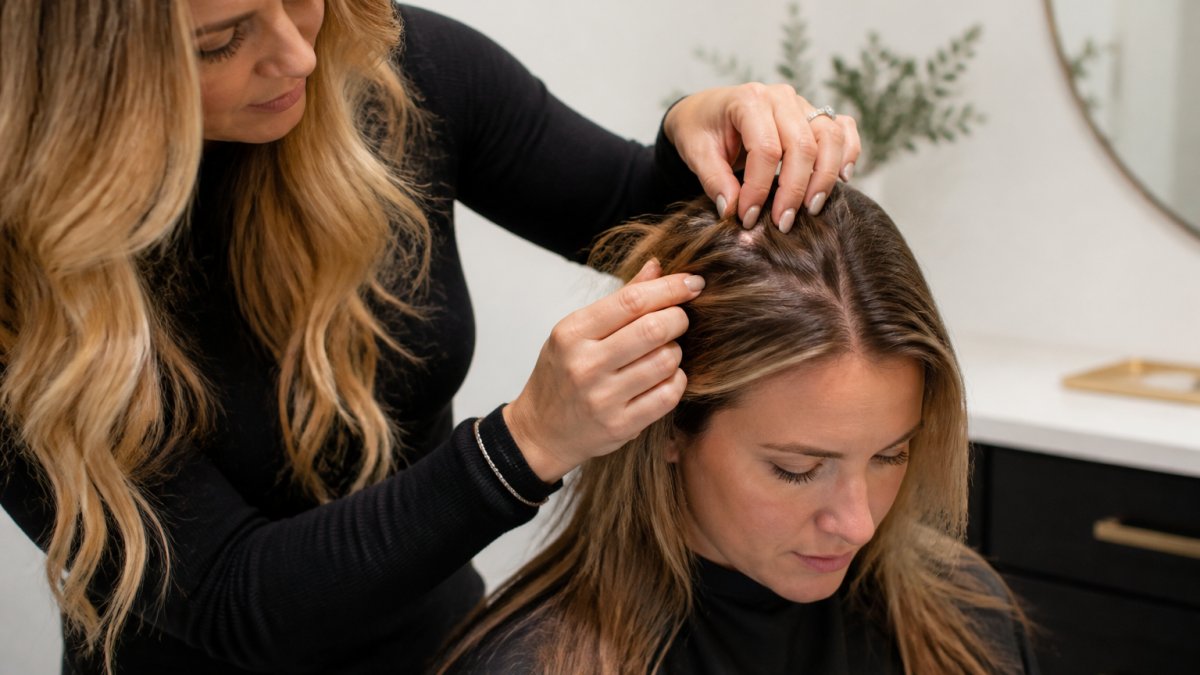
Evaluate density, texture, and what your hair can safely carry
Start by looking at your hair honestly. Pull it back into a ponytail. Can you see your scalp? How much? Where?
Feel the texture. Is it fine, medium, or coarse? Fine hair needs lighter methods. Coarse hair can handle more weight.
Ask yourself these questions:
- Can I see my scalp when my hair is wet and pulled back?
- Are there specific areas (crown, part line, temples) where density is noticeably lower?
- Does my hair feel fragile, or does it feel strong but just thinner than it used to?
- How much shedding do I see in my brush or shower drain?
The answers shape everything that comes next. If you have significant scalp visibility, full extensions across your whole head might not work.
Consider your lifestyle and maintenance commitment
Extensions aren't set-and-forget. Every method requires upkeep. The question is whether you're willing to do it, and honestly, whether your schedule allows it.
Think about your typical week:
- Do you exercise? How often? Sweat and friction affect how long extensions last.
- Do you travel? Frequent travel means more stress on the hair and less time for maintenance.
- How much time can you spend on hair care each day? Five minutes? Twenty?
- Are you willing to come back for touch-ups or adjustments?
I've had clients who loved the idea of extensions but couldn't commit to the maintenance. That's not a failure. That's information. Some methods require less upkeep. Some require more.
Hair Extensions for Fine Hair: Matching Method to Texture
Fine hair needs a different approach than thick hair. The goal isn't to find the "best" method. It's to find the method that respects what your hair can carry.
Why weight and tension matter with delicate hair
Fine hair is delicate. That doesn't mean it's weak, it means it's vulnerable to pressure.
This is where I see the biggest mistakes. Women come in after having extensions applied somewhere else, and their natural hair is broken or thinning even more.
With fine hair, the principle is simple: distribute weight, minimize tension, and use lighter attachment methods.
Methods designed for fine and fragile strands
Not every extension method works for fine hair. Here's what actually works:
Tape-in extensions sit flat against your scalp and distribute weight across a wider surface area. They're lighter than other methods. The tape sits close to the root, so tension is minimal. For fine hair, this is often the best choice.
Weft extensions use a thread base that can be customized for your hair. The weight is distributed along the entire weft, not concentrated at individual points. This spreads the load.
Mesh integration and meshless integration are restoration methods that work with your natural hair rather than against it. These are designed for coverage and density, not length.
K-tip extensions can work for fine hair, but they require careful placement and realistic expectations. Each tip is a single point of attachment, so tension concentrates there.
What I don't recommend for fine hair: heavy wefts, high tension, or methods that pull the hair tight. Your hair can't carry that safely.
Hair Toppers for Thinning Hair: Coverage Without Commitment
Sometimes extensions aren't the answer. Sometimes a topper is.
When a topper is the better choice than full extensions
I have clients who come in wanting extensions, and after we talk through their situation, I recommend a topper instead. This isn't because toppers are easier or cheaper. It's because they're the right tool for the job.
A topper works when:
- You have significant scalp visibility in specific areas (crown, part line, temples)
- Your natural hair is too fragile or too thin to safely carry extensions
- You want coverage without commitment
- You prefer to remove your hair at night
- You're navigating temporary density changes
A custom topper clips or integrates onto your natural hair. It covers the area where you need density. Your natural hair stays untouched. No tension. No weight on delicate strands. No risk of damage.
The trade-off? You're not adding length. You're adding coverage and fullness. If that's what you actually need, a topper solves the problem faster and safer than extensions.
Tape-in Extensions for Fine Hair: A Lighter Approach
Tape-in extensions are one of the best options for fine hair because they're designed to distribute weight. Let me explain how and where they work best.
How tape-ins distribute weight and minimize tension
Tape-in extensions use adhesive strips that sit flat against your scalp. The tape itself is the attachment point. This is different from methods where each extension is attached to individual strands.
Because the tape is flat and wide, the weight of the hair spreads across a larger surface area. Instead of tension pulling down on a few strands, it's distributed across many.
The tape sits close to the root. This means the stress on your natural hair is minimal. Your hair isn't being pulled or twisted. It's supporting weight, yes, but in a way your fine hair can handle.
Placement strategy for thinning density areas
With tape-in extensions for thinning hair, placement is everything. You're not covering your entire head. You're targeting the areas where you need density.
Common placement zones:
- Crown area: If your crown is thin, place tapes here for lift and fullness
- Part line: Thinning along your part? Tapes placed just behind the part line add density without being visible
- Temples and sides: If temples are sparse, strategic placement adds dimension
- Back of head: Many women thin at the nape. A few tapes here add fullness without commitment
Start with fewer tapes than you think you need. You can always add more. Starting heavy and then removing tapes is harder on your hair than building up gradually.
The weight of the extensions matters too. Lighter hair in the tapes means less stress on your natural hair. Thicker, heavier hair looks fuller but pulls harder. For fine hair, lighter is smarter.
How to Care for Hair Extensions to Protect Thin Hair
Extensions are only as good as the care you give them. With fine hair, that care becomes even more critical.
Daily practices that preserve your natural hair integrity
Your natural hair is still growing under the extensions. It's still shedding. It's still vulnerable. How you care for it matters.
Gentle handling is non-negotiable:
- Use a wide-tooth comb or extension brush, never a regular brush
- Comb from the ends upward, never from the roots down
- Don't sleep with wet hair, it's weaker when wet and more prone to breakage
- Avoid tight hairstyles that pull on the attachment points
- Use a silk or satin pillowcase to reduce friction
- Don't use heavy products at the roots, they weigh your hair down and can loosen attachments
When you wash, be deliberate. Shampoo gently at the scalp. Let water run down the length of your hair, don't scrub or agitate. Condition the mid-lengths and ends, avoiding the roots and attachment areas.
Heat styling stresses fine hair. If you use heat, use a heat protectant and keep temperatures moderate. Air-drying is better when possible.
Maintenance schedules for different extension types
Different methods need different care schedules. This isn't optional, it's what keeps your natural hair safe.
| Extension Type | Maintenance Frequency | Key Care Focus |
|---|---|---|
| Tape-ins | Every 6-8 weeks | Tape adhesive weakens; needs repositioning |
| Weft extensions | Every 8-12 weeks | Weft placement and tension check; hair growth |
| Toppers | Daily removal recommended | Clip or integration point inspection |
| Mesh/Meshless Integration | Every 4-6 weeks | Density assessment; natural hair health check |
Between appointments, your job is protection. Don't skip it. Skipping maintenance doesn't save money, it costs you your natural hair.
What to Discuss During Your Consultation
A real consultation isn't a sales pitch. It's a conversation about what's actually possible for you.
Questions to ask about your specific situation
Before you commit to any method, ask these questions:
- What happens to my natural hair if I do this?
- How much weight will this method add to my hair?
- Where exactly will the attachment points be, and why?
- What's the realistic timeline for results?
- What does maintenance actually look like?
- If my hair doesn't respond well, can we change methods?
- What's your experience with fine or thinning hair specifically?
Listen to the answers. A good specialist will give you honest answers, not just reassurance. They'll tell you if you're not a candidate. They'll explain trade-offs. They won't promise that extensions will fix everything.
Red flags: when extensions aren't the right fit
Some situations call for a different approach. If you hear any of these, think carefully:
- "Your hair is too thin, but let's try anyway", No. If your hair can't safely carry extensions, extensions aren't the answer.
- "We'll use heavy extensions to add more coverage", Wrong. Heavier isn't better for fine hair. It's damaging.
- "You don't need to come back for maintenance", False. All extensions need maintenance.
- "This will fix your hair loss", Extensions don't treat hair loss. They provide coverage. That's different.
- "We do the same method for everyone", Red flag. The method should fit your hair, not the other way around.
Learning how to choose hair extensions for thinning hair starts with one question: what does your hair need, and what can it safely carry? At Conceited Beauty Bar in Lancaster, I work through this assessment with every client. The goal isn't to sell you a method. It's to find the approach that respects your hair's integrity while giving you the coverage and fullness you want. Some clients are perfect candidates for extensions. Others are better served by a topper or a different solution entirely. That conversation, the honest one about what's realistic for your hair and your life, is where real results begin. Ready to explore what's possible for you? Begin your discovery with a consultation designed around your specific situation.
Frequently Asked Questions
What type of hair extensions are best for thinning hair?
The best method depends on your natural hair's density, texture, and what it can safely carry. Tape-in extensions, mesh integration, and meshless integration are often good choices because they distribute weight evenly and allow your natural hair to breathe. K-tip and weft extensions can work if your hair has enough density to support them. I assess each client individually, there's no one-size-fits-all answer. The method should be fitted to your hair, never the other way around.
Can you wear hair extensions if your hair is thinning?
Yes, but with careful planning. Extensions can add coverage and fullness, but your natural hair must be able to safely carry the weight without additional stress. This is why I evaluate your specific situation during a consultation. Some clients benefit from extensions, while others find that a custom topper provides better coverage with less tension on their natural hair. The goal is to enhance what you have while protecting your hair's integrity.
How often do hair extensions need maintenance?
Maintenance frequency depends on the method. Tape-in extensions typically need repositioning every 6-8 weeks as your natural hair grows. Mesh and meshless integration systems have different schedules based on your lifestyle and how quickly your hair grows. Daily care also matters, gentle brushing, avoiding excessive heat, and using extension-safe products help extend the life of both your extensions and your natural hair. I'll outline a realistic maintenance plan during your consultation based on your schedule and commitment level.
What should I ask during a hair extension consultation?
Ask about the specific method's weight and how it will be placed on your natural hair. Discuss your lifestyle, maintenance commitment, and how often you can come in for adjustments. Be honest about any concerns, if you've had bad experiences with extensions before, tell me. Ask about the integrity of your natural hair and what signs to watch for. Ask how the method will address your specific density concerns. A good consultation is a conversation, not a sales pitch.